
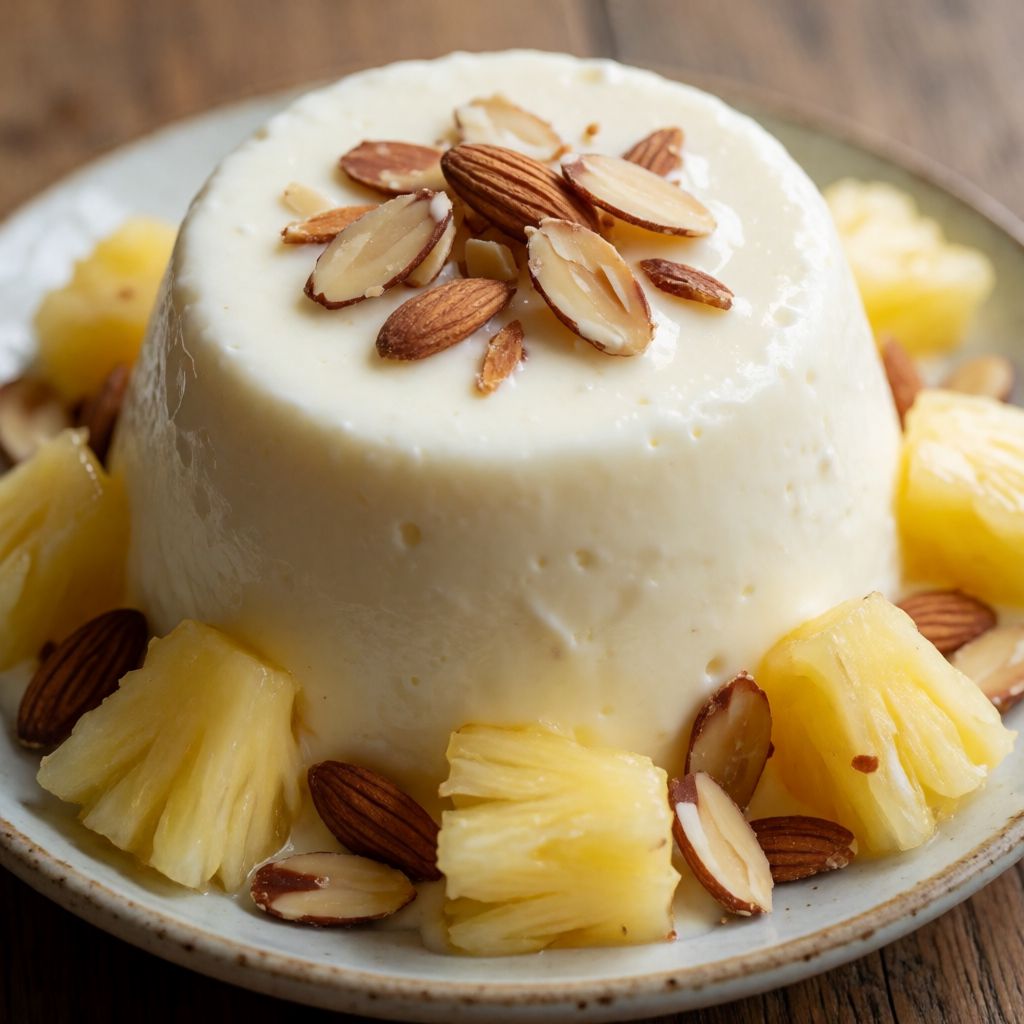
 AI photo
Bavarian Cream with Pineapple
A chilled milk-and-almond Bavarian cream folded with sweet pineapple and whipped cream.
Labels are worked out automatically from the ingredients and can be wrong. Check the packaging if it matters to you.
Ingredients





Steps
Cut the pineapple into small pieces, place in a saucepan, add 50 g of sugar and cook over a low heat, stirring often.
15 minRemove the pan from the heat and let the pineapple cool.
Toast the almonds in the oven at 180°C.
3 minLet the almonds cool, then put them in a blender with 1 tablespoon of sugar and grind to a fine crumb.
Soak the gelatine in cold water to soften it.
10 minCombine the milk, ground almonds and remaining sugar in a saucepan. Bring the milk to the boil, stirring often.
Squeeze the gelatine well and stir it into the milk after removing the pan from the heat.
Strain the milk mixture to remove the ground almond pieces, then let it cool.
Fold the pineapple into the cooled milk mixture, then fold in the whipped double cream.
Pour the mixture into a mould and chill in the fridge until the cream sets.
Turn the mould out, dipping its base in hot water for a few seconds to release the dessert onto a plate.
Call it Bavarian if you like, but it was never really Bavaria's. The name comes from French kitchens, where a Bavarian cook once worked and the dish got tagged with his homeland — the same way we call puff pastry "mille-feuille" without asking who first flaked it that thin. What you actually have in that mould is custard's quieter cousin: milk, sugar, something to flavour it, but instead of egg holding it together, you use gelatine. That's the whole trick of the dish — no oven, no curdling to watch for, just a liquid that remembers it's supposed to become solid once it's cold enough.
What decides whether it works is not any single step but the order of three temperatures. The milk has to be hot enough to pull flavour out of the almonds — that's why you bring it to the boil. The gelatine has to go in only after the heat is off, because boiling breaks the very protein chains that make it set; some cooks drop gelatine straight into a simmering pot to "dissolve it properly" — no, because that's exactly how you ruin it, and you'll find out six hours later staring at a mould of flavoured milk. And the cream has to be cold and whipped before it meets the base, because its job is to carry air into the mixture, not just fat.
Start with the almonds, because toasting them isn't decoration — it's chemistry you can smell. Raw almonds carry their flavour locked inside oil that hasn't gone anywhere yet; heat at 180°C pushes that oil to the surface and starts the browning reactions that give you the deep, slightly bitter note instead of a flat, milky one. You're not cooking them through — you're waiting for the smell in the kitchen to change from "nuts" to "roasted nuts," which usually happens before the colour tells you anything. Grinding them with a spoonful of sugar afterwards stops the oil from clumping into a paste in the blender — sugar acts as a dry abrasive here, nothing more romantic than that.
The gelatine is the one ingredient where the brand matters more than the amount. 10–12 g assumes sheet gelatine of ordinary strength; if you only have powder, the ratio is close but the hydration is different, so soak it properly and judge by feel — it should be soft and slightly swollen, not stiff, before you squeeze it into the hot milk. If you ever reach for agar-agar as a plant-based swap, know you're changing the dish's whole character — agar sets firm and stays firm even warm, so the cream loses that soft give that gelatine gives it. There's no real substitute that behaves the same; there's only a different dessert with the same shape.
Double cream is doing a specific job here, not just adding richness: it's carrying air. Only cream with enough fat — double cream's 48% or so, or any cream above roughly 35% — will whip and hold that air once beaten. Thinner creams collapse back to liquid before you've even folded them in, and the whole point of folding rather than stirring is to keep those air bubbles alive inside the setting gelatine mesh, which is what gives Bavarian cream its lightness against a dense custard. Stir hard at this stage and you knock the air straight back out — fold like you're trying not to wake it.
Pineapple, cooked briefly with sugar, is there to break down its fibre and pull its juice out so it folds through the cream instead of sitting in wet lumps. If you're using canned pineapple in syrup, you can skip step one almost entirely and cut the added sugar back, since the fruit's already soft and already sweet — taste before you add, not after.
Straining the milk after the gelatine goes in isn't fussiness — it's there to catch every last gritty almond fragment that survived the blender, because even a fine crumb will feel coarse once it's suspended in a smooth set cream rather than crunched between teeth. A fine sieve or a double layer of muslin does the job; you don't need the kind of tamis a restaurant kitchen has.
Unmoulding by dipping the base in hot water for a few seconds works because gelatine softens well below the temperature your tongue would call "hot" — a few seconds melts only the thinnest layer touching the mould, enough to break the seal, without melting the cream underneath. Hold it too long and you'll watch your careful set slump sideways on the plate, which is the one mistake in this whole recipe that can't be fixed once it's happened.