
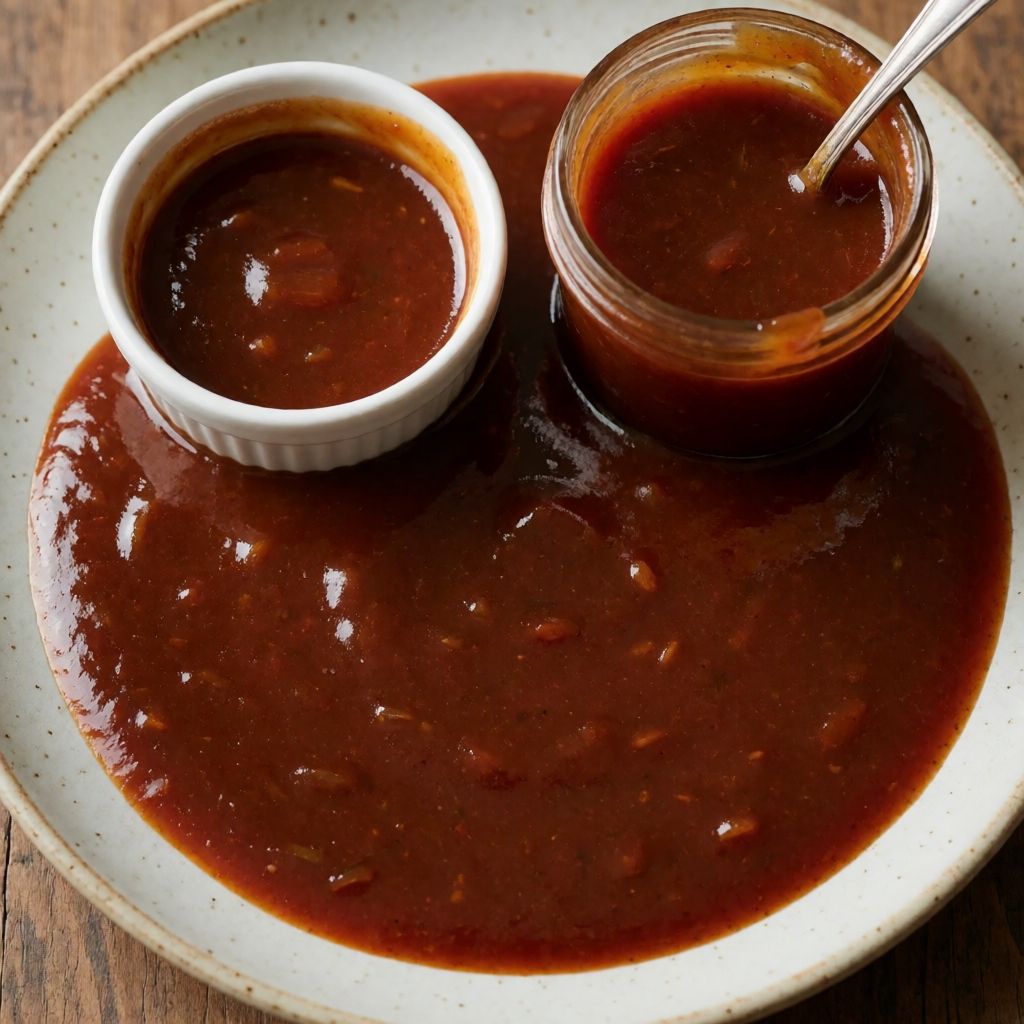
 AI photo
BBQ Sauce
A tangy homemade barbecue sauce, simmered until rich and glossy.
Labels are worked out automatically from the ingredients and can be wrong. Check the packaging if it matters to you.
Ingredients
- 1 pcs Onion finely grated
- 3 clove Garlic crushed
- 3 tbsp Brown sugar
- 200 ml Ketchup
- 100 ml Water
- 3 tbsp Apple cider vinegar
- 3 tbsp Soy sauce
- 2 tbsp Worcestershire sauce
- 2 tsp Dijon mustard
- 1 tsp Smoked paprika
- 1 pinch Black pepper freshly ground, to taste











Steps
Put all the ingredients for the barbecue sauce into a saucepan.
Bring to the boil, stirring constantly, and mix well until the marinade is smooth.
Leave to simmer, covered, for 20 minutes, then taste.
20 minBlend the sauce to your desired consistency — it can be smooth and even like a sauce, or have a bit more texture.
This recipe makes about 400ml of sauce.
This isn't barbecue sauce as Americans in the South would make it — no smoker, no overnight brisket, no wood smoke climbing through wet meat for six hours. It's a kitchen simulation of all that, built in twenty minutes in a saucepan, and it works because it borrows the flavours that smoke and time would have given you and gets them from bottles instead.
Myth: "proper barbecue sauce needs real smoke." No — it needs the taste of smoke, and smoked paprika supplies that honestly, because the peppers really were dried over a wood fire before they were ground. You get the phenolic compounds that read as "smoky" on your tongue without lighting anything in a flat with no garden.
What actually decides whether this sauce works: the raw bite of the grated onion and crushed garlic has to vanish completely, not just soften at the edges. Simmering in an acidic liquid breaks onion down almost the way frying in fat would — it's the heat plus the vinegar doing the work, just slower. Taste it before you call it done. If the onion still bites back, it needs more time in the pan, not more ketchup thrown at the problem.
And then there's thickness. The sauce is ready when it clings to the back of a spoon instead of running off it like the ketchup you started with. Twenty minutes covered is your floor, not your answer — watch the surface for that slight slow-moving sheen, don't just watch the clock.
Ketchup is doing more work here than it gets credit for. It's already cooked tomato, sugar and vinegar balanced by someone else, in a factory, years before you opened the bottle — you're not rebuilding that balance from raw tomatoes, you're adjusting one that already exists. That's the real reason this sauce takes twenty minutes and not two hours: most of the cooking already happened.
Soy sauce and Worcestershire sauce are your stand-in for the long char a real barbecue pit gives meat. Both are old fermentation tricks — soybeans, fish, tamarind, salt, time — built originally to preserve protein cheaply, and as a side effect they load a sauce with savoury depth no fresh ingredient gives you quickly. Without a smoker and eight hours, this is how you borrow that depth instead.
Sugar and vinegar are a push and pull, and you need both ends pulling or the sauce falls over. All sugar and it tastes like jam spread on ribs. All vinegar and it tastes like a pickle someone forgot to drain. The brown sugar matters more than white would because of the molasses still in it — any sugar carrying that dark, slightly bitter note works: demerara, muscovado, even white sugar with a spoon of golden syrup stirred through if that's what's in the cupboard. The vinegar just needs to be sharp without smelling of anything but sharpness — cider vinegar is mild and a little fruity, but malt vinegar, already sitting in most British kitchens next to the chip shop condiments, does the same acid job; use slightly less, it's stronger.
Notice there's no oil in this sauce, which is why the onion and garlic go in raw and cook in the liquid itself rather than being fried first. Myth: "you must sweat onion and garlic in oil before anything else." No — that rule exists for dishes building a base in fat. Here the vinegar and heat are the cooking medium, so frying first would just be an extra pan to wash for no gain. The Dijon mustard isn't there to bind fat and water either, since there's barely any fat to bind — it's there for its own sharp, slightly fermented bite, which lifts the ketchup's sweetness instead of just reinforcing it.
On the hob: bring it to the boil means gentle, broken bubbles, not a hard rolling boil — sugar and tomato catch and scorch on the bottom of a thin domestic saucepan far more easily than people expect, and a burnt sauce can't be rescued by blending. Keep it covered, and if your pan has no lid that fits, a plate on top does the same job — holds moisture in, stops tomato spatter across your hob, which is the actual point of a lid here, not ceremony.
Blend it or don't — a stick blender is enough, no need for a food processor. Myth: "proper sauce must be silky smooth." No — a little texture from the onion is fine, some people prefer it, taste decides that, not appearance. Let it sit a day in the fridge before you use it if you can; the vinegar softens, the flavours stop sitting in separate corners and start tasting like one thing. Four hundred millilitres is enough to glaze a tray of chicken thighs for four to six people, or sit in a jar for a few weekends of grilling — patience here isn't just about the pan, it's about letting the jar wait too.