
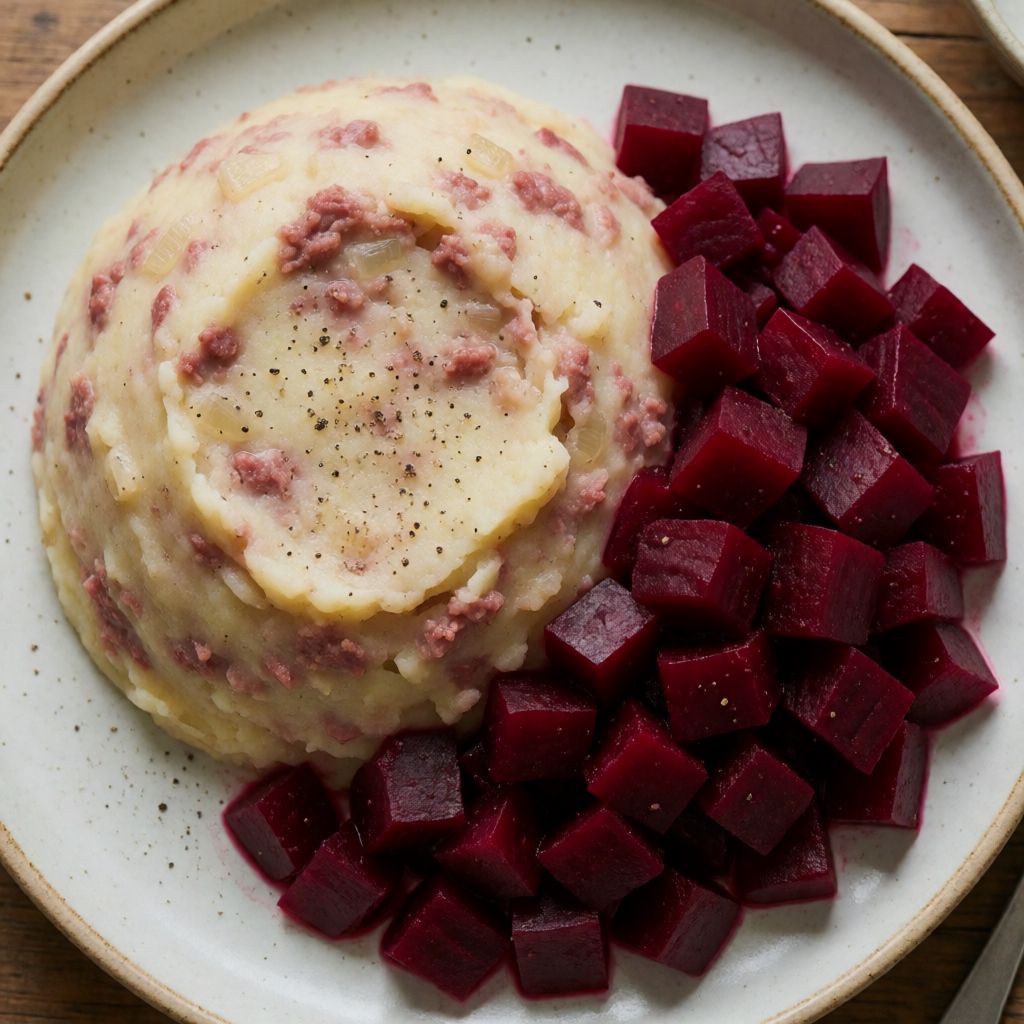
 AI photo
German-Style Beef Labskaus with Mashed Potato and Roasted Beetroot
A North German-style braised beef dish served with potato and a side of roasted beetroot, finished with chives.
Labels are worked out automatically from the ingredients and can be wrong. Check the packaging if it matters to you.
Ingredients
- 600 g Beef shoulder diced
- 4 pcs Onion finely chopped
- 1 tsp Black pepper whole
- 6 pcs Bay leaf
- 1 l Stock
- 1 kg Potato diced
- 2 tbsp Apple cider vinegar
- 1 tbsp Mustard
- 1 tbsp Butter for frying
- Salt
- Black pepper freshly ground
- 300 g Beetroot cut into batons
- 1 tbsp Olive oil
- 100 ml Chives finely chopped












Steps
Heat a good knob of butter in a pan and brown the beef until golden-brown.
Add the onion, whole black pepper, bay leaves and stock, then let the dish simmer gently for about 45 minutes.
45 minAdd the potato and simmer together until soft and slightly broken down.
Season the dish with apple cider vinegar, mustard, salt and pepper. Taste and adjust the seasoning as needed.
Roasted beetroot: cut the beetroot into batons or cubes, toss with olive oil, salt and pepper, and roast at 175°C with fan assistance for 25 minutes.
25 minThe beetroot should still have a little bite.
Serve the labskaus hot with the roasted beetroot on the side and sprinkle with chives.
Labskaus is a sailor's dish dressed up for a Sunday plate — beef, onion and potato cooked down together until the potato gives up its structure and thickens the whole pot into something between a stew and a mash. There's no technique to hide behind here. What decides whether it works is whether you let the beef actually brown before anything else touches the pan, and whether you let the potato break down rather than just go soft.
Browning first matters because a cold pan crowded with meat and liquid never browns anything — it just boils the beef grey. Get butter hot enough that it stops sizzling wetly and starts smelling faintly nutty, lay the beef in without crowding it, and leave it alone. Scrape and turn only when a crust has actually formed. Skip this and you get stewed beef that's merely had the colour run out of it, not beef with any savour built in.
The long simmer after that isn't really about the beef — 600g diced shoulder would get tender in less time on its own. It's the stock extracting what the bone and connective tissue of a working cut need to give up, slowly, at a bare murmur rather than a boil. A boil toughens the outside of the meat faster than it can soften the inside; a murmur gives collagen time to turn to gelatine instead. Forty-five minutes is the lower bound, not the finish line — the beef should yield rather than resist when you press a piece.
Beef shoulder is the right cut because it's working muscle — full of connective tissue that needs a long, gentle simmer to turn soft, and full of flavour that quick-cooking cuts like sirloin simply don't carry. If your butcher's shoulder looks lean and pale, chuck or shin will do the same job; anything from the front end of the animal that's cheap because it's tough is the right instinct. A quick-cooking steak cut here would just end up dry and stringy, not tender — tenderness in this dish comes from time, not from starting with a tender piece of meat.
Onion, four of them, finely chopped, isn't a garnish — it's most of the body of the sauce once it's broken down over the long simmer, so don't skimp thinking it's just aromatics. Whole black peppercorns and bay leaves are there to perfume the stock without turning it gritty or bitter the way ground pepper would if it sat in a pot for forty-five minutes — fish them out before serving if you don't want to bite into one.
The stock should taste of something on its own, not just be salted water — a proper beef or chicken stock, homemade or a good bought one, because everything else in the pot is leaning on it for savour. If all you've got is a stock cube, use it, but go lighter on salt later since those run salty.
Potato: a floury variety — Maris Piper or King Edward, the ones that already fall apart a bit when you boil them for a roast — is what you want here, because the whole point is that it breaks down and thickens the dish. A waxy potato like Charlotte will hold its shape stubbornly and leave you with a stew with potato chunks in it rather than labskaus.
Apple cider vinegar and mustard go in at the end, not before, because their job is to cut through the richness of slow-cooked beef and starchy potato — add them too early and the acid just cooks off and you lose the lift. Taste after adding them; you're correcting a dish that's otherwise all one register of savoury and soft.
The beetroot is roasted separately and deliberately kept with "a little bite" — some say vegetables need to be fully soft to be "done," but a beetroot cooked to total collapse loses its texture against the soft beef and potato, and the whole plate turns into one uniform mush. Roasting at a domestic oven's 175°C with the fan on gives you dry, concentrated heat rather than the steamy environment of boiling, which is why it caramelises at the edges instead of just going mushy. If your oven runs hot or cold against its dial — most do — judge by a skewer meeting slight resistance, not by the clock.
Chives at the end are there for the one thing nothing else in the pot provides: a clean, grassy, cold note against a dish that's entirely brown and soft otherwise. Finely chopped spring onion tops will do if you've no chives, for the same reason — contrast, not flavour matching.