
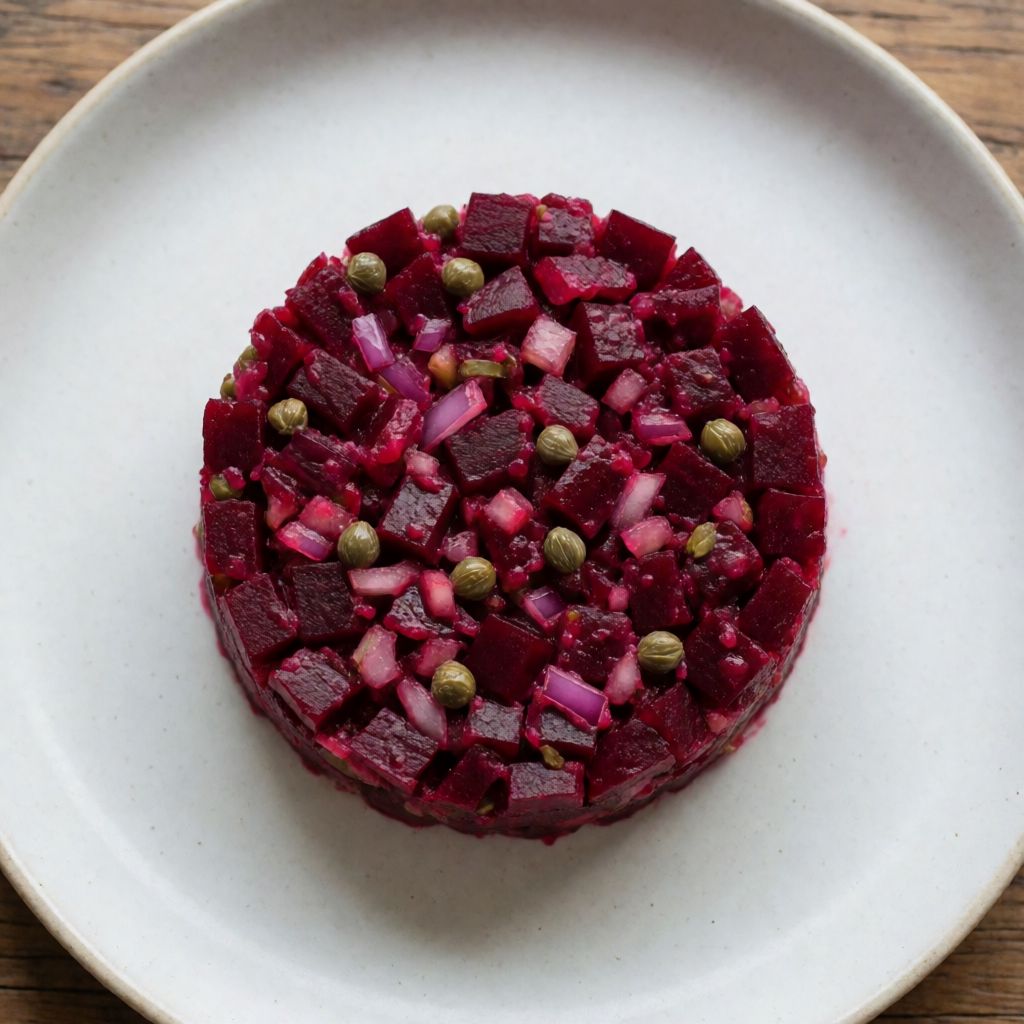
 AI photo
Beetroot Tartare
A beetroot tartare: roasted and fresh beetroot with capers and red onion, topped with avocado, horseradish cream and chervil.
Labels are worked out automatically from the ingredients and can be wrong. Check the packaging if it matters to you.
Ingredients
- 400 g Beetroot whole, unpeeled
- 100 g Beetroot peeled and cut into very small cubes
- 15 g Capers
- 1 pcs red onion
- 1 tbsp apple cider vinegar
- 1 kg Salt
- Black pepper freshly ground
- 2 pcs Avocado diced
- 1 bunch chervil




Horseradish cream
- 75 g garlic cream cheese
- 50 ml Crème fraîche 18%
- 20 g Horseradish finely grated
- Salt
- Black pepper freshly ground



Steps
Wash the beetroot with the skin on and pat dry. Place in a heatproof dish on a little salt and cover with the rest of the salt.
5 minRoast in a preheated fan oven at 220°C for about 1 hour, or until tender.
60 minPeel the roasted beetroot and blitz in a food processor with the capers and finely chopped onion.
10 minTransfer to a bowl and season with apple cider vinegar and pepper to taste. Add the raw beetroot cubes and season with salt and pepper to taste.
3 minMix the cream cheese, crème fraîche and horseradish, and season with salt and pepper to taste.
3 minPlate using a forming ring: first place the finely diced avocado and press it evenly, then add the beetroot. Remove the ring, serve with a little horseradish cream and sprinkle chervil on top.
What was changed
The oven temperature was rounded to the market's display step .
This is a tartare in the way a steak tartare is a tartare — raw, cut small, held together by seasoning rather than heat. Except here the "raw" element is doing a trick: most of the colour and sweetness is cooked beetroot, salt-baked until it's essentially candy, and only a fraction stays genuinely raw for bite. Everything else on the plate — the horseradish cream, the avocado, the capers — exists to answer one problem: beetroot alone is sweet, wet, and a bit flat, and needs fat, heat and acid stacked against it or it tastes like a vegetable that's given up.
What decides whether it works is the salt crust. You bury unpeeled beetroot in a kilo of salt and roast it hard at 220°C. That's not seasoning — a kilo of salt isn't going in your mouth, it's going in the bin after. What it does is pull moisture out evenly and insulate the beetroot from direct oven heat, so it steams in its own skin instead of scorching at the edges and staying raw in the middle. Some say you can just roast beetroot wrapped in foil and get the same result — no, because foil traps the steam against the skin and you get a slightly boiled, slippery texture; salt draws water away and leaves you with something denser, almost jammy, which is what you want when it's about to be blitzed into a paste.
Ingredient by ingredient, starting with the beetroot itself, because there are two different jobs for one vegetable. The 400g whole, unpeeled ones are for roasting — buy them small to medium and roughly the same size so they cook at the same rate; a beetroot the size of a fist takes considerably longer than one the size of a golf ball, and you don't want to be guessing which one is done by poking a fork through a kilo of hot salt. The 100g peeled and diced raw is for the crunch; here freshness matters more than size — a beetroot that's been sitting in your veg drawer for three weeks goes rubbery raw, which is fine cooked but unpleasant in a dice you're meant to bite through.
On the salt: this isn't a recipe where you can economise by using less, because the mechanism depends on the beetroot being fully surrounded. Table salt or coarse cooking salt both do the job equally well here — you're not eating it, you're using it as an oven within your oven. Don't reach for expensive flaked sea salt; it's wasted on a crust that goes in the bin.
Capers are doing acid-and-salt work, small and sharp against the sweetness of roasted beetroot. If you can't get capers, a very finely chopped gherkin with a squeeze more vinegar gets you most of the way there — the point is sourness plus a bit of bite, not the specific brine taste of a caper, though it is nicer.
Red onion rather than white or brown is a deliberate choice for colour as much as taste — a yellow onion blitzed into a dark red purée looks like it's been put there by accident. If red onion isn't to hand, a shallot works and is gentler, useful if you find raw onion repeats on you.
Apple cider vinegar is mild and slightly fruity; it won't fight the sweetness of the beetroot the way plain white vinegar can. Any vinegar with a soft, rounded acidity does the same job — a light wine vinegar is the closest substitute, and lemon juice in a pinch, though it brings its own citrus note along with the sourness.
Garlic cream cheese plus crème fraîche is simply fat carrying flavour — the garlic cheese gives body and a gentle allium note, the crème fraîche loosens it so it spoons rather than sits like a brick. If garlic cream cheese isn't sold near you, plain cream cheese with half a crushed garlic clove worked through it is the same thing made by hand. Horseradish, freshly grated rather than from a jar, is what gives this cream its point — jarred horseradish is often cut with vinegar and sugar and loses its sting fast once opened; fresh grated horseradish bites back, which is exactly what a sweet beetroot dish needs leaning against it.
Avocado should be ripe enough to give slightly under thumb pressure but still hold a clean cut edge — too soft and it won't keep shape in the forming ring, too firm and it tastes of very little. And on the forming ring itself: in an ordinary kitchen a wide cookie cutter or even a trimmed tin with both ends cut out does exactly the same job — you're not plating for show, you're stopping the avocado and beetroot sliding into each other before they're meant to.
Patience is the ingredient most likely to get skipped here, and it's the one that makes the difference between a sweet mash and a dish with structure. The beetroot needs its full hour buried in salt — pulling it early because it "feels done" on the outside means the centre is still raw and your purée will be gritty and pale in patches rather than one even dark colour. Let it go until a skewer meets no resistance all the way through, not until the clock says sixty.