
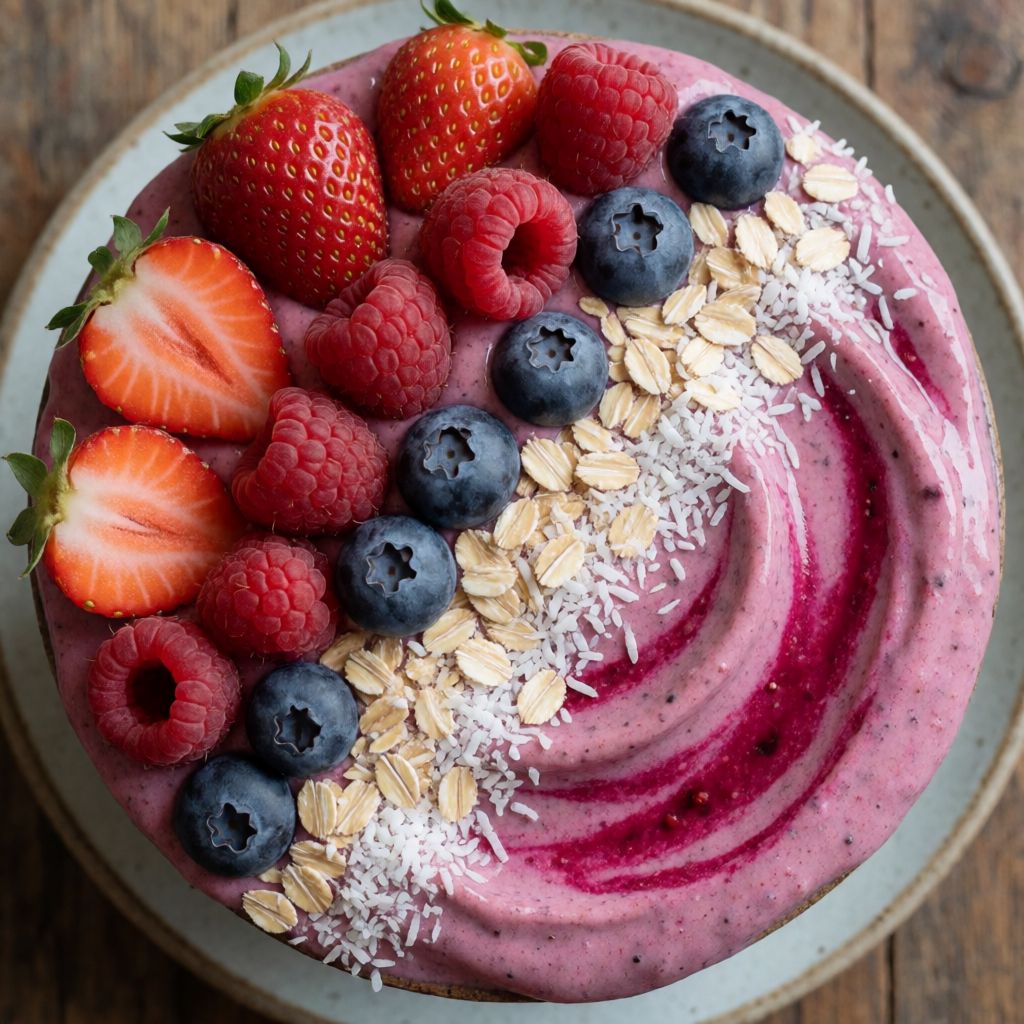
 AI photo
Berry Smoothie Bowl
A quick, bright berry smoothie bowl topped with fresh fruit, oats and coconut.
Labels are worked out automatically from the ingredients and can be wrong. Check the packaging if it matters to you.
Ingredients
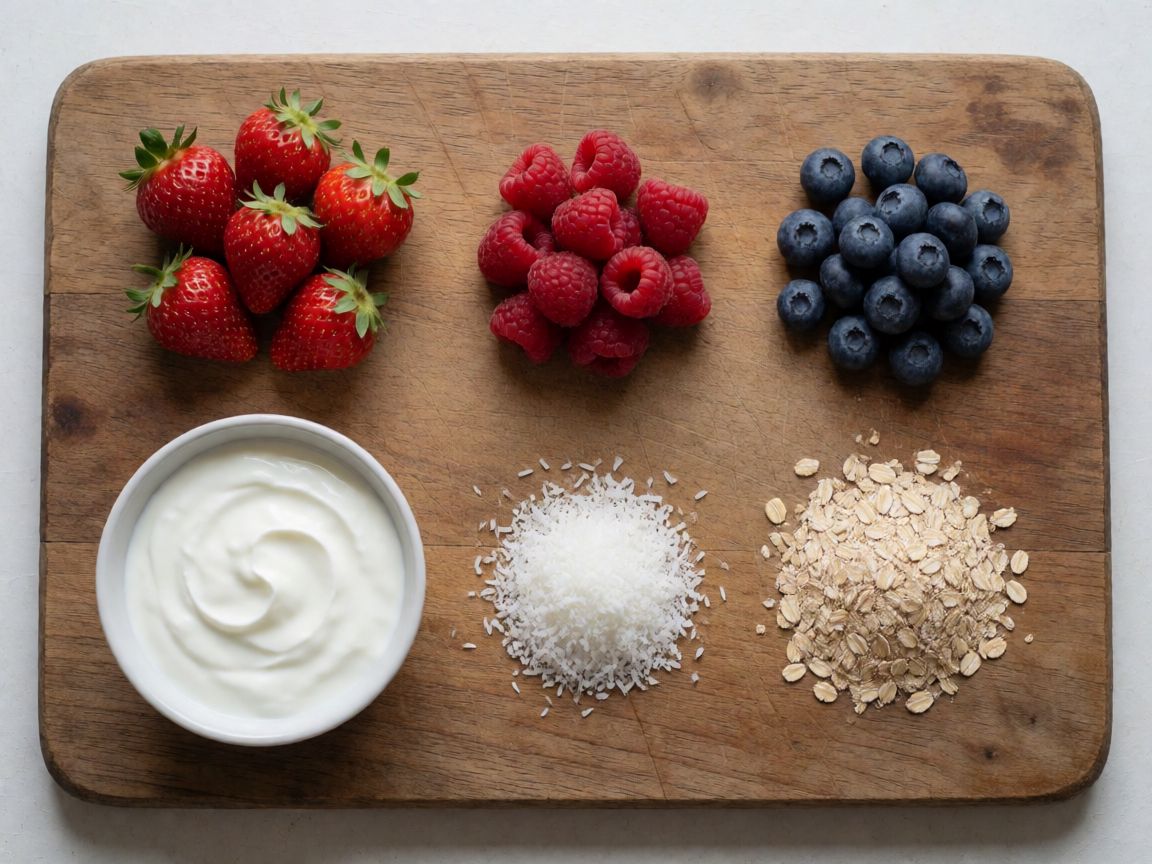
- 50 g Strawberries
- 50 g Raspberries
- 30 g Blueberries
- 1 pcs Greek yogurt
- Desiccated coconut to taste
- Rolled oats to taste






Steps
Rinse the strawberries, raspberries and blueberries.
2 minPut the berries in the blender jug and add the Greek yogurt.
1 minBlend everything until smooth.
2 minPour the mixture into a bowl.
1 minTop the smoothie bowl with pieces of strawberry, blueberries, raspberries, rolled oats and desiccated coconut to taste.
4 min
A smoothie bowl is a smoothie that refused to be a drink. The only thing that separates the two is thickness — and thickness is the whole trick here. Thin it the way you'd thin a smoothie for a straw, and you've just made a very good smoothie in the wrong vessel; the toppings sink, the spoon finds nothing to hold onto, and you're drinking a dessert instead of eating one.
What decides whether it works is the ratio of frozen or very cold fruit to yogurt, and how little you blend once it's smooth. Greek yogurt is thick to begin with — that's the point of choosing it over regular yogurt, which weeps water and turns the whole thing runny within minutes of standing. Berries at room temperature add their own water as they break down, so the colder they go in, the less you fight for that spoon-standing consistency afterwards.
Some say a smoothie bowl needs a fancy blender with a tamper and six speeds. No — it needs a blender that will actually move a thick, cold mass without you adding liquid to help it along. Adding liquid is the one thing you cannot do here, because every splash of milk or juice is a step back toward "drink" and away from "bowl". If your blender stalls on something this thick, pulse it in short bursts and scrape down between — patience with the blender costs you thirty seconds and saves the texture.
The berries themselves don't need to be exotic or perfectly ripe — in fact a bit overripe is better, since riper fruit breaks down faster and needs less blending, which means less time for the mixture to loosen and warm up. Strawberries, raspberries, blueberries: this trio works because they're close in water content and none of them is so dominant in flavour it drowns the others. If you're buying British in season, swap in blackberries or whatever's cheap at the greengrocer that week — the mechanism (frozen or well-chilled fruit, blended thick) doesn't care which berry supplies it. Frozen berries, straight from the bag, are honestly the better choice here, not a compromise — they do double duty as the "cold" that keeps everything from turning to soup, the way ice cubes would in a drink, except they also become the dish instead of diluting it.
Greek yogurt is doing structural work, not just flavour work. Its thickness comes from being strained of whey, so it holds its shape and holds the blended berries up rather than letting them settle into a puddle. Regular yogurt, crème fraîche loosened with nothing, or any dairy that hasn't had the water taken out of it will give you a thinner result no matter how cold your berries are — if that's all you've got, cut back on how long you blend and accept the toppings will drift a little. The "1 pc" measure in the ingredients is a little odd for yogurt — read it as a single pot, the kind you'd find in a UK supermarket fridge aisle, roughly 150g.
Desiccated coconut and rolled oats on top aren't decoration, though they look it. The oats give you something to chew against the softness of the puree — texture contrast is what stops a bowl of blended fruit feeling like baby food. Raw rolled oats, not cooked: here you want their dryness and crunch, not their porridge softness, so don't pre-soak them. Desiccated coconut does something similar but drier still, and if you don't have it, any dry, flaky thing with a mild flavour of its own — toasted flaked almonds, a few crushed digestive biscuits — will do the same job of giving the spoon something to catch on.
There's no cooking here, which is worth saying plainly: the "10 min" on this recipe is almost entirely rinsing berries and faffing with a blender jug, not technique. That's the whole appeal of a smoothie bowl in a country where breakfast competes with getting out the door — it rewards you for having frozen fruit in rather than for any skill with heat. The one patience this recipe asks for is restraint at the blender: stop the moment it's smooth, not a pulse longer, because every extra second is heat and air going into a mixture that's only good cold and thick.