
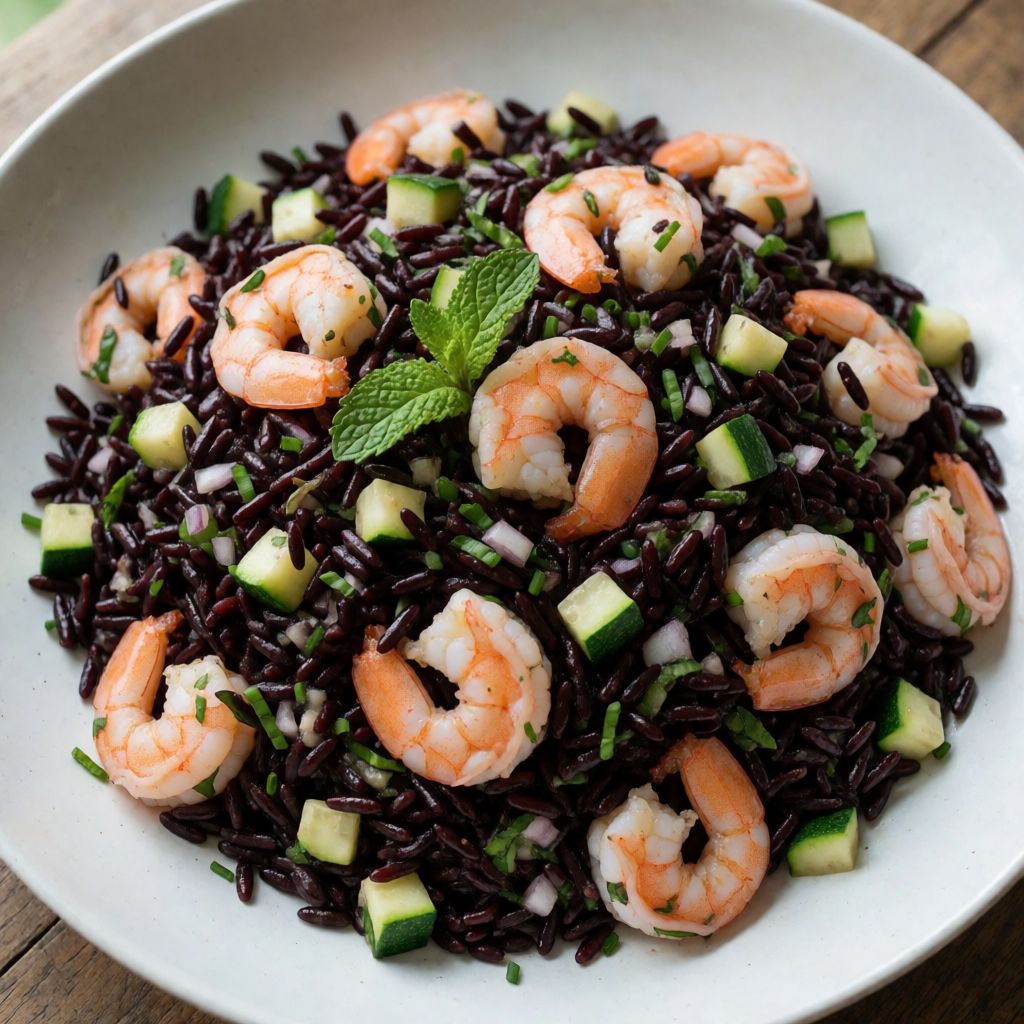
 AI photo
Black Venere Rice Salad with Prawns
A refreshing black Venere rice salad with prawns, courgette, shallot, mint and chives.
Labels are worked out automatically from the ingredients and can be wrong. Check the packaging if it matters to you.
Ingredients
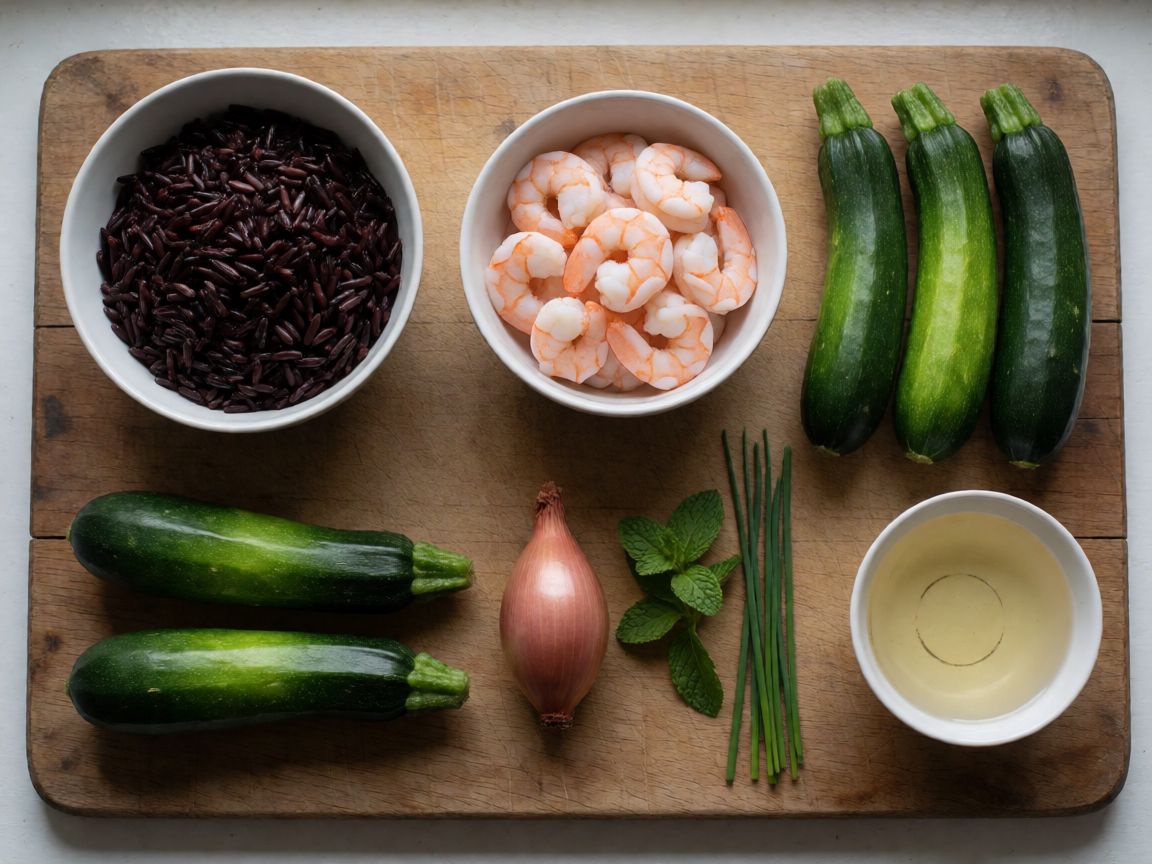
- 350 g Black Venere rice
- 400 g Prawns
- 3 pcs Courgette
- 1 pcs Shallot
- 1 bunch Mint
- 5 pcs Chives
- 125 ml White wine
- 3 tbsp Olive oil
- Salt to taste
- Black pepper to taste








Steps
Fill a large pot with water, bring to the boil, add salt and wait for it to return to the boil.
Tip the Venere rice into the boiling water and cook for 40 minutes, or as stated on the packet.
40 minDrain the cooked rice, cool it under cold water and set aside.
Wash and trim the courgettes, cut into rounds and fry on a hot griddle pan.
Remove the heads from the prawns, peel off the shells and devein them.
Heat 2 tbsp of olive oil in a wide pan.
Add the chopped shallot, put in the prawns and pour in the white wine, letting it reduce.
Finely chop the chives and mint with a knife.
When the wine has almost completely reduced, add the fried courgettes, stir in the chopped herbs, and season with salt and pepper.
Cook the mixture for a few more minutes. It is done when the thickest part reaches 63°C [c1].
Combine the courgette and prawn mixture with the rice, add a spoonful of olive oil and mix well.
What was changed
The doneness temperature for the prawns was kept as stated in the original recipe.
Black Venere is not a seasoning rice, it's a story about selection: Chinese farmers centuries ago pulled the darkest grains out of the paddy and kept them for the emperor, because the dark pigment — the same anthocyanin that colours blueberries — was rare and prized. Everyone else got the white stuff. So what you're cooking is, genetically, a wild-type rice that was never bred soft and sticky. That's why it stays firm, nutty, faintly earthy, and why it wants a proper 40-minute boil like pasta, not the lid-on steam-and-wait of white rice. Boil it in plenty of salted water, taste a grain near the end rather than trust the clock, and drain and cool it under the tap — that cold rinse stops the grains gluing into a block and knocks the starch back so the salad stays loose rather than clumping into a stodgy tangle.
The dish itself is a cold rice salad built around three things that each need their own fast, hot treatment: prawns, courgette, and a quick wine reduction that ties them together. None of this is slow cooking — it's three short, hot jobs done one after another in the same pan, which is exactly how a home hob with one wide pan and no kazan should work.
Prawns: buy them with heads and shell on if you can — a prawn that's been sitting shelled on a tray loses juice and takes on that flat, chlorine-rinsed smell. Taking the head and shell off yourself, and running a finger down the back to pull the dark vein, is not fussiness; that vein is the gut, and leaving it in is what gives a prawn a gritty, bitter bite nobody can place. Deveining takes thirty seconds a prawn, not the ten minutes people imagine. The 63°C the recipe asks for in the thickest part is the point where prawn flesh turns from grey-translucent to opaque white and firm — go past it in a hot pan and the protein seizes, squeezing out moisture, and you get the rubber-band texture that gets blamed on "overcooking" when really it's just missed that one point and kept going another thirty seconds too long.
Courgette: look for ones that feel heavy for their size and have tight, shiny skin — a light, spongy courgette is mostly water and will steam itself grey in the pan instead of taking colour. Cut into rounds, not matchsticks, because rounds give you flat faces to actually make contact with a hot ridged pan; a domestic griddle won't get kazan-hot, so don't crowd it, and accept char lines rather than an even all-over brown. No griddle pan at home? A regular frying pan, left dry and properly hot before the courgette goes in, will still give you colour — you just lose the stripes, not the flavour.
Shallot, not onion: shallots are gentler and sweeter, and because the pieces are small they melt into the wine reduction rather than staying as crunchy onion lumps in a cold salad, which is unpleasant precisely because cold mutes sweetness and exaggerates raw sharpness. If you only have onion, use less of it and chop it finer than you think you need to.
White wine: its job here isn't flavour on its own, it's acid and aromatics that reduce down into something syrupy that coats the prawns and courgette — this is deglazing, lifting the stuck-on bits of flavour off the pan base, the same mechanism as gravy off a roasting tin, just faster and lighter. Any dry, cheap white does this; an oaky or sweet one will throw the balance off. No wine open? A splash of dry vermouth or even water with a squeeze of lemon will reduce and deglaze, just with less perfume.
Olive oil: used twice, cold and hot, for different reasons. Hot, to fry the shallot and prawns, it just needs to tolerate heat without burning — any neutral oil with no smell of its own, sunflower or a mild vegetable oil, would do that job. Cold, stirred in at the end, it needs flavour, because that's the only place in the dish flavour comes from a fat rather than a pan — this is where you spend a slightly better bottle, if you have one.
Mint and chives: added raw and at the very end because both lose their sharpness fast under heat — mint turns tea-like and dull, chives turn to limp green threads. Chop them with a knife rather than mincing them to paste; a bruised herb weeps its oils into the board instead of the salad.
Black Venere rice itself, if you can't find it: any whole-grain black or wild rice blend will give a similar bite and colour, though you lose some of that particular nutty depth — don't substitute a white rice and call it the same dish, because the whole point of the salad is the contrast between firm dark grains and soft prawn and courgette, and white rice collapses that contrast completely.