
 AI photo
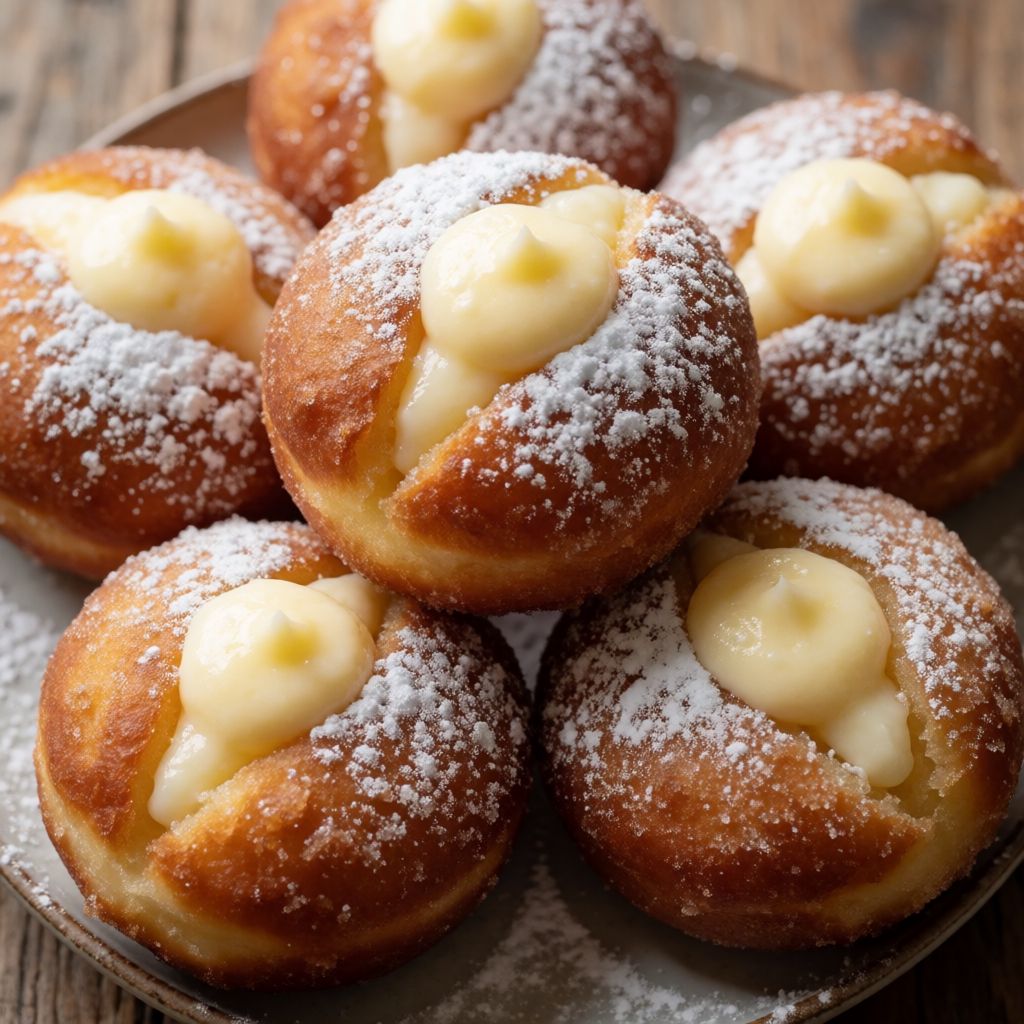
Bomboloni with Custard Cream
Italian-style fried doughnuts filled with vanilla custard cream.
Labels are worked out automatically from the ingredients and can be wrong. Check the packaging if it matters to you.
Ingredients
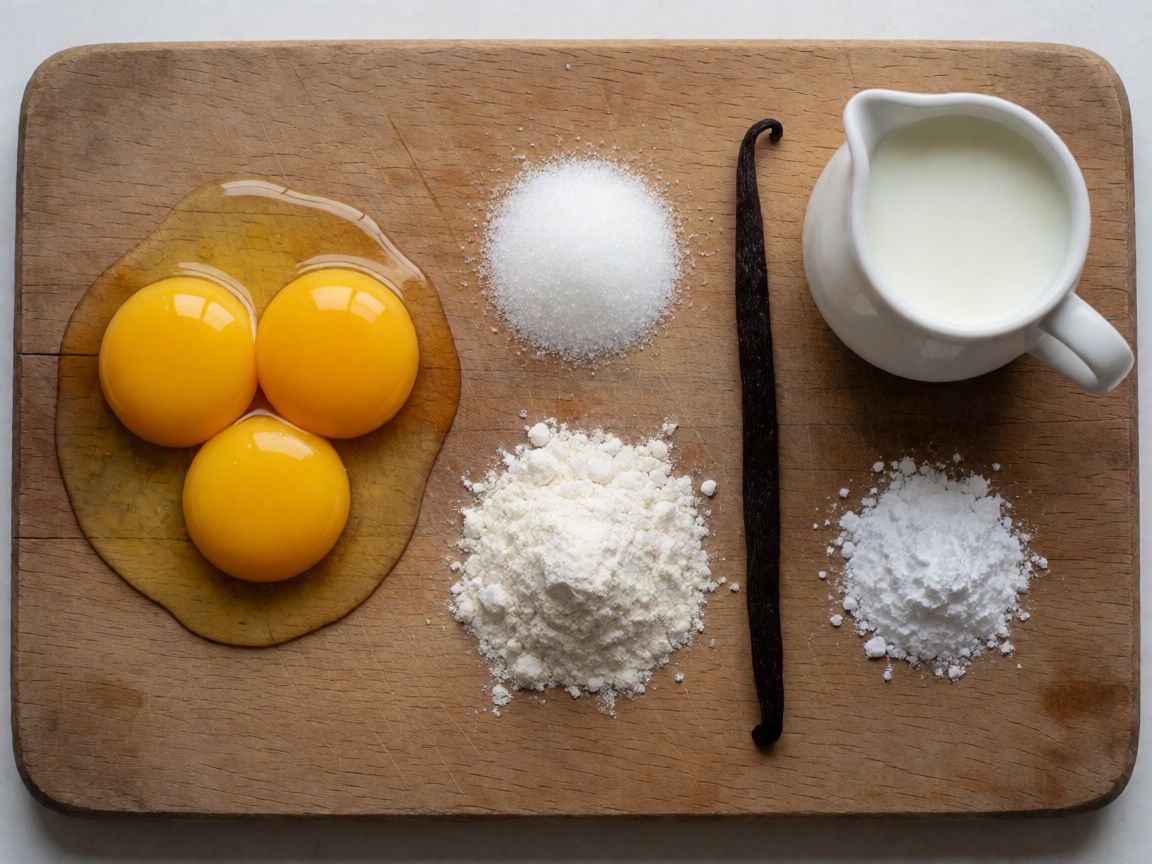
- 3 pcs Egg yolk
- 110 g Caster sugar
- 30 g Plain flour
- 300 ml Milk
- 1/2 pcs Vanilla pod
- Icing sugar to taste, for serving
- Vegetable oil as needed, for frying







For the dough
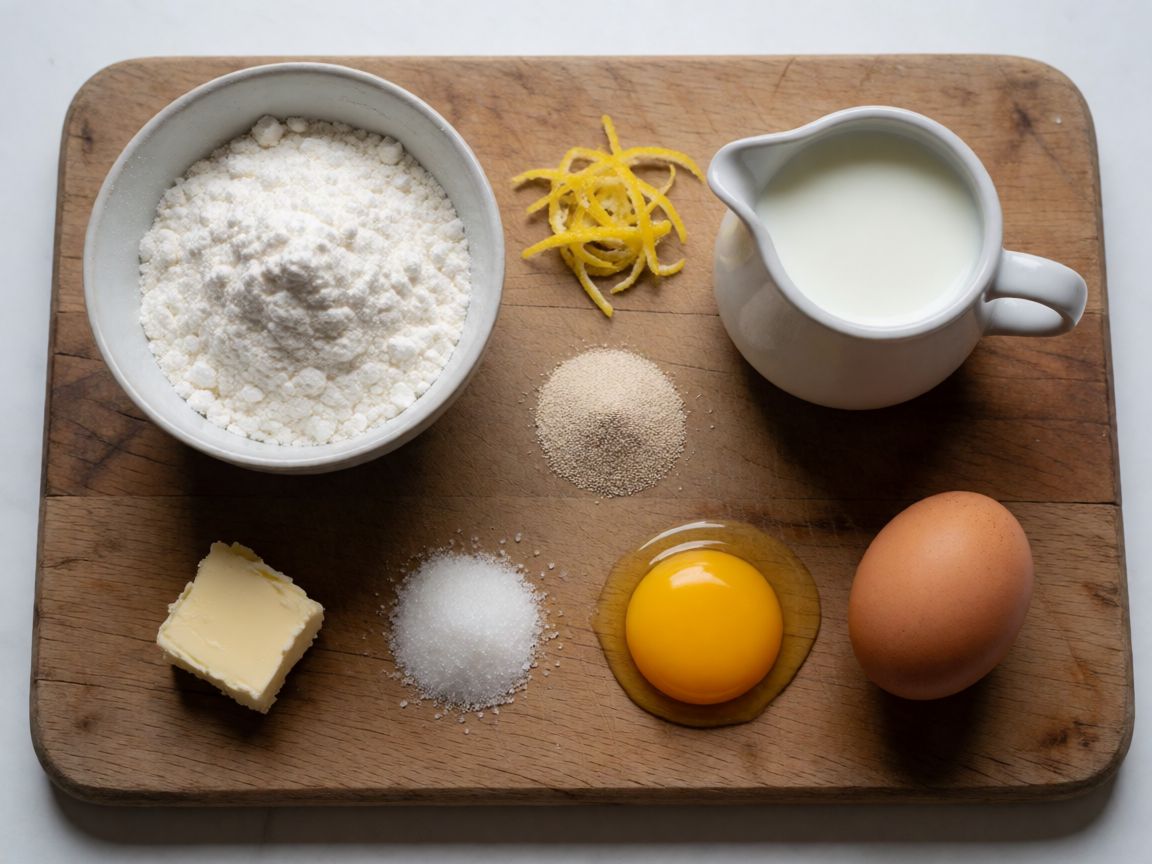
- 350 g strong white flour
- 70 ml Milk
- 18 g Yeast or 6 g dried yeast
- 50 g Caster sugar
- 30 g Butter
- 1 pcs Egg yolk
- 1 pcs Eggs
- lemon zest
- Salt to taste
- Water as needed





Steps
Pile the flour on the worktop, make a well, add the sugar, egg yolk, egg, salt and lemon zest, and mix with your fingers.
Dissolve the yeast in the warm milk, pour into the dough and knead.
Add the butter and knead to a smooth ball, place in a bowl and cover with cling film.
Leave the dough to rise until noticeably increased in volume.
25 minIn a saucepan combine the egg yolks and sugar, whisk together, add the flour, then gradually pour in the milk.
Flavour the custard with the vanilla pod and bring to the boil, stirring constantly, then leave to cool.
Roll out the dough to a thickness of 4-5 mm, cut out 8 cm circles, place on a tray and cover with cling film.
Leave the dough to rise until the circles have nicely puffed up.
35 minFry the circles in oil until golden on both sides.
Cool the bomboloni and fill them with the custard cream using a piping bag.
Dust the bomboloni with icing sugar on both sides.
A bombolone is a doughnut that doesn't know it's a doughnut — Italy's answer to a question Naples asked about what to do with leftover brioche dough and a deep pan of hot oil on a Sunday morning. What decides whether it works isn't the frying, it's the dough's willpower: a soft, enriched, buttery dough that has been given time, twice, to build the air pockets that let it puff into a pillow instead of frying into a hockey puck.
Some say a doughnut needs a special flour, something marked "00" or "bread" in gold letters. No — what it needs is a flour strong enough to trap gas, and strong white flour, the same bag you'd use for a decent loaf, does that job perfectly. The protein forms a net; the yeast blows bubbles into it; the net holds. Weak cake flour collapses under its own enthusiasm and you get a dense, oily disc.
The custard inside is not an afterthought — it's the point of contrast. The outside is fried, sweet, slightly crisp-chewy; the inside has to be cool, smooth, faintly eggy-vanilla, so your mouth gets two different experiences in one bite. If you rush the custard and it's still warm when it goes in, it'll melt the dough's structure from within and you'll have a soggy, collapsed middle by teatime.
And the frying itself is the one non-negotiable mechanism: too cool an oil and the dough drinks it like a sponge before the crust sets; too hot and the outside burns while the centre stays raw dough, which is worse than it sounds because nobody wants raw yeast dough with their tea.
Start with the dough logic, because everything else depends on it. You're building an enriched dough — egg, butter, a little sugar — which means slower fermentation than a plain bread dough, because fat and sugar both get in the yeast's way, coating the strands and tying up water. That's why the first rise needs to be judged by the eye, not the clock: it's done when the dough has visibly swelled, not when a timer beeps. Twenty-five minutes is a floor, not a verdict — a cold kitchen in a British winter, with the heating off because someone's saving on the gas bill, will easily need double that. Some say you must prove dough somewhere warm like an airing cupboard — no, you just need somewhere without a draught; a covered bowl on the worktop away from the window does the job, it just takes longer.
Yeast — fresh or dried, 18g or 6g — does the same chemical work either way: it eats sugar, breathes out carbon dioxide, and that gas is what inflates the gluten net you built with the strong flour. Fresh yeast is more forgiving and forms bubbles a touch faster; dried is sleepier but keeps for months in a cupboard, which matters more in most flats than the marginal gain in rise time.
The butter goes in after the first knead, not before, and that's not tradition for tradition's sake — it's sequencing. Add fat too early and it coats the flour before the gluten strands have formed, and you never build the elastic net properly; add it once the dough already has some structure, and the butter just makes that structure tender and rich without weakening it. If you're out of butter, any fat that's solid at room temperature and has no strong flavour of its own will do roughly the same job — a flavourless margarine, say — though you lose a little of that dairy roundness.
The custard is a straightforward thickened cream, and the sequence there also prevents a specific failure: whisking yolks and sugar together before anything else coats the yolk proteins in sugar so they don't seize and scramble the moment hot milk hits them. The flour thickens by swelling its starch granules in the heat, and you bring it to the boil deliberately, because an undercooked custard keeps its raw-flour taste and never properly sets, leaving you with a filling that's really just sweetened milk. Real vanilla pod gives you both the scent and visible black flecks — if you haven't got one, a good vanilla extract works as a criterion-match: anything that smells of vanilla rather than of vanilla-flavoured chemistry.
The second rise matters as much as the first, maybe more, because this is where the dough's whole future volume is decided — fry it too soon and it has no spring left, it just sits in the oil and goes leathery rather than ballooning. Cut the circles, cover them loosely — cling film is fine, or a clean tea towel if you're out — and wait for them to look proud of themselves, puffed and a bit wobbly, before they ever see the oil.
On frying in an ordinary flat: you won't have a deep-fat fryer with a dial, so go by what the oil tells you — a small offcut of dough dropped in should sizzle immediately and rise to the surface within a couple of seconds, bubbling steadily, not violently. That's your cue the oil is ready; wait longer and you're guessing. Use any oil with no smell of its own — sunflower, vegetable, groundnut — because this isn't the place for olive oil's personality; you want the custard and the dough to be what you taste, not the frying medium. Fry in small batches, because dropping in too many at once drops the oil's temperature and you're back to the sponge problem. Drain them on kitchen roll, not because paper is traditional, but because it's the thing in the house that pulls the surface oil off without you needing a wire rack you probably don't own.
Filling waits until they're properly cool — patience, again, as an ingredient — because warm dough plus custard means steam, and steam means a soggy doughnut that deflates while you're still deciding whether to have a second one with your tea.