
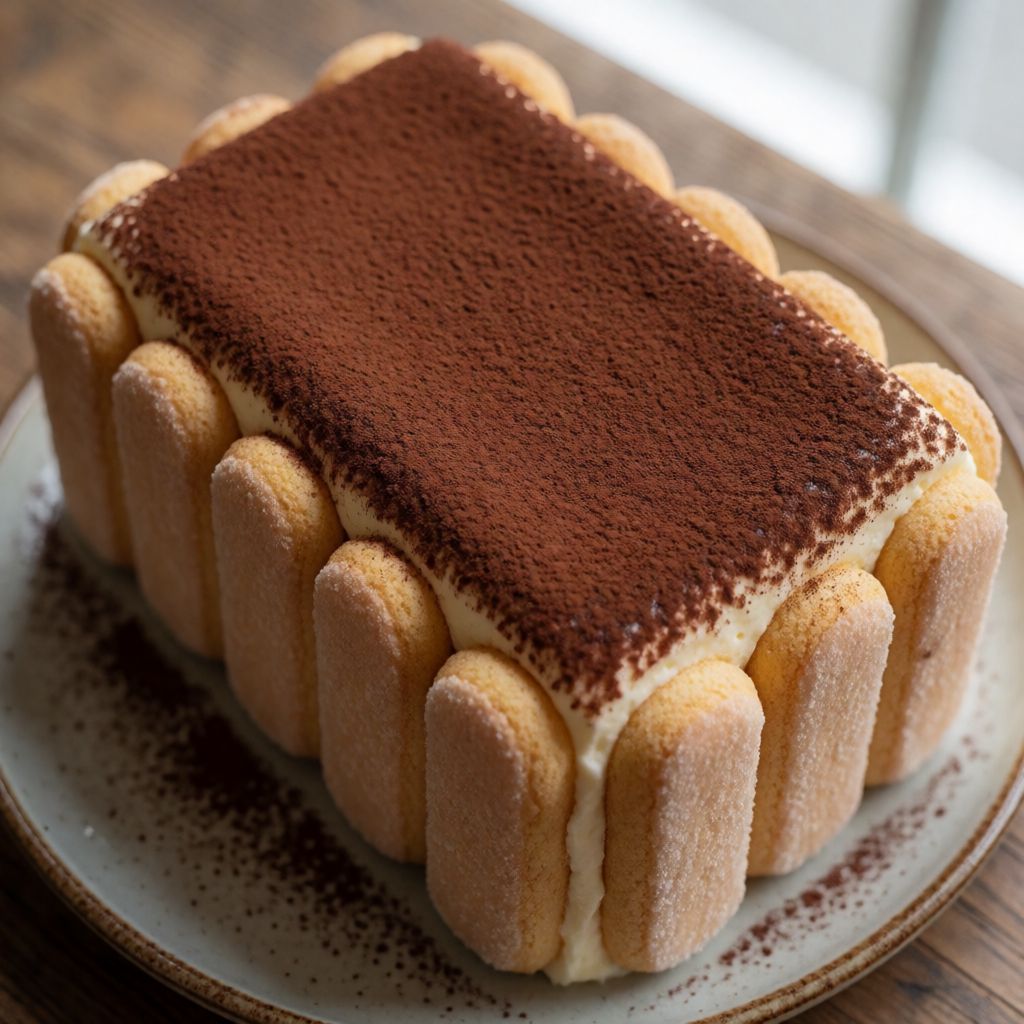
 AI photo
Brick Cake
A layered no-bake cake of coffee-soaked biscuits and vanilla custard, dusted with cocoa between each layer.
Labels are worked out automatically from the ingredients and can be wrong. Check the packaging if it matters to you.
Ingredients
- 300 g sponge finger biscuits
- milky coffee to taste
- cocoa powder to taste
- 6 pcs egg yolks
- 120 g caster sugar
- 80 g cornflour or plain flour
- 0.5 pcs vanilla pod
- 1 l milk







Steps
Pour the milk into a saucepan and bring to the boil with half the vanilla pod for flavour.
In a bowl, combine the egg yolks with the sugar and whisk together.
Sift in the cornflour and mix well.
Once the milk has boiled, remove the vanilla pod and pour in the egg mixture, stirring over low heat until thickened.
Pour the custard into a bowl and leave to cool.
Wet a 28x10 cm loaf tin and line it with cling film.
Dip the biscuits in the milky coffee and arrange the first layer.
Cover with the custard and dust with cocoa powder.
Repeat the layers, finishing with a layer of biscuits.
Chill in the fridge.
180 minTurn the cake out onto a plate, remove the film and dust with cocoa powder.
A brick cake is a crème pâtissière stiffened enough to hold its own weight, poured over coffee-soaked sponge fingers and left in the fridge until it sets into something you can turn out like a loaf and slice. It's the Italian idea of tiramisù filtered through the French idea of custard, and the reason it works has nothing to do with "chilling" in the vague sense people use the word — it's starch doing a job, and the job has to be done properly or the whole thing slumps when you unwrap it.
What decides whether it stands up as a brick, or collapses into a trifle, is the custard. Cornflour (or plain flour) thickens by gelatinising — its starch granules swell and lock water into a gel once they've been heated enough, and that gel is what gives this cake its structure once cold, not the fridge. The fridge just finishes the job the stove started: cold makes the set firmer, but cold alone, on a custard that hasn't actually thickened on the heat, gives you cold yellow milk with biscuit in it. So the custard needs to visibly change on the hob — from liquid and shiny to a mixture that coats the back of a spoon and holds a trail when you drag a spoon through it — before you trust it to a bowl.
The egg yolks are there for richness and colour, not for thickening — that's the starch's job, and the two happen side by side rather than together, which is why you whisk yolks and sugar first (the sugar coats the yolk proteins and stops them seizing into grains when hot milk hits them later) and only then sift in the cornflour. Skip whisking the sugar in properly and you risk little cooked flecks of egg in your custard — that's the curdling people blame on "too much heat," when really it's often too little buffering from the sugar.
Cornflour versus plain flour: cornflour is pure starch, so it thickens more per gram and sets to a cleaner, glossier custard; plain flour carries gluten and protein alongside its starch, which mutes the shine a little and needs slightly more of it to do the same job, but it works fine and it's what most people already have in the cupboard. Either way the principle is the same — starch granule, hot liquid, enough time at heat for the granule to burst and thicken, not before.
The milk should just reach the boil with the vanilla pod in it, because that's when its flavour transfers best — vanilla's aromatic compounds are more soluble once the milk's hot. If you've no pod, a spoon of vanilla extract stirred in at the end does the job, though you lose the little black flecks that tell you it's the real thing and not a shortcut. Any milk with fat in it works; skimmed will set thinner because fat also helps carry and round out flavour, not just texture.
The biscuits are sponge fingers because their open, dry crumb drinks liquid fast and evenly — that quick absorption is exactly why the dip has to be brief. A dense British sponge or plain cake wouldn't behave the same way; it would need longer and still soak unevenly. If sponge fingers aren't to hand, a dry, light biscuit that isn't coated in anything will do roughly the same job — the test is whether it darkens and softens within a couple of seconds of contact with liquid.
Milky coffee rather than espresso is a kindness to the biscuit, not a rule carved in stone: strong, hot espresso straight from the machine would oversoak and over-bitter a fragile sponge finger in the time it takes to lift and turn it, so it's cut with milk the way you'd cut your own cup of tea, for gentleness rather than tradition's sake. Cocoa powder between layers is there for bitterness and colour contrast against the pale custard — unsweetened is right, since the custard already carries the sugar.
On a British hob there's no kazan-level or café-level consistent heat to lean on, so watch the custard rather than a clock once it's on the stove: low heat, constant stirring, and you're looking for the moment it thickens visibly — that's your cue, the minutes in the recipe are only the floor under it. The loaf tin lined with wet cling film is a simple trick worth keeping: the water stops the film sticking to itself and tearing, and the film itself is what lets you turn a custard-and-biscuit stack out cleanly without a fight, standing in for the lightly oiled mould a bakery would use.