
 AI photo
Homemade Brioche Croissants: An Easy Recipe for Soft, Fluffy Breakfast Pastries
A simple homemade recipe for soft, fluffy brioche croissants, perfect for a cosy breakfast.
Labels are worked out automatically from the ingredients and can be wrong. Check the packaging if it matters to you.
Ingredients
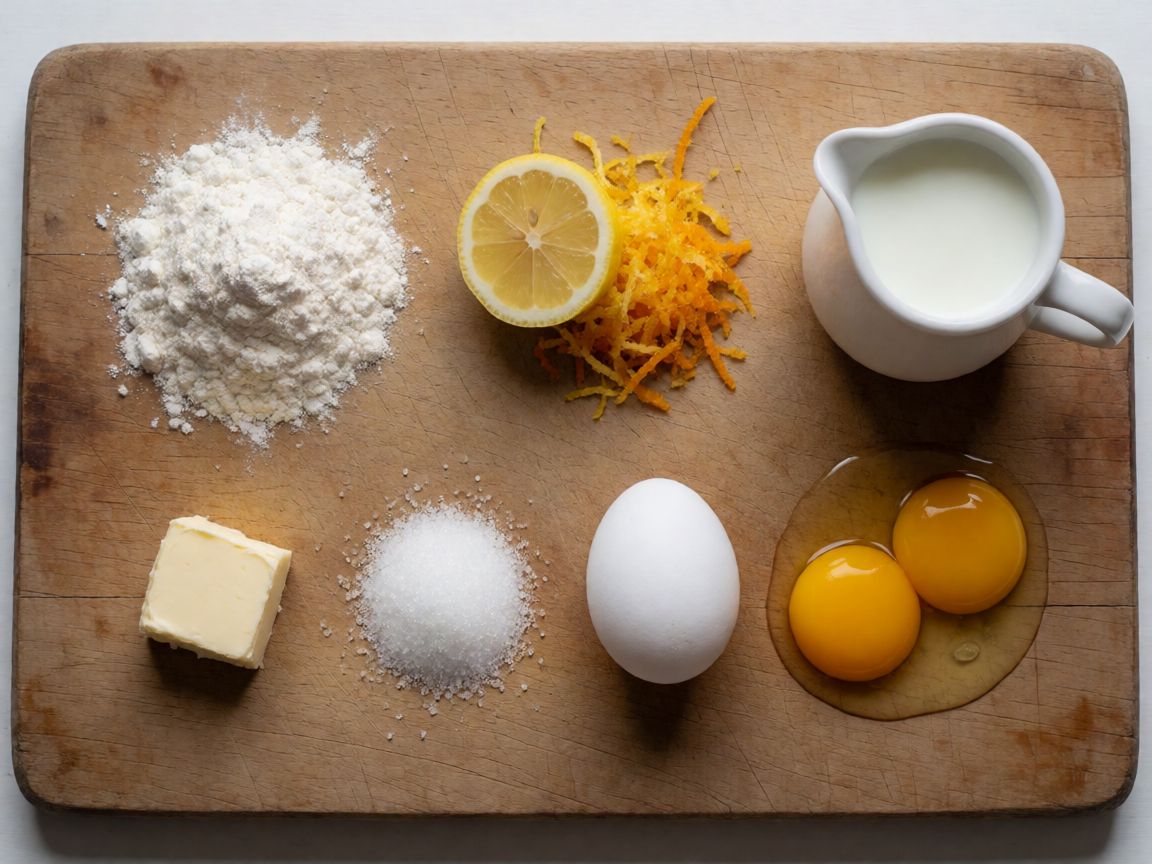
- 500 g Plain flour
- 0.5 pcs Lemon zest
- 0.5 pcs Orange zest
- 75 g Butter
- 90 g Caster sugar
- 1 pinch Salt
- 150 ml Milk
- 1 pcs Egg
- 2 pcs Egg yolks
- 25 g Yeast or 8 g dried yeast
- 1 tbsp Icing sugar for dusting











Steps
In a mixer bowl, combine the flour, sugar, yeast, milk, and the lemon and orange zest, and knead into a dough.
Add the egg and egg yolks one at a time, work in the butter in portions, add the salt, and knead for a further 4-5 minutes.
5 minTip the dough out onto the worktop, knead briefly by hand, shape into a ball and place in a bowl for its first rise, covering with cling film.
Leave the dough in the oven with the light on for its first rise for 40-60 minutes, or until doubled in size.
50 minRoll out the dough by hand and with a rolling pin to a thickness of 4-5 mm, dusting with flour.
Cut the dough into triangles with a 5-6 cm base and 10-12 cm height, make a small cut in the base of each, add a spoonful of jam or chocolate spread, and roll up into croissants.
Place the croissants on a baking tray lined with baking paper and put them in the oven with the light on for a second rise of 40 minutes.
40 minBrush the surface of the croissants with milk and bake in a preheated fan oven at 180°C for 15 minutes.
15 minDust the croissants with icing sugar.
Let's be honest about what this is: it's not a croissant, it's a brioche wearing a croissant's clothes. A real croissant is laminated — dozens of thin butter sheets rolled between dozens of thin dough sheets, so the oven's heat turns the moisture in that butter to steam and the layers rip apart from each other, giving you the open, flaky, almost hollow crumb. This recipe skips lamination entirely. The 75g of butter here gets worked straight into the dough, like you would for a bun. So what you're making is a sweet, eggy, citrus-scented brioche bread, shaped into a crescent and filled like a pastry. That's not a failure of the recipe — it's the whole point, and it's worth saying plainly so you don't bake it expecting shatter and flake.
What decides whether it works is the dough's hydration and the rise, not the shaping. Brioche dough is enriched with egg, butter and sugar, all of which fight the yeast and slow gluten development — that's why it goes into the mixer rather than being hand-kneaded from the start, and why it needs two separate rises rather than one long one. Skip or rush either rise and you get a dense, bready lump instead of something that pulls apart in soft strands.
The zest and the egg yolks are doing more work than they look like. Lemon and orange zest aren't decoration; they cut through the fat and sugar so the dough reads as bright rather than just rich. The extra yolks (beyond the whole egg) add fat and colour without adding the water that whites would — more tender crumb, better golden crust, less risk of a soggy middle.
Flour: plain flour, not strong bread flour, is correct here and not a mistake — this dough wants tenderness, not chew, and plain flour's lower protein keeps the texture soft like a bun rather than elastic like a baguette. If all you have is strong flour, it'll still work, just knead a touch less and expect a slightly firmer crumb.
Yeast: 25g fresh or 8g dried is the swap ratio because dried yeast is simply fresh yeast with the water removed — roughly a third the weight does the same job. Either way, it needs to wake up gently; this dough is already carrying egg, sugar and butter, all of which slow fermentation down, which is exactly why the recipe gives you a range — 40 to 60 minutes — rather than a fixed time. Trust the size of the dough, not the clock. "Doubled" means doubled, not "looks a bit bigger."
The "oven with the light on" trick deserves a word, because people often assume proving needs real heat. It doesn't — yeast works happily around body temperature, and an oven light simply nudges a cold British kitchen up a few degrees without turning the oven into a second heat source that could skin the dough's surface. If your oven light does nothing, a warm (not hot) spot near a radiator, or the top of the fridge, does the same job.
Butter: softened, worked in portions, not melted and not cold. Cold butter won't incorporate and leaves streaks; melted butter turns the dough greasy and slack because it adds all its water at once instead of blending gradually with the gluten structure. Any unsalted butter works — salted will just mean you dial back the pinch of salt.
Milk: 150ml is there for moisture and tenderness, not just liquid volume — full-fat gives a softer crumb than skimmed because of the extra fat. It also coats the top before baking, which is the gentler, more domestic cousin of an egg wash: less shine, less risk of over-browning in a home oven that often runs hotter than its dial admits.
Icing sugar at the end is cosmetic, and that's fine — but dust it only once the croissants are properly cool, not warm. Warm surfaces melt sugar into a wet glaze instead of leaving it as that soft, final snow you actually want.
Some say you need a kazan — sorry, wrong recipe entirely, that joke belongs to a different dish of mine. For this one, all you need is a decent mixer or a patient arm, a tray, and the willingness to wait twice: once for the dough to wake up, once for the shaped pieces to relax before the oven. That waiting is the ingredient nobody weighs but everybody skips at their peril.