
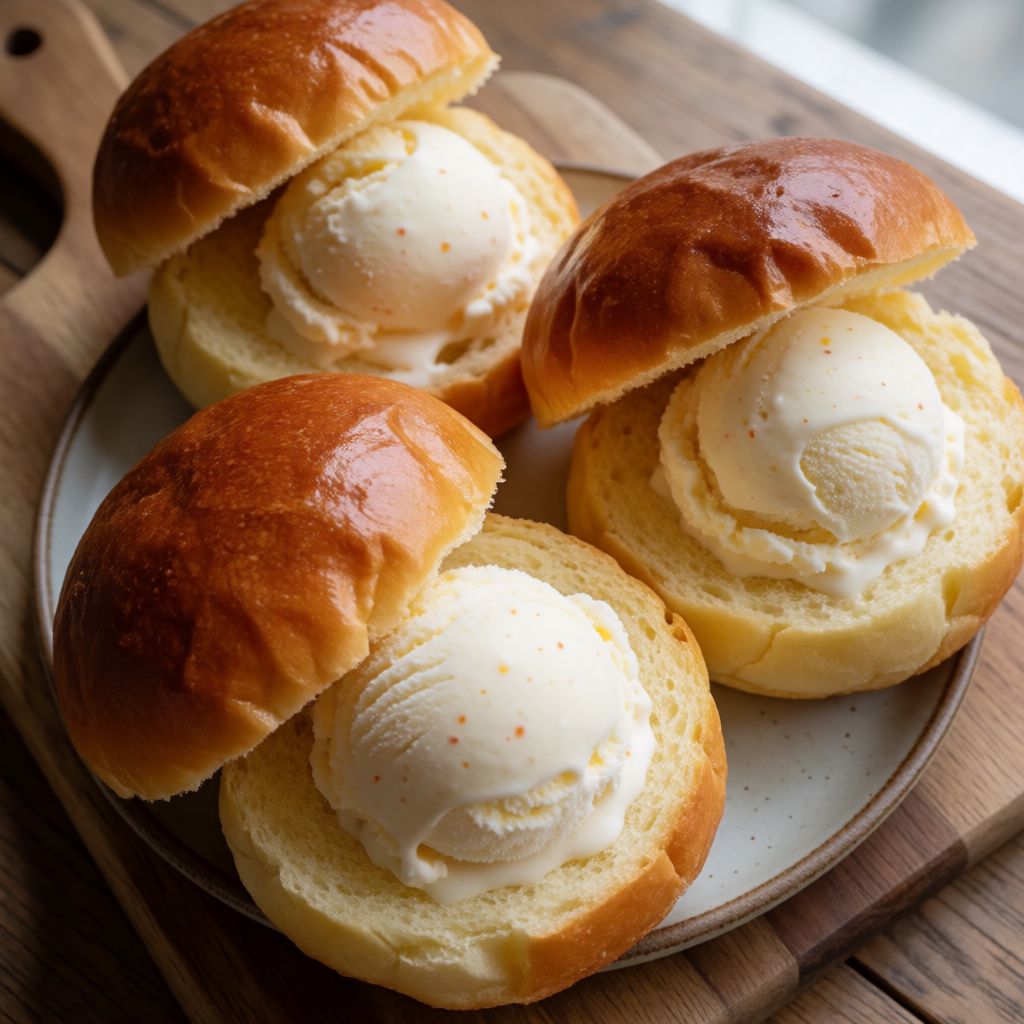
 AI photo
Brioche Buns with Ice Cream
Soft Italian-style brioche buns, split and filled with ice cream, finished with a dusting of icing sugar.
Labels are worked out automatically from the ingredients and can be wrong. Check the packaging if it matters to you.
Ingredients
- 250 g Plain flour
- 250 g Strong white flour
- 130-150 g Milk
- 1 pinch Orange zest to taste
- 1 pinch Lemon zest to taste
- 90 g Caster sugar
- 75 g Butter
- 1 pcs Egg
- 2 pcs Egg yolks
- 20 g Fresh yeast or 8g dried yeast
- 1 pinch Salt
- Ice cream to taste, for filling
- Icing sugar for dusting











Steps
Tip both types of flour into a bowl, add the butter, the egg with the two yolks, the yeast, milk, sugar, zest and salt. Knead into a dough using a stand mixer.
Leave the dough to rise until it has doubled in size.
240 minDust the work surface with flour, roll out the dough and shape the brioche buns — round buns or crescents.
Brush the brioche buns with milk, place on a baking tray lined with baking paper and put in the oven on its lowest setting to rise.
15 minBrush the brioche buns with milk again.
Bake at 180°C for 12-15 minutes in a preheated fan oven (or at 190°C for 15-18 minutes in a conventional oven).
15 minRemove the brioche buns from the oven and leave to cool completely.
Cut the brioche buns in half and fill with ice cream.
Dust the brioche buns with icing sugar.
A brioche bun is an egg yolk suspended in flour, propped up with just enough gluten to hold its shape, then torn open and stuffed with cold ice cream. That contrast — warm-tasting, soft-crumbed bread against something that's actually cold — is the entire point of the dish. If you've never had it, it reads as odd on paper. It isn't odd in the mouth.
What decides whether this works isn't the baking. It's the dough, two days before you ever see an oven. Brioche is a two-flour compromise: plain flour for softness, strong flour for structure, because you need a crumb tender enough to bite through easily but strong enough to trap all that butter and egg without collapsing into a flat, greasy puddle. Get the balance wrong — too much plain flour — and your bun won't hold its dome. Too much strong flour and you've baked a slightly sweet bread roll, not a brioche.
The second thing that decides it: how long you let the dough sit before baking. Four hours isn't a number to argue with, it's a description of what yeast does to fat. Butter slows fermentation down — a lean dough would double in an hour, this one needs far longer because the yeast is working through a dough coated in grease. Rush this and you get a dense, close-crumbed bun that tastes of raw butter rather than one that's actually risen through it.
Some say brioche needs a professional oven or a proper French bakery behind it. No — it needs patience and a reliable egg-to-flour ratio, both of which work fine in a domestic kitchen with a stand mixer and a decent fan oven.
Flour first. Plain and strong, roughly half and half, isn't a whim — it's managing gluten. Strong flour (high protein) builds the elastic network that lets a sticky, butter-and-egg-heavy dough actually rise rather than slump. But all strong flour makes a chewy, bread-like crumb, wrong for something you want to pull apart gently around a scoop of ice cream. Plain flour softens that. If you only have one or the other, lean toward strong and add a spoon less liquid — you can always correct texture with hydration, not with protein you don't have.
The egg and two extra yolks are not decoration. Yolks carry fat and emulsify it into the dough, which is why brioche has that yellow, almost custardy crumb and keeps soft for days — the fat coats the starch and slows it going stale. If you skip yolks and use whole eggs only, you lose richness and the crumb dries faster. No real substitute here except more butter, and that changes the structure, not just the flavour.
Butter: use unsalted, and let it come properly soft, not melted, before it goes into the mixer — melted butter oils the gluten strands instead of folding into them, and the dough ends up greasy rather than enriched. "Any oil with no strong flavour of its own" is not the rule for brioche; here you specifically want the butter's flavour, because it's half of what you're tasting under the ice cream.
Yeast — fresh gives a more even, slightly sweeter rise; dried works fine at roughly a third the weight, which is why the recipe already gives you both figures. Don't proof dried yeast in hot milk thinking you're helping it along — above blood heat and you kill it, and then nothing you do afterwards rescues a dough that never rises.
Zest is there for a top note, not a dominant flavour — a pinch of each, not a spoonful, because too much and the bitter pith oils come through and fight the butter. Milk for brushing, twice, is for colour: the sugars in milk brown under heat, giving you that deep gold crust rather than a pale one. An egg wash would brown faster and harder — fine if you want a shinier, crisper top, but it changes the character slightly toward a glazed roll.
On ice cream: this isn't really an ingredient you cook, it's a contrast you choose. Vanilla keeps the bun's butter and citrus honest; anything too assertive (intense chocolate, fruit sorbets) starts competing with the zest rather than sitting alongside it. Fill only once the bun is properly cold — not just cool, cold — because residual oven heat melts the first layer of ice cream into the crumb and you lose the contrast that's the whole reason you made this.