
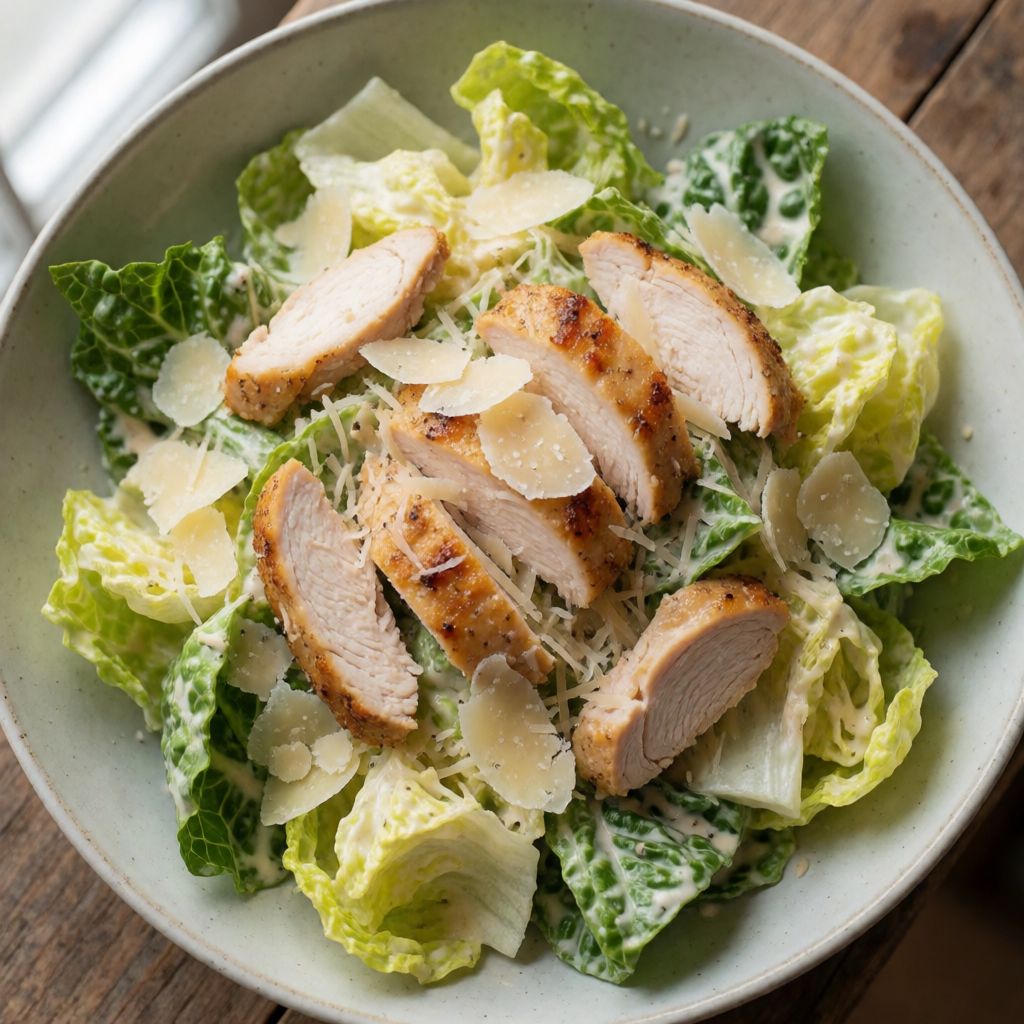
 AI photo
Caesar Salad
A classic Caesar salad with pan-fried chicken breast, crisp romaine, crunchy croutons and a homemade Caesar dressing.
Labels are worked out automatically from the ingredients and can be wrong. Check the packaging if it matters to you.
Ingredients
- 4 pcs Chicken breast
- 2 pcs Romaine lettuce torn into large pieces
- 50 g Parmesan shaved or coarsely grated
- 1 tsp Butter for frying the chicken
- 1 tsp Olive oil for frying the chicken
- Salt
- Black pepper freshly ground
- 2 pcs Bread slices, for croutons
- 1 tsp Butter for croutons






Caesar dressing
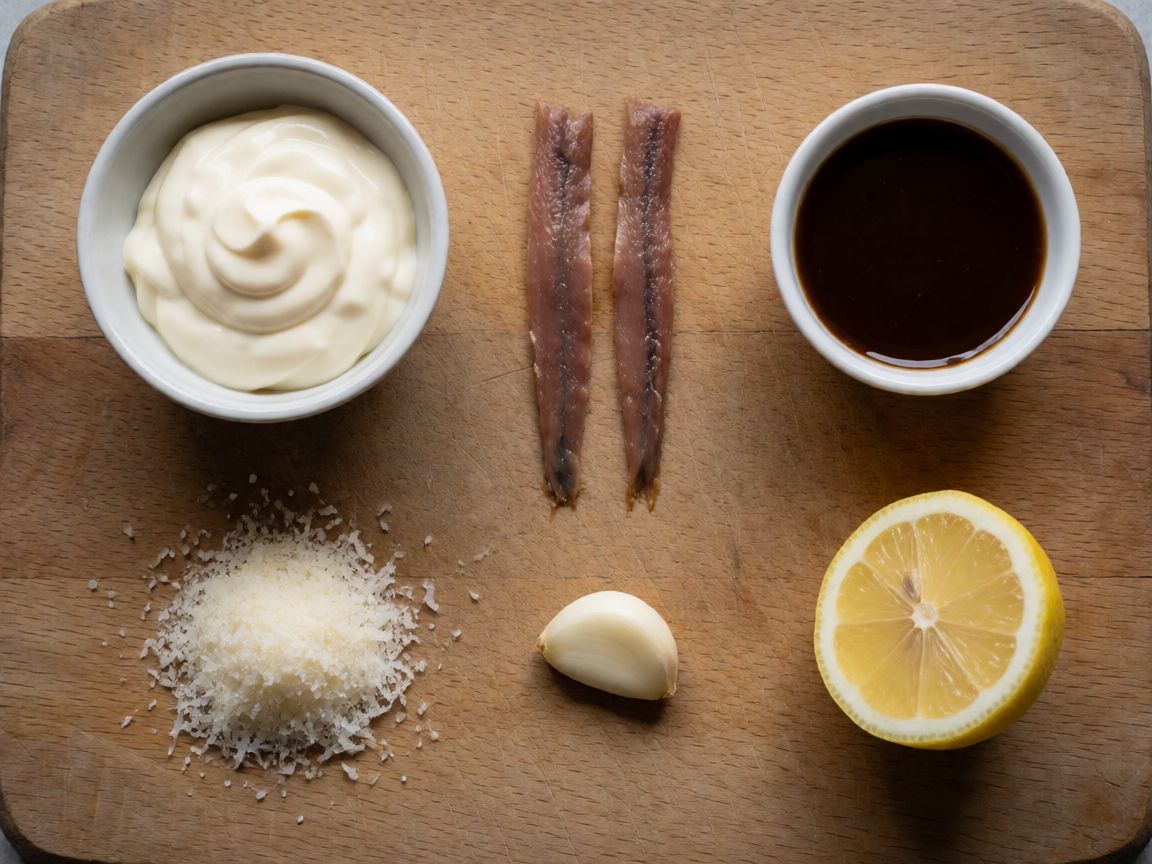
- 100 ml Mayonnaise
- 2 pcs Anchovies
- 1 tsp Worcestershire sauce
- 30 g Parmesan freshly grated
- 1 clove Garlic crushed
- ½ pcs Lemon a little juice





Steps
Score the skin of the chicken breasts with a sharp knife and season with salt and pepper.
2 minPut the butter and oil in a cold frying pan and lay the chicken breasts in skin-side down.
1 minFry the chicken breasts slowly over medium heat, skin-side down, for 20 minutes. Meanwhile prepare the dressing, croutons and salad.
20 minTurn the chicken breasts over, increase the heat and fry on the other side for about 4–5 minutes.
5 minTear the romaine lettuce into large pieces and divide between four plates.
2 minSlice the chicken breasts and arrange on the plates.
2 minButter the bread slices on both sides and fry over medium heat.
3 minCut the bread into cubes to make croutons.
1 minMix the mayonnaise, anchovy fillets, Worcestershire sauce, Parmesan, garlic and lemon juice for the dressing.
2 minSeason the dressing with salt and pepper to taste.
1 minAdd the dressing, shaved Parmesan and croutons to the salad.
1 min
Forget the romantic story about Caesar Cardini inventing this tableside in Tijuana out of kitchen-raid desperation — the story's probably true, but it doesn't tell you why the dish still works a hundred years later. What this salad actually is: a cold, sharp, savoury dressing clinging to crisp leaves, with crunch and protein added so it reads as a meal instead of a side. Everything about the method serves that one idea — contrast. Cold crunchy lettuce against warm sliced chicken. Crisp croutons against soft leaves. A dressing that's basically liquid umami bombs (anchovy, Parmesan, Worcestershire) riding on mayonnaise's fat so it coats instead of pooling.
What decides whether it works isn't the lettuce or even the dressing — it's the chicken skin. Cold pan, skin-side down, slow heat, twenty minutes, no flipping. That's not fussiness, that's physics: skin is mostly fat and connective tissue, and fat needs time at gentle heat to render out and crisp the skin without the meat underneath seizing up and turning to rubber. Start it in a screaming hot pan and you'll get scorched skin sitting on top of a breast that's still tight and dry in the middle — the classic failure, and everyone blames the chicken, when really they rushed the pan.
Romaine is the only lettuce that belongs here, and it's not snobbery — it's structure. The ribs are stiff enough to hold dressing without collapsing into wet rags, the way a soft butterhead or bagged mixed leaves would. If you can't get romaine, cos lettuce is the same plant under a different name in most UK shops, or use the crispest leaves of a hard white cabbage-adjacent lettuce like little gem — anything with backbone. Tear the leaves by hand rather than cutting them: a knife bruises the cut edge and it browns and weeps within the hour, torn edges don't.
The dressing is where people either trust the method or panic and buy a bottle. Anchovies aren't there for fishiness — two fillets dissolve into the mayonnaise and vanish, leaving only a savoury backbone you can't quite name, which is exactly the point: it should taste "right" rather than "fishy." No anchovies in the cupboard, a dash of Worcestershire sauce alone will fake most of that same umami note, since Worcestershire itself is fermented anchovy at its core — you're just leaning harder on one ingredient instead of two. Garlic goes in crushed, not chopped, because crushing ruptures more cells and releases more of the sharp allicin that mellows as it sits in the fat — chop it and you get patchy bites of raw heat instead of an even hum through the whole dressing. The lemon juice is there to cut the mayonnaise's richness, not to make it taste of lemon — a little goes further than you think, add it last and taste before reaching for more.
Parmesan appears twice for two different jobs: grated fine into the dressing so it melts into the body of it, shaved or coarse into the finished salad so you actually bite into it. Use a vegetable peeler for the shavings — a grater turns it to dust, a knife turns it to rubble. Any hard, aged, salty grating cheese stands in if Parmesan's not to hand — a mature Cheddar won't give you the same savoury depth, but a Grana Padano or even a well-aged Pecorino will do the job honestly.
Butter for the chicken skin, butter again for the croutons — both for the same reason: butter browns and smells like butter, where a neutral oil alone would just make things crisp without the toasted-milk-solids flavour underneath. The small amount of olive oil mixed with the butter for frying the chicken stops the butter's milk solids from burning before the fat gets hot enough to crisp the skin — oil raises the smoke point, butter brings the flavour, together they cover each other's weakness. For the croutons, butter both sides of the bread before frying, not after — soaking it in while it's still cool means it crisps evenly rather than just scorching on one face while the other stays soft and chewy in the middle, which is the usual crouton letdown.
On a domestic hob there's no kazan here, no need for one — a wide frying pan is actually the better tool for this dish than anything deep, because you want the chicken skin in full contact with the metal, not crowded or curling up the sides. Fry the chicken two breasts at a time if your pan's not wide enough to lay all four flat without touching — crowd the pan and the skin steams instead of crisping, which is a different kind of soggy disappointment with the same cause as rushing the heat: moisture with nowhere to go.
This feeds four as a proper lunch, not a starter-sized nibble — plan on one chicken breast and a good double handful of torn romaine per person, with the dressing spread thin rather than drowning the leaves. Too much dressing and you've made soup; a Caesar should coat, not swim.