
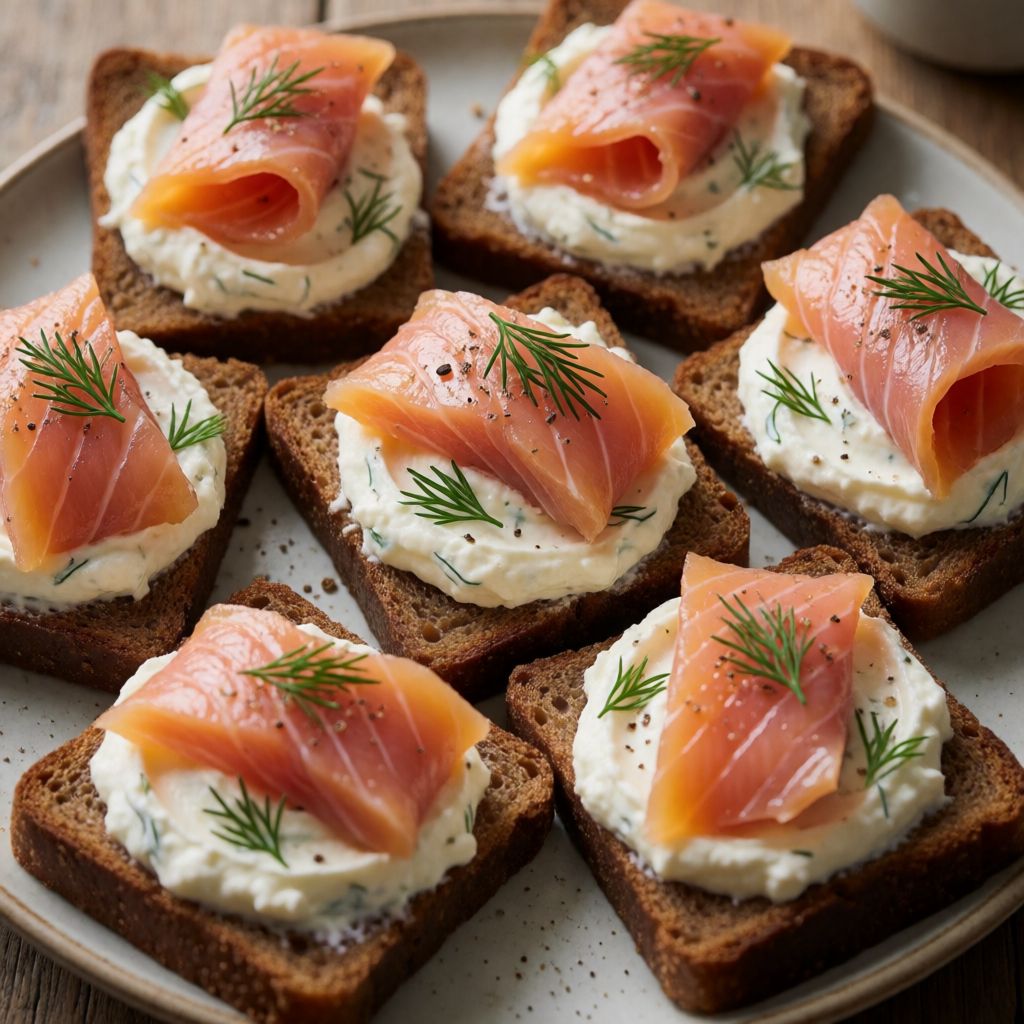
 AI photo
3 Easy Canapés
Three simple canapés: smoked mackerel on rye, cucumber with roe and cream cheese, and ham with cream cheese on toast.
Labels are worked out automatically from the ingredients and can be wrong. Check the packaging if it matters to you.
Ingredients
- 8 pcs Rye bread toasted slices, cut into a neat shape if you like
- 1 pcs Smoked mackerel half a fillet
- 2 tbsp Peppery cream cheese
- 1 bunch Dill for garnish
- 1 pinch Salt
- 1 pinch Black pepper freshly ground
- 8 pcs Cucumber slices
- 40 g Lumpfish roe
- 2 tbsp Cream cheese
- 8 pcs Bread toasted slices
- 2 tbsp Cream cheese
- 8 pcs Ham
- 8 pcs Olives





Steps
Mash the smoked mackerel with the peppery cream cheese and season with salt and pepper.
Spoon the mixture into a piping bag and pipe onto small canapés of rye bread.
Garnish the mackerel canapés with dill.
Place a full teaspoon of lumpfish roe on each slice of cucumber.
Spoon the cream cheese into a piping bag and pipe small rosettes around the roe.
Finish the roe canapés with a little dill and pepper to taste.
Toast the bread slices for the third type of canapé.
Spread the bread with cream cheese and top with ham and an olive.
Secure all the canapé components with a cocktail stick.
What was changed
Lumpfish roe replaces the original roe, as it is not available in UK shops; lumpfish roe is used instead.
Three canapés, really, pretending to be one recipe — and that's the honest way to say it. There's no cooking here at all: cook time is zero because nothing is cooked. The whole dish is assembly, and what decides whether it works is not flavour but structure — does the topping stay on the bread when someone picks it up, or does it slide off onto their shirt.
That's the real engineering problem of a canapé. You're building a small tower on a base that's about to go soggy. Toasting the bread isn't for crunch as an end in itself — it's a timer. Toast dries the surface so the moisture in mackerel, cream cheese or ham takes longer to soak through and collapse the base into paste. It buys you the twenty minutes between assembly and someone actually eating it. Untoasted bread under a wet topping is a myth waiting to fail quietly at a party.
The mackerel one is the most forgiving: mashed fish and peppery cream cheese bind into a paste that grips the bread rather than sitting on it loose. The roe-and-cucumber one is the opposite — cucumber is mostly water, so you're racing the clock from the moment you slice it, and the roe sitting proud on top means gravity, not adhesion, is what's keeping it there until the stick goes in. The ham-and-olive one is the simplest and the most stable, which is exactly why it's the one to make if your hands are full or your kitchen counter is small.
Start with the bread. Rye for the mackerel is not fashion — it's flavour logic. Smoked fish is assertive and a touch oily; a mild white toast disappears under it, rye pushes back with its own sourness and holds its own. If you don't keep rye in, any dense, close-crumb bread toasted properly will do — what you're avoiding is a loose, airy sandwich loaf that turns to crumbs the second you spread anything wet on it. For the plain toasted bread under ham and olive, you've got more freedom, because ham and olive don't need a bread that argues with them.
The mackerel itself: half a fillet, smoked, meaning it's already cooked and seasoned by the smoking process — you're not applying heat, you're applying a fork. Mash it properly, bones out, skin out if it's loose, because a canapé is a two-bite food and nobody wants to find out the hard way there's a bone in bite one. Peppery cream cheese is doing two jobs at once — fat to carry flavour and smooth the mash into something pipeable, and pepper already built in so you're not guessing how much to add. If you can't find the peppery version, plain cream cheese plus a genuinely generous crack of black pepper worked into it gets you there; taste it before you pipe, because cold cheese dulls seasoning and you want it a little sharper than seems right straight off the spoon.
The cucumber slices are not a vegetable course, they're a plate. They carry no flavour of their own worth mentioning — any firm, pale, waxy cucumber works, and the only real choice is cutting the slices thick enough that they don't buckle under a teaspoon of roe. Lumpfish roe is the budget stand-in for proper fish roe — small black or red beads, salty, a bit of pop to them, and it's used here exactly because it's affordable and sold in small jars that won't go to waste after one party. Don't reach for caviar thinking it's "more correct" — it's a different price bracket solving the same decorative job, and on a canapé nobody will taste the difference under cream cheese and dill anyway.
Ham and olive is the one that needs the least explaining because it's the one built on habits already in a British kitchen — cold meat, cheese, something salty and briny to cut the fat, the same logic as a ploughman's lunch shrunk down to a mouthful. Use whatever ham you'd put in a sandwich; there's no cut here that matters more than another. The olive's job is purely to give a sharp, salty counterpoint to the cream cheese's fat — green or black, whichever you prefer, though a pitted one saves someone's tooth later.
The cocktail stick at the end isn't fussy presentation — it's structural. Once that stick goes through bread, topping and garnish together, it's doing the job the toasting started: holding the thing together on the way from plate to mouth. Skip it and you're trusting cream cheese to be glue, which it isn't.
Patience here isn't about waiting for something to cook, since nothing does. It's about not rushing the piping and not assembling too far ahead — do these within the twenty minutes before guests arrive, not the night before, or the toast will have lost its fight against moisture and you'll be serving damp regret instead of canapés.