
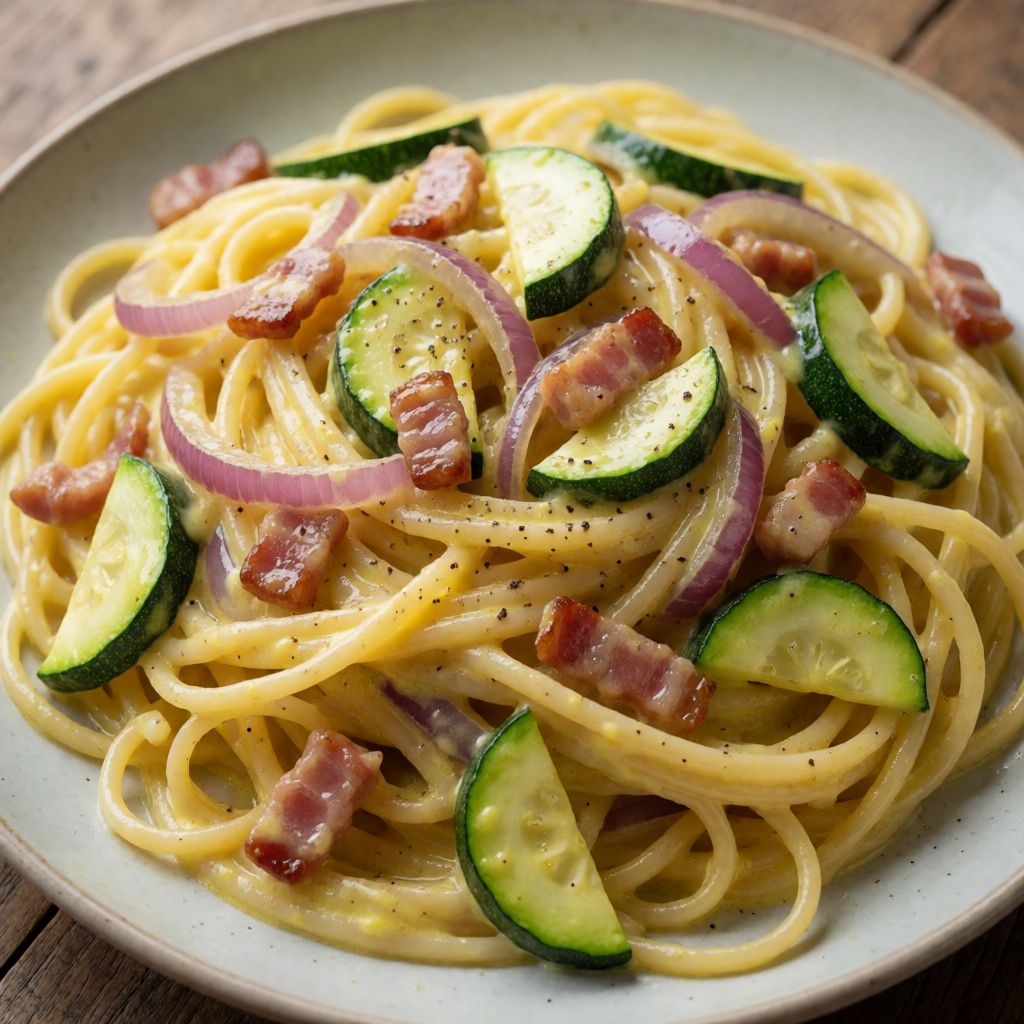
 AI photo
Carbonara with Pancetta, Courgette and Saffron
A creamy carbonara twisted with crisp pancetta, courgette and a touch of saffron.
Labels are worked out automatically from the ingredients and can be wrong. Check the packaging if it matters to you.
Ingredients
- 400 g vermicelli or spaghettini
- 1 pcs red onion
- 3 pcs courgette
- 1 pcs saffron
- salt to taste
- black pepper to taste
- 4 pcs bell pepper
- 2 tbsp Pecorino Romano
- 1 tbsp Parmesan
- 150 g smoked pancetta
- 2 tbsp olive oil









Steps
Fry the smoked pancetta in a dry pan with no oil until crisp, cooking to 70°C at its thickest point, then set aside.
5 minIn the same pan heat the olive oil and fry the red onion, then add the courgette and cook for a few minutes so it stays crisp.
5 minDissolve the saffron in a small glass of warm water.
2 minBoil the vermicelli or spaghettini in salted water.
10 minWhisk the egg yolks with the Pecorino Romano, Parmesan and black pepper until smooth.
3 minDrain the pasta and tip it into the pan with the courgette, add the pancetta, the egg mixture and the dissolved saffron.
2 minToss everything quickly over the heat, sprinkle with Parmesan and serve.
3 min
This is not carbonara. Let's say that plainly, because the name is doing you a disservice. Real carbonara is eggs, pecorino, guanciale, pepper — nothing else, no cream, no vegetables, no onion anywhere near it. What you've got here is a saffron-and-courgette pasta that borrows carbonara's technique — raw egg yolks turned into sauce by the heat of the pan, not the hob — and that borrowing is exactly where it can go wrong or right.
What decides this dish is timing at the very end: the egg mixture has to meet pasta that's hot but not boiling, in a pan that's off the direct flame or nearly off it. Too hot and the yolks seize into scrambled egg clinging to strands of spaghetti — that's the "carbonara gone wrong" everyone's had in a bad restaurant. Too cool and it stays raw and slick, won't cling, tastes of nothing but egg. The pasta's own residual heat and a splash of its starchy cooking water are what cooks the sauce gently and gives it that coating-not-clumping texture.
The pancetta gets fried dry, no oil, because it's already fatty — its own fat is the only fat it needs, and bringing oil into that pan just dilutes the crisping and stops it browning. You're rendering it, not frying it in the oil-and-batter sense. Crisp at the edges, the fat run clear and gold in the pan — that's your cue, not a clock.
Start with the pasta itself. Vermicelli or spaghettini — thin strands — because this is a light sauce built on egg and starch, not a sauce with body of its own like a ragù that needs something broader to carry it. If you've only got spaghetti in the cupboard, use it; the dish survives, it just eats a little heavier. What you shouldn't do is reach for a short pasta like penne — the egg-yolk coating works by strands sliding past each other and over themselves, and that doesn't happen the same way with tubes.
Pancetta, smoked, 150g for four people — that's not a lot, and it shouldn't be. Its job is seasoning and crunch, little islands of salt and smoke through the dish, not a meat course. Cooking it to 70°C at the thickest point is the one number in this recipe that isn't about look or feel, and it's there because pancetta is cured but not cooked — that temperature is where the risk of it being under-rendered pork actually ends. If pancetta isn't sold where you shop, guanciale is the traditionalist's answer but expensive and odd to find in a UK supermarket; a good smoked streaky bacon, cut into lardons, does the job of smoke-plus-fat almost as well, though it brings a sweetness pancetta doesn't have.
The egg yolks and the two cheeses are the actual sauce — remember that, because everything else is garnish around it. Pecorino Romano is salty and sharp in a way that cuts through the egg's richness; Parmesan is milder and rounds it off. If you can only get Parmesan, use more of it and go lighter-handed with extra salt in the pasta water, because Parmesan alone won't bring the same savoury edge. The black pepper in the mix isn't decoration either — it's there from the start, mixed into the yolks, because pepper bitten into whole off the pan stays sharp and separate on the tongue; pepper worked into the sauce turns into a warmth running through the whole bowl.
Saffron is the one ingredient here worth being honest about: it's expensive because growing it is absurdly labour-intensive — each flower gives three threads, picked by hand, and it takes thousands of flowers for a gram. That's not mystique, that's agriculture. A pinch — the "1 pcs" in this list likely means a small sachet or a few threads, not a whole packet — steeped in warm water gives you colour and a faint honeyed bitterness. If you don't have it, don't try to fake the colour with turmeric; you'll get yellow but none of the character, and turmeric's earthiness fights the dish rather than joining it. Better to leave it out entirely and let the dish be a courgette-and-pancetta carbonara without the gold.
Courgette and bell pepper and red onion are the vegetable backbone, and British courgettes especially carry a lot of water — slice them and they'll weep onto a plate if you leave them standing. Cook them briefly in the olive oil after the onion's gone from sharp white to soft and translucent (not browned — browned onion here would fight the delicate saffron rather than support it), and stop before the courgette softens all the way through. You want it to still have resistance when you bite, because the pasta and sauce are already soft and the whole dish needs one thing with texture or it reads as mush.
On the pan itself: you don't have a kazan or a proper wok burner, you've got a flat electric or gas hob and a wide frying pan, and that's fine — this dish was never built for intense standing heat anyway. The trick with no lid handy is just to use a plate upturned over the pan if you need to hold heat in for a minute, which you mostly won't here since nothing's meant to steam for long. Patience is the real ingredient at the final toss: rush the egg-and-pasta moment and you get scrambled egg noodles; give it thirty unhurried seconds off the heat, stirring, and you get sauce.