
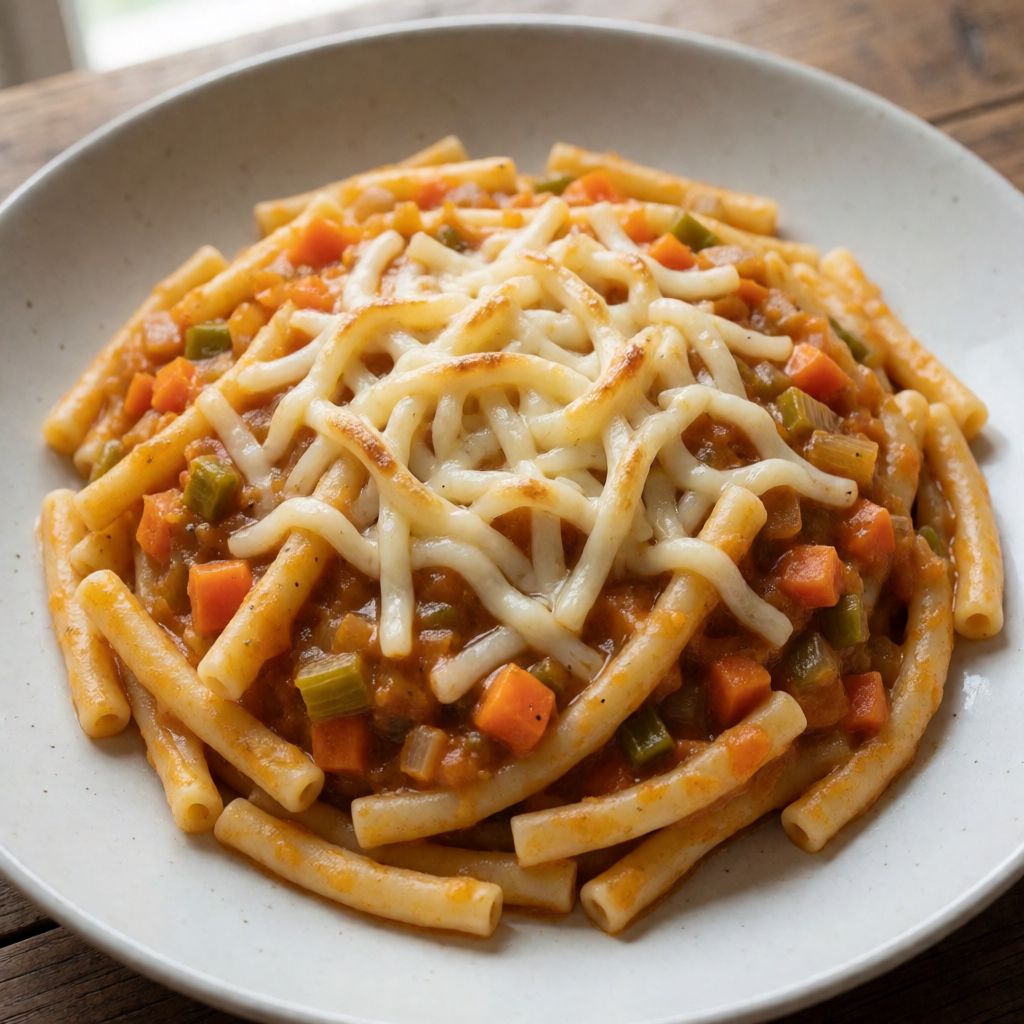
 AI photo
Casarecce with Vegetable Ragù and Smoked Scamorza
A colourful pasta dish with a rich vegetable ragù, finished with melted smoked scamorza and pecorino.
Labels are worked out automatically from the ingredients and can be wrong. Check the packaging if it matters to you.
Ingredients
- 400 g Casarecce pasta
- 150 g Smoked scamorza
- 2 tbsp Olive oil
- 1 pcs Carrot
- 1 pcs Onion
- 1 pcs Celery stick
- 1 clove Garlic
- Parsley to taste
- 1 pcs Courgette
- 1 pcs Yellow pepper
- 1 pcs Aubergine
- Tomato paste to taste
- 1 pinch Chilli powder
- Salt to taste
- Basil to taste
- Pecorino Romano to taste












Steps
Finely chop the carrot, onion, celery, garlic and parsley, and fry in olive oil, then add the yellow pepper.
Add the aubergine in cubes, then the courgette in cubes.
Stir in the tomato paste, season with salt, add a pinch of chilli powder, and cook.
10 minTear a few basil leaves by hand.
Cook the pasta and drain in a sieve.
Transfer the pasta to a large bowl, sprinkle with pecorino Romano, add the scamorza in cubes, and serve.
What was changed
Chilli powder because ground cherry chilli pepper isn't commonly sold in British shops.
This is not a tomato-sauce pasta drowning in liquid — it is a ragù of cut vegetables, fried and reduced until they hold their shape but give no resistance, then tossed through pasta with cubes of smoked cheese that melt from borrowed heat alone. What decides whether it works is almost entirely about size and sequence: cut everything roughly the same size so it finishes at the same time, and put the slower vegetables in before the faster ones. Aubergine goes in before courgette because aubergine is dense and spongy and needs the extra minutes to soften through; courgette is mostly water and collapses fast — add it too early and by the time the aubergine catches up, the courgette is paste.
The second thing that decides it is the tomato paste. You don't just stir it in and call it sauce. It needs a minute or two in the hot fat with the vegetables, where it darkens from brick-red to something closer to rust. That's the raw, slightly tinny acidity cooking off — skip this and the whole dish tastes thin and sour no matter how long you simmer after.
Doneness for the vegetables isn't a clock reading. It's a texture: a piece of aubergine should give under a spoon without disintegrating, the pepper should have lost its squeak but not its colour. Ten minutes is the floor here, not the answer — a weaker domestic flame might need longer, and that's fine, because nothing in this pan is in a hurry.
The soffritto — carrot, onion, celery, garlic, parsley, finely chopped and fried first — is not decoration, it's the whole flavour budget of this dish before a single tomato appears. This is cucina povera logic: a handful of root vegetables that keep all winter, turned into a base that makes everything added afterwards taste like it's been cooking for longer than it has. Onion gives body and sweetness as it softens, celery gives a green, slightly bitter backbone, carrot adds sugar to balance it, and garlic — added once the onion has gone soft and translucent, never before — gives sharpness without burning into bitterness. If your garlic tastes acrid in the finished dish, that's not the garlic's fault; it went in too early, next to raw onion, and scorched while everything else was still finding its feet.
Aubergine and courgette and pepper belong together for a reason that has nothing to do with flavour theory and everything to do with a calendar: in a Mediterranean garden they all ripen within the same few weeks of late summer, so you cook what you've got, together, before it spoils. That's also why there's no single 'correct' ratio between them — use what's firmest and most plentiful. If you have none of one, lean harder on the others; the dish tolerates imbalance better than it tolerates mush.
Tomato paste is used here instead of fresh tomatoes or passata because it's concentrated — it brings deep tomato flavour without adding liquid the pan then has to boil off, which matters on a domestic hob that won't throw the kind of fierce, wide heat a wok or kazan gives you. The criterion for substituting it: anything that is tomato with most of its water already removed. A double-concentrate tube works even better than tinned paste. If you only have fresh ripe tomatoes, you can use them, but expect to cook them down much longer to get the same depth — patience bought with time instead of concentration.
Casarecce is shaped like a short scroll curling in on itself, which exists to trap small chunks of sauce inside the curl rather than let them slide off a flat strand. The criterion for swapping it: any short pasta with a twist, ridge or hollow that can hold a cube of vegetable — fusilli, cavatappi, even penne rigate at a push. Don't rinse it after draining; the starch clinging to the surface is exactly what the sauce and melting cheese need to grip onto, not something to wash away.
Scamorza is mozzarella's drier, firmer cousin — same stretched-curd cheese family, aged a little and often smoked over wood, which is why it holds its shape in cubes instead of oozing. If you can't find smoked scamorza, plain scamorza or smoked mozzarella both work by the same logic — a stretched-curd cheese that melts in strings rather than splitting. With no smoked cheese at all, use a mild melting cheese and add the smoke another way, a pinch of smoked paprika into the ragù while it cooks. Pecorino Romano, grated over at the end, is there for salt and sharpness rather than melt — it's sheep's cheese, assertive. Parmesan will substitute, but it's milder and less salty, so taste before you add more salt elsewhere.
On a domestic hob, use the widest pan you own, not the deepest — width lets the water the vegetables release actually evaporate instead of turning the whole thing into a stew. If you need to slow something down without a lid, an upturned plate does the job of holding heat in just as well, and nobody in this recipe is waiting for a kazan that isn't there.