
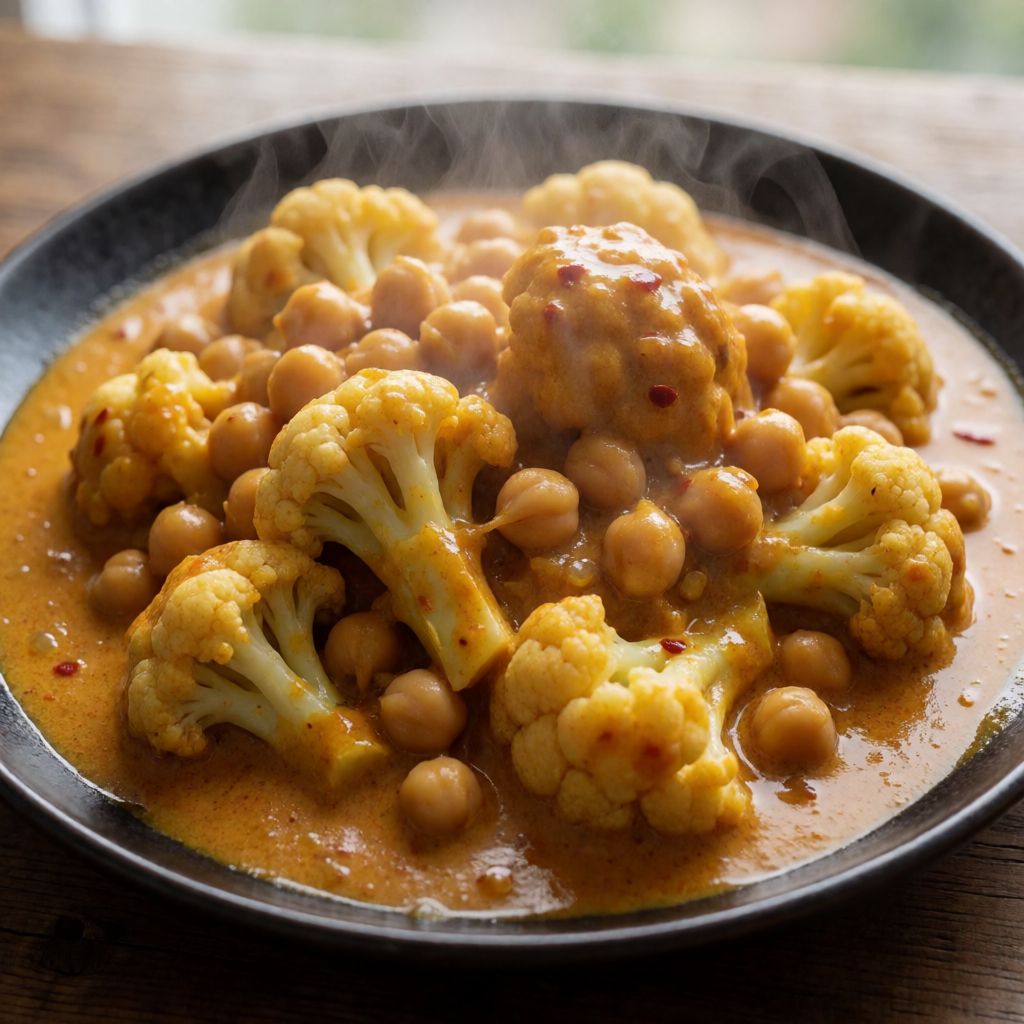
 AI photo
Cauliflower and Chickpea Curry in a Creamy Coconut Sauce
A gently spiced cauliflower and chickpea curry, simmered in coconut milk and finished with yoghurt and almonds.
Labels are worked out automatically from the ingredients and can be wrong. Check the packaging if it matters to you.
Ingredients
- 2 pcs Onion thinly sliced
- 1 tbsp Garam masala
- 0.5 tsp Chilli flakes
- 1 tsp Turmeric
- 4 clove Garlic finely chopped
- 1 tbsp Ginger finely grated
- 1 pcs Lime juiced
- 400 ml Coconut milk
- 1 pcs Cauliflower broken into florets
- 1 can Chickpeas drained and rinsed
- 75 g Tomato paste
- 100 ml Greek yoghurt
- 75 g Almonds blanched and roughly chopped
- 1 tbsp Olive oil for frying
- Salt to taste
- Black pepper freshly ground
- 1 bunch Coriander fresh, roughly chopped
- 300 ml Basmati rice


















Steps
Cook the rice according to the packet instructions.
Heat the oil in a pan and fry the onion until soft.
Add the garam masala, chilli flakes, turmeric, garlic, ginger and lime juice, and mix well.
Add the coconut milk and bring to the boil.
Add the cauliflower, chickpeas and tomato paste.
Cover and simmer for 10-15 minutes, until the cauliflower is tender.
Before serving, stir in the Greek yoghurt and half the chopped almonds, then season with salt and freshly ground pepper.
Serve in deep bowls with the rice, sprinkled with the remaining almonds and roughly chopped coriander.
This is a curry built on a trick most home cooks skip: you bloom the spices in fat before any liquid touches the pan, not after. Garam masala, chilli, turmeric, garlic and ginger go into the pan once the onion has gone soft and translucent — not browned, just gone limp and sweet — because the aromatic compounds in those spices are oil-soluble, not water-soluble. Dump them straight into coconut milk and most of what makes garam masala worth buying stays locked up, never released, and you get a curry that tastes of tin and vegetable rather than of itself. Thirty seconds to a minute in hot fat, until the spices smell different than they did dry — sharper, almost toasted — and only then does the coconut milk go in.
The cauliflower is the second decision point. You want florets that bend before a knife-tip under pressure feels no resistance, not florets that collapse into mush. Covering the pan matters here, and not for mystique — a lid (or in a flat without one, a plate that fits the pan's mouth) traps the steam that actually cooks the top half of each floret, since the sauce only ever reaches halfway up. Lift the lid and you lose that steam, and the cauliflower on top stays raw while the bottom turns to porridge. The chickpeas are along for texture and bulk, not drama — they've already been cooked once in the tin, so they're not solving any problem, just absorbing whatever sauce is around them.
What decides whether this works isn't the ingredient list, it's restraint at two moments: not burning the spice bloom, and not boiling the yoghurt. Everything else is forgiving.
The yoghurt goes in at the very end, off any real heat, and this is the one rule in the whole dish that punishes you hard if ignored. Yoghurt is mostly water held in suspension by milk proteins, and those proteins unravel and clump the moment they hit a simmer — that's curdling, and once it's happened you can't talk it back. Some say stabilise it with a spoonful of flour first; no, because the real fix is simpler: take the pan off the heat, let it sit a minute so it's not actively boiling, then fold the yoghurt through. Greek yoghurt survives better than thin yoghurt because it's already had whey drained out of it, so there's less water to turn to steam and shock the proteins — if you've only got the thinner stuff, stir it through a little of the hot sauce first to warm it gently before it joins the pan, the same trick you'd use tempering eggs.
Coconut milk is doing fat and liquid at once — it's what turns ground spice and raw vegetable into something that coats a spoon instead of running off it. Buy the kind in a tin, not the thin stuff sold as a drink, because the drink has been diluted for pouring over cereal and won't reduce into anything. If a tin's separated into a solid cap and thin liquid underneath, that's normal — it just means the fat has set, give it a stir.
Tomato paste here isn't for tomato flavour so much as for the Maillard-adjacent reaction it goes through once it hits hot fat and spice — paste that's been concentrated already caramelises fast, deepening colour and rounding out sourness that fresh tomato can't match in the ten minutes you've got. Garam masala itself is a late-addition spice blend by design, built from already-roasted, already-ground spices, which is exactly why it goes in near the start here rather than simmered for half an hour like a whole-spice base would need — it's pre-toasted, so your job is just to wake it up in fat, not cook it down.
Almonds split into two uses and that's deliberate, not decorative: half goes in to melt slightly into the sauce and thicken it, half stays back to go on top raw for crunch against the soft cauliflower. If you haven't got almonds, any nut with a mild, not-too-oily character does the same job — cashews work, blanched and chopped the same way; skip walnuts, their bitterness fights the spice rather than rounding it. Lime juice at the start seems early for a finishing acid, but it's there to cut through the fat of the coconut milk before the dish gets heavy, not to brighten it raw at the end — you can always add more juice at the table if it tastes flat.
On a British hob, with gas or a coil ring rather than a kazan's even heat, the one honest limit is that your pan will have hot spots — so when you're blooming spices, keep the pan moving, don't let one patch catch while the rest is still raw. This feeds four properly, as a main with rice rather than a side, and it holds its temperature better than most curries do if your Sunday roast runs long and this has to wait on the back of the hob — patience is the one ingredient not listed on the card, and it's the one that decides whether the cauliflower is tender or broken.