
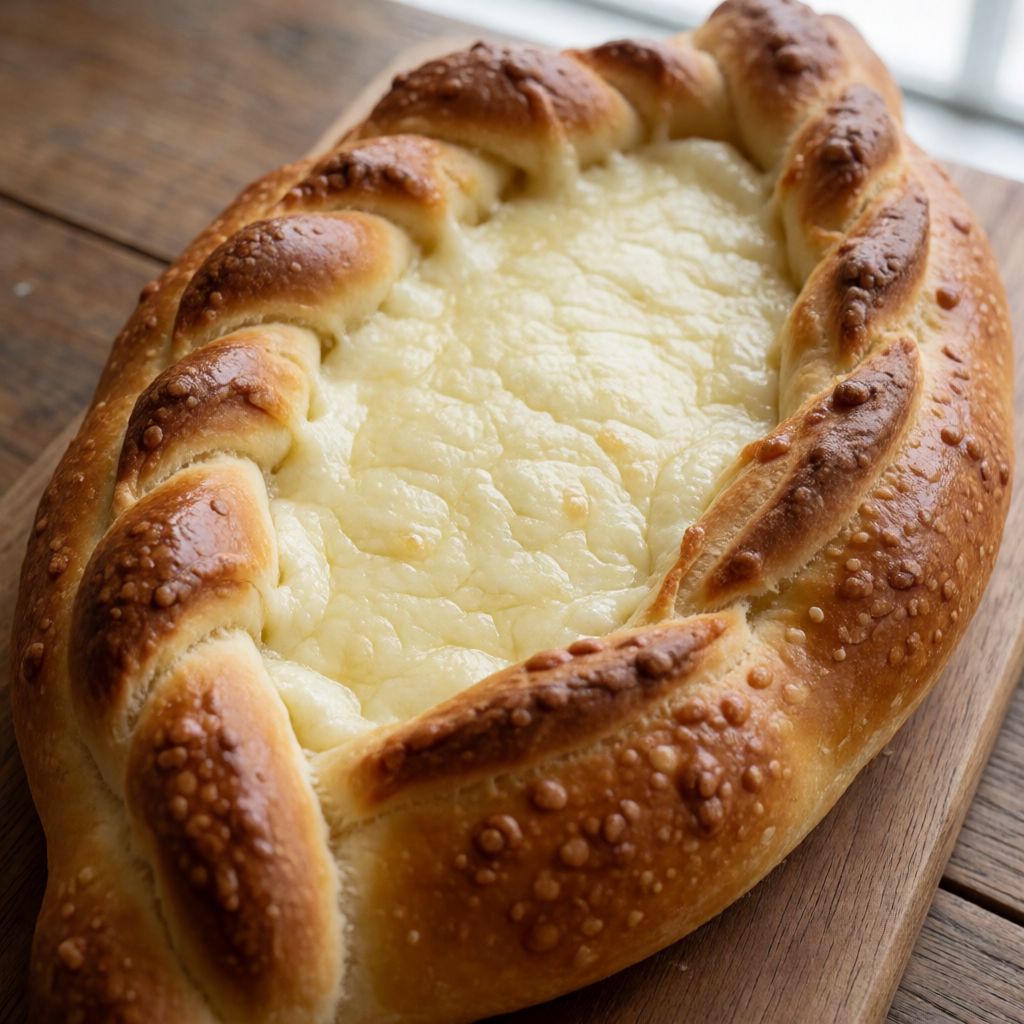
 AI photo
Turkish-Style Cheese Boat Pies
Boat-shaped yeasted breads filled with cheese, potato, pesto, sun-dried tomatoes and olives.
Labels are worked out automatically from the ingredients and can be wrong. Check the packaging if it matters to you.
Ingredients
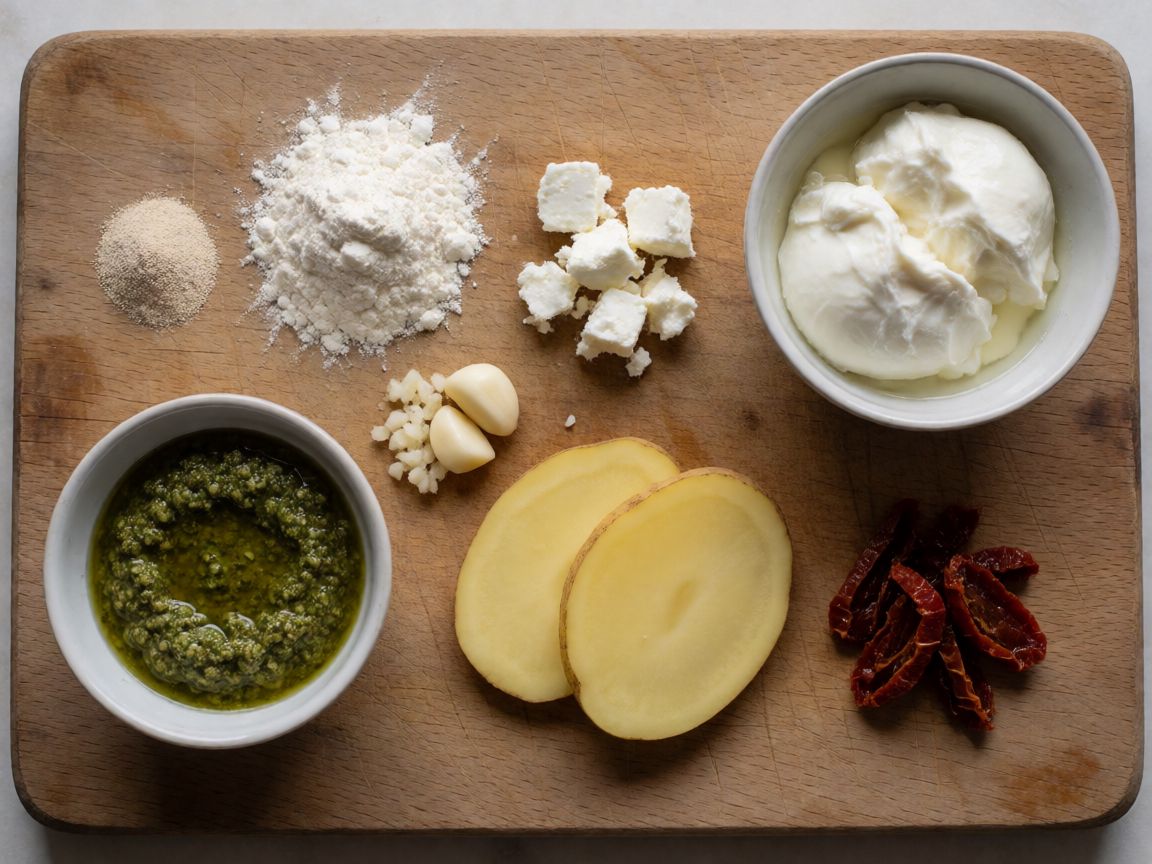
- 10 g Yeast
- 350 ml Water room temperature
- 3 tbsp Olive oil
- 1 tsp Salt
- 500 g Plain flour
- 250 g Mozzarella fresh
- 100 g Feta
- 2 pcs Potatoes cut into paper-thin slices
- 2 clove Garlic crushed
- 1 tbsp Olive oil
- 50 g Pesto
- 50 g Sun-dried tomatoes dried
- 75 g Olives
- 1 bunch Basil fresh













Steps
Dissolve the yeast in the water, then add the flour, olive oil and salt.
Knead the dough in a mixer on medium speed for 10 minutes, until it becomes elastic, smooth and soft.
10 minTransfer the dough to a bowl greased with olive oil, turning it so it is coated with oil on all sides.
Leave the dough to rise, covered, first for 30 minutes on the worktop, then refrigerate for 10–24 hours.
1 hour before baking, preheat the oven with a baking stone to maximum temperature.
60 minDust the worktop with flour.
Divide the cold dough into portions for the number of people and roll each into an elongated oval, folding up the edges so they are a little thicker.
Place the shaped pieces on baking paper, two per sheet if you like.
Tear the mozzarella into pieces, crumble the feta and scatter both over the dough.
Arrange the potato slices on top.
Mix the garlic with the olive oil and pesto, drizzle over the potatoes, then add the sun-dried tomatoes and olives.
Lower the oven temperature to 210°C (fan) and transfer the paper with the pies onto the hot baking tray.
Bake for about 13–15 minutes, or until the bread is crisp and golden.
14 minBefore serving, sprinkle with finely chopped basil.
This is pide — the Turkish "boat," not a pizza with pretensions. The boat shape isn't decoration: it's a dam. Roll the edges up and thick, and the cheese melts into a pool instead of running off the paper and burning on your tray. Skip that fold and you'll be scrubbing smoke off a baking sheet, wondering what went wrong.
What decides whether this works is the same thing that decides any flatbread: heat, fast and from below. A pide crust browns and crisps in minutes in a wood oven running near 300°C. Your UK oven, even on its top setting, tops out somewhere around 250–280°C — so the recipe's trick of a stone, pre-heated an hour, matters more here than it would in Istanbul. The stone is a battery of heat that doesn't flinch when you open the door and slide in cold dough; a bare tray loses its warmth in that moment and your base stays pale and leathery instead of blistered.
Cold, slow-fermented dough is not fussiness for its own sake. Dough fridge-rested for ten-plus hours develops flavour through slow enzyme and bacterial activity that a quick hour on the counter can't fake — and it's also firmer, easier to stretch into a boat without it springing back or tearing. Some say you can skip the fridge and just prove it longer at room temperature; no, because warm dough is slack and sticky, and a slack dough won't hold its folded rim — it'll slump, and the filling runs.
Patience is the actual ingredient here, not the yeast. The yeast just needs time to be given to it.
Flour and water are the skeleton, but it's the fat and salt that decide texture. Olive oil in the dough is there for suppleness — it coats gluten strands and keeps the crumb from going tough and bready, so the base stays chewable rather than cracker-dry after a blast at high heat. Any oil with no smell of its own would do the structural job — a neutral vegetable oil — but you'd lose the faint grassiness that belongs in this bread, so stick with olive oil here and save the neutral oil for things where flavour doesn't matter.
Mozzarella and feta are doing two different jobs, not one. Mozzarella melts — it's a stretched-curd cheese, so heat turns it molten and binds the topping together. Feta doesn't melt in the same way; it's a brined, acid-set cheese that holds its shape and just softens, so it brings salt and sharp tang against the milder mozzarella. Leave feta out entirely and the pie goes bland and one-note; leave mozzarella out and you get dry crumbles sitting on bread with nothing to hold them. If you've only got a block mozzarella meant for grating, tear it smaller — the drier texture needs more surface exposed to melt properly.
The potato, sliced paper-thin, is there to cook through in the same 13–15 minutes the bread needs. Thicker slices simply won't be done — you'll get a crisp top and a raw, starchy bite underneath, because potato needs real time at real heat to break down its structure, and a pide gets neither the time nor usually the enclosed heat of a baked potato in its jacket. Thin is not a style choice; it's the only way the vegetable and the bread finish together.
Garlic, oil and pesto mixed and drizzled over the potato is doing what a sauce does on any flatbread — carrying fat-soluble flavour into every bite rather than leaving it sat on top in a blob. Sun-dried tomatoes and olives are concentrated, salty, intense — they're there in small amounts because they're meant to punctuate, not dominate; use more and the dish turns into a competition between three loud ingredients instead of a layered one. If you can't get good sun-dried tomatoes, a few halved cherry tomatoes roasted dry first will get you a comparable depth, though you lose the chew.
Basil goes on raw, after baking, because basil loses its scent to heat fast — the aromatic oils in the leaf are volatile, and ten minutes in a hot oven would leave you with a leaf that tastes faintly of hay and not basil. Sprinkle it at the end and you get the actual plant.
On yeast: 10g fresh-style yeast against 500g flour is a workable ratio for an overnight cold prove, where the fridge does the heavy lifting on flavour and the yeast just needs to get going before the cold slows it down. If you're using dried yeast instead, use roughly a third of that weight — dried yeast is more concentrated per gram, and too much will leave the dough tasting of itself, slightly bitter, slightly beery. For four people this makes four decent-sized boats, enough for a casual lunch or starter course rather than a full Sunday-roast-sized dinner — treat it as a flatbread meal with a salad, not as the main event at the table.