
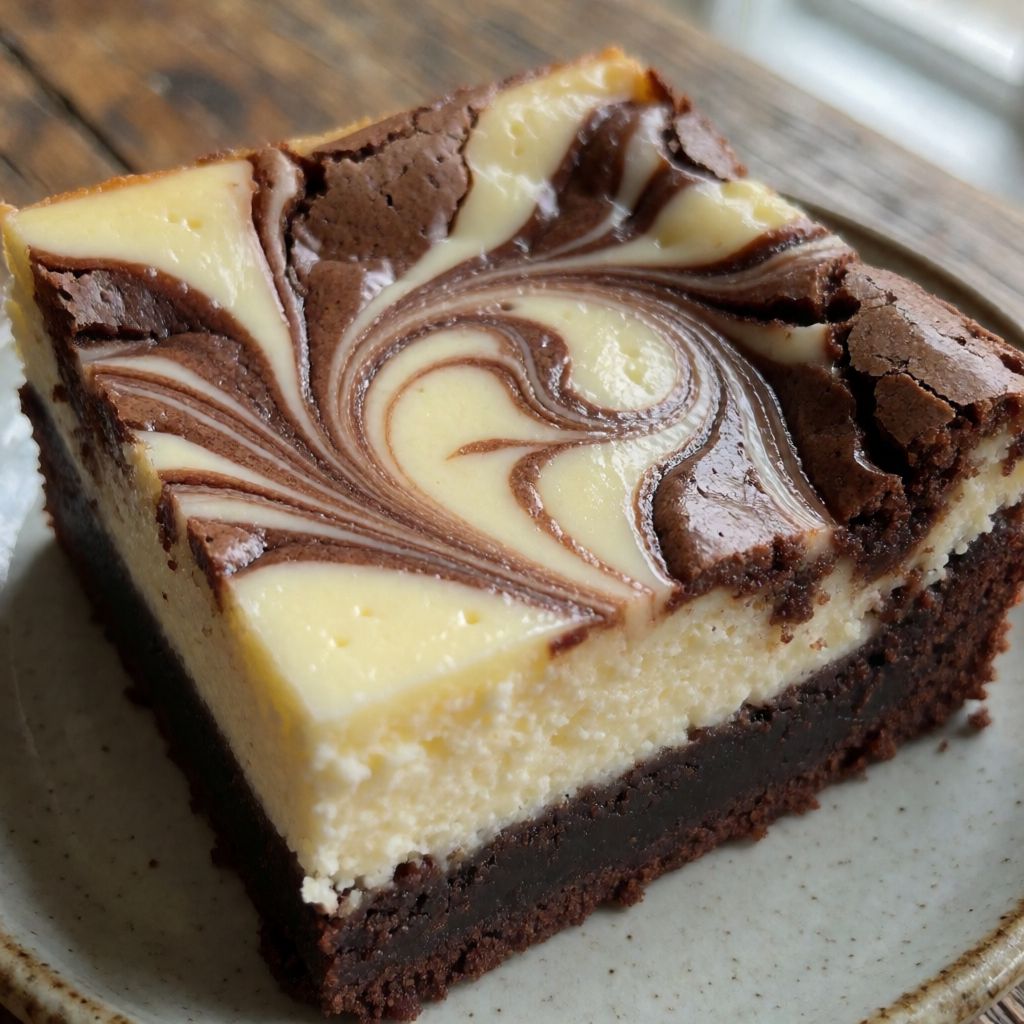
 AI photo
Cheesecake Brownie
A fudgy chocolate brownie swirled with a creamy cheesecake layer, baked together and cut into neat squares.
Labels are worked out automatically from the ingredients and can be wrong. Check the packaging if it matters to you.
Ingredients
- 200 g Cream cheese
- 1 pcs Egg yolk
- 50 g Caster sugar
- 170 g Dark chocolate
- 120 g Butter
- 200 g Caster sugar
- 120 g Plain flour
- 3 pcs Eggs
- 1 pinch Salt
- 1.5 tbsp Cocoa powder
- 120 g Dark chocolate chopped









Steps
Melt the chopped butter and broken dark chocolate together in a bain-marie until thick and smooth.
Add the sugar to the chocolate-butter mixture, stir and leave to cool for a few minutes.
Add the room-temperature eggs, beat well, then gradually fold in the cocoa powder, plain flour and salt.
Add the chopped dark chocolate, mix and set the batter aside.
Beat the egg yolk with the caster sugar until pale and fluffy, then add the cream cheese and mix until smooth.
Line a baking tin with parchment and pour in half of the chocolate batter.
Spoon half of the cheese mixture in 5 dollops over the chocolate batter.
Cover with the remaining chocolate batter, smooth it out, then add the cheese mixture in 5 more dollops.
Lightly swirl the two batters together with a spatula and smooth the surface.
Bake the cheesecake brownie in the oven at 160°C for about 50 minutes.
50 minCheck with a skewer that it is done, let the dessert cool, then cut into 16 small squares.
What was changed
In the ingredient list, bell pepper was replaced with Egg yolk, since the steps clearly call for an egg yolk for the cheesecake layer.
A brownie is a cake that failed to rise and got loved for it. That's the whole mechanism here: you want the eggs to trap just enough air to hold the crumb together, and no more. Whip them in too enthusiastically, or add too much flour, and you've made a chocolate sponge — pleasant, maybe, but not what this is. The flour here (120 g against 170 g chocolate and 120 g butter) is there to give the batter a spine, not to leaven it. There's no raising agent at all. That's not an oversight — it's the point.
What decides whether this works is what happens on top of that brownie base: the cream cheese dollops. Don't fold them in. The swirl you see on the surface is cosmetic — underneath, you want two distinct textures, a dense fudgy chocolate layer and a cool tangy cheese layer sitting in pockets through it. If you overmix at step 9, you get a uniformly beige-brown cake with none of the contrast, and you've basically made a worse chocolate cake with cream cheese diluted through it for no reason.
Start with the fat-and-chocolate bain-marie in step 1. This isn't about melting chocolate neatly — you could do that in a microwave in thirty seconds. It's about controlling the temperature so the chocolate doesn't seize and the butter emulsifies into it rather than separating. A direct flame under the pan risks exactly that: chocolate that goes from glossy to grainy in about four seconds because a sugar-and-fat mixture scorches far below water's boiling point, which is why the bain-marie — water underneath, never touching the bowl above — exists at all. In a British kitchen this is a heatproof bowl over a pan of simmering water, nothing more exotic than that.
Dark chocolate: look for something around 60-70% cocoa solids. Much higher and the bitterness fights the sugar instead of balancing it; much lower (your everyday milk-adjacent "dark" bar) and you'll need to cut the added sugar or the whole thing turns into fudge. If you've only got chocolate chips meant for baking, fine — they melt predictably, which is more useful here than flavour complexity.
The butter should be unsalted, because you're adding your own pinch of salt later and want to control it — and it should go in cold-but-choppable, not melted ahead of time, so it melts in step with the chocolate rather than racing ahead and splitting into oil.
Eggs come in two forms here and they're doing different jobs. Three whole eggs, room temperature, go into the brownie batter at step 3 — room temperature because a cold egg dropped into warm melted chocolate-butter will seize small lumps of fat before it has a chance to emulsify, same mechanism as the bain-marie, just at the other end. The fourth egg is split: just the yolk, for the cheese layer. The yolk carries fat and emulsifying lecithin without the white's water and protein, which is exactly what you want in a dense, custardy cheesecake swirl — a cheesecake made with whole egg bakes lighter and more souffléd, which is wrong for this.
Cream cheese: full-fat, plain, nothing with gelatine stabilisers added for spreadability (those set differently in the oven and can turn rubbery). If you can't get it, a thick Greek yogurt strained an hour through muslin gets you close on tang, though you lose a bit of richness.
Cocoa powder at only 1.5 tablespoons is a flavour top-up, not the chocolate source — the real cocoa mass comes from the 170 g + 120 g of dark chocolate. Don't be tempted to swap more cocoa powder in for chocolate to save money; cocoa powder has had its fat removed, and that fat is half of why a brownie is fudgy rather than dry.
On the tin: line it properly, because this batter is loose going in and the cheese layer weeps a little fat and moisture as it bakes — an unlined tin means you're prising a stuck, two-textured cake off metal, and the swirl pattern you worked for tears apart in the process. A domestic oven running a touch hot or cold compared to its dial is normal; the skewer test in step 11 is there precisely because the clock can't account for that, only your own oven's quirks can, and that only comes from baking it more than once.