
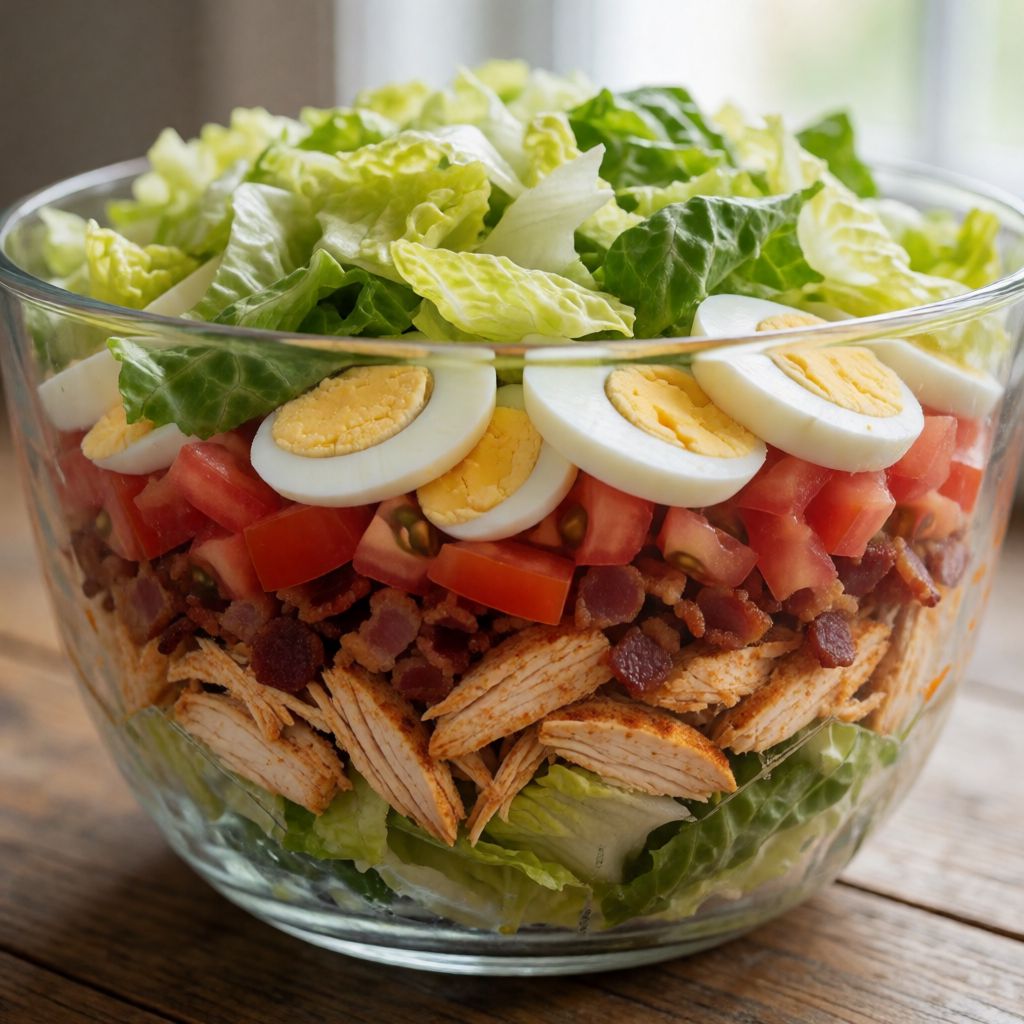
 AI photo
Layered Chicken and Bacon Salad
A layered salad with chicken, bacon, eggs, avocado and blue cheese, finished with a honey-mustard vinaigrette.
Labels are worked out automatically from the ingredients and can be wrong. Check the packaging if it matters to you.
Ingredients
- 2 pcs Chicken breast
- 1 pinch Smoked paprika
- 4 pcs Eggs
- 150 g Bacon
- 200 g Tomato halved
- 1 pcs Romaine lettuce roughly chopped
- 2 pcs Avocado diced
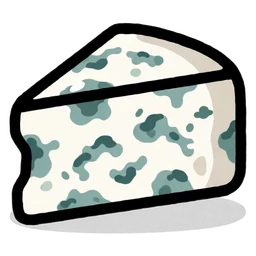
- 100 g Blue cheese crumbled
- 1 bunch Chives finely chopped
- 1 tsp Olive oil
- Salt
- Black pepper freshly ground








For the vinaigrette
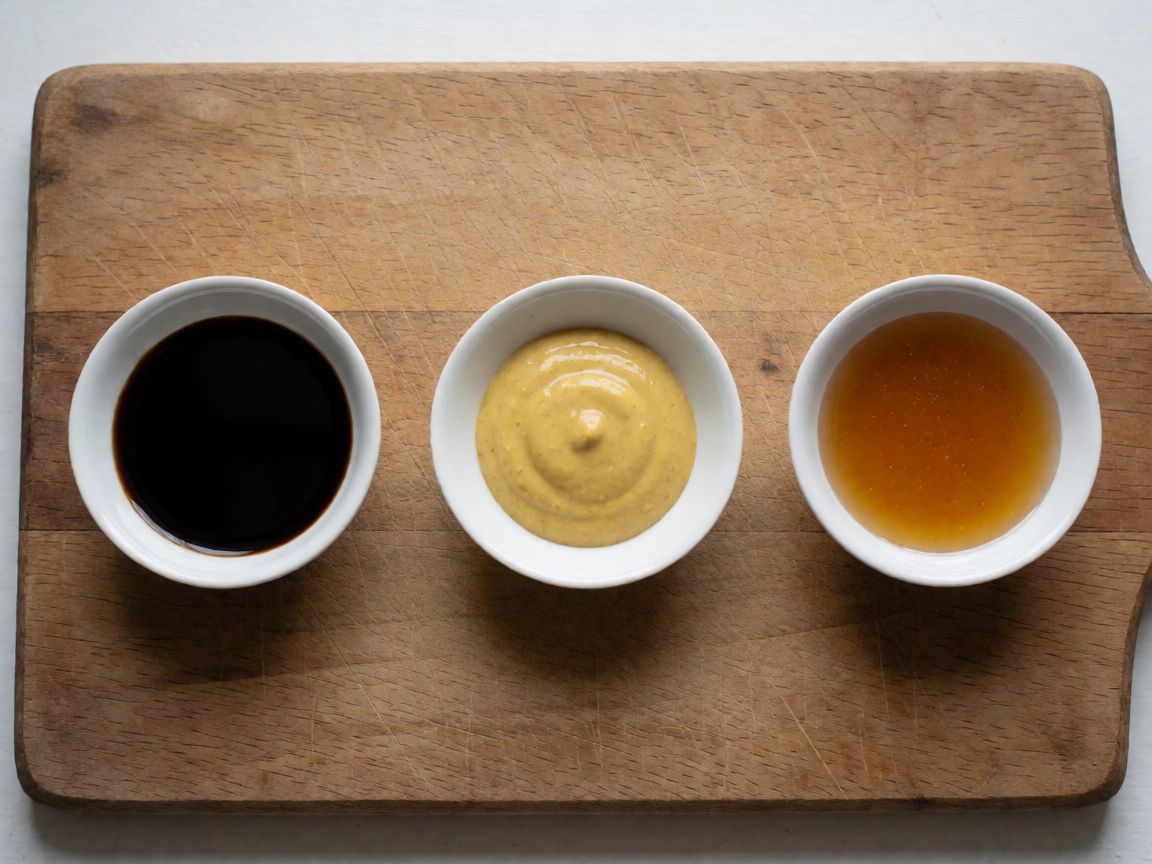
- 50 ml Olive oil
- 50 ml Balsamic vinegar
- 2 tsp Dijon mustard
- 1 tsp Honey
- Salt
- Black pepper freshly ground



Steps
Season the chicken with salt, pepper and smoked paprika and place on a baking tray lined with parchment. Roast at 225°C for about 20 minutes until the skin is crisp.
20 minBoil the eggs for 8 minutes, cool in cold water, peel and quarter them.
8 minFry the bacon in a pan until crisp, remove and chop roughly.
For the vinaigrette, whisk together the olive oil, balsamic vinegar, mustard and honey, then season with salt and pepper.
Arrange the salad on a large platter, laying out all the ingredients in separate groups. Drizzle with the vinaigrette and sprinkle with chives.
This is not really a salad, it's a cold buffet pretending to be one dish — the American "Cobb" idea, where the whole point is that nothing touches anything else until the fork does. You lay chicken, egg, bacon, tomato, avocado, lettuce, blue cheese in their own stripes on a platter, and the eating is the mixing. Do it in a bowl tossed together and you've made something else — a chopped salad, fine, but not this one. The logic is visual and textural: four or five things that would turn to mush if you dressed them an hour early stay crisp, bright and separate until the last moment.
What decides whether it works is heat control on two fronts, chicken and egg, because everything else is assembly. The chicken breast is the one component that can go from good to dry while you're not looking — breast meat has almost no fat to buffer overcooking, so a high oven and a short clock matter more here than in anything with a kazan or a slow braise behind it. The egg is the other clock: eight minutes from boiling water gives you a yolk that's set at the rim and still soft-dark gold in the centre, not the grey-ringed hard-boiled egg people default to because nobody told them eggs have a window too.
Take the chicken breast first, because it's the thing most likely to disappoint you. Smoked paprika under salt and pepper isn't decoration — it's a workaround. You're not building the slow, real smoke of a fire here, you're buying a hint of it in a jar, and that's an honest trade for a domestic oven that has no live flame to speak of. 225°C with the skin on, uncovered, is there to render the fat under the skin fast enough that it crisps before the meat underneath dries — a lower oven would leave you with flabby skin and overcooked flesh, because the two need different speeds to both finish right. If your oven doesn't reliably hit 225°C, or runs hot in spots, the cue that matters more than any clock is the skin: it should look tight and gone gingery-brown, and the thickest part of the breast should give slightly to a press, not feel rigid. Rigid means you've already lost the moisture.
The eggs: eight minutes from a boil, then straight into cold water. The cold water isn't just to stop them burning your fingers — it stops the yolk's cooking by its own residual heat, which is the usual reason people end up with that dull green-grey ring around a yolk that's gone from gold to ash. Cooled fast, the yolk stays amber. Quarter them only once fully cool, or they'll smear instead of cut.
Bacon needs no instruction beyond "crisp," because that's not a time, it's a state — the fat has to render out and the meat has to tighten and curl, and a pan with no added oil does that on its own once it gets going, since bacon carries its own fat. Don't crowd the pan; too many rashers at once steam each other instead of frying, and you get limp, pale bacon that never crisps no matter how long you leave it. That's the defect traced to its cause: it isn't under-time, it's over-crowding.
Avocado and tomato want almost no handling — avocado diced just before serving, because cut avocado begins browning the moment air hits the flesh (that's oxidation, nothing to do with freshness going off, and a squeeze of the vinaigrette's acid slows it). Romaine stays roughly chopped and raw for the crunch underneath everything softer; it's the one component doing structural work, holding air and space between the heavier ingredients so the whole platter doesn't collapse into a wet heap.
Blue cheese: crumbled, not melted into anything, because its whole job is sharp little hits against the sweetness of the honey in the dressing and the fat of the avocado. If blue cheese isn't your thing or isn't in the fridge, any firm, salty, assertive cheese does the same contrast work — a mature cheddar, crumbled rather than sliced, will do it differently but it will do it.
The vinaigrette is simple arithmetic, not alchemy: oil for body, balsamic for acid, mustard to hold the two together so they don't split back into oil-and-vinegar the moment it sits, honey to round off the vinegar's sharpness. Use any oil with no smell of its own — a flavourless light olive oil, a plain vegetable or rapeseed oil, anything that won't fight the balsamic. If you've only got cheap vinegar with no depth, the honey is doing more work than usual, so taste before you add it all.
Patience here isn't about long cooking — it's about not rushing the plating. Let the chicken rest a few minutes off the heat before slicing, so the juice stays in the meat rather than on your board. Let the platter sit assembled for a minute before you pour the dressing, so you can actually see the groups before they're glistening and harder to judge. This dish feeds four as a proper lunch, less if it's sitting alongside something else — think of it the way you'd think of cold cuts after a Sunday roast, a spread you build rather than a pot you stir.