
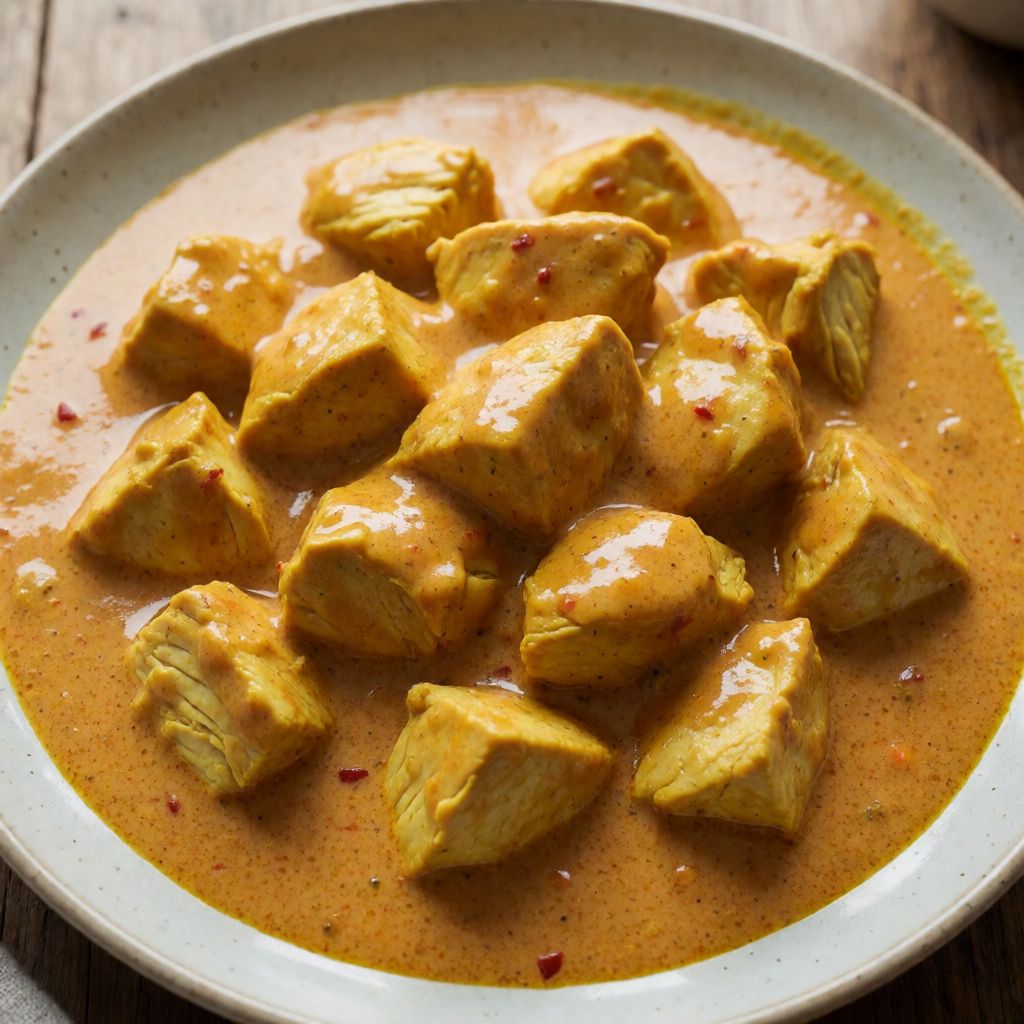
 AI photo
Chicken in Mild Creamy Curry Sauce
A gently spiced chicken curry with coconut milk, tomato and almonds, served with basmati rice.
Labels are worked out automatically from the ingredients and can be wrong. Check the packaging if it matters to you.
Ingredients
- 500 g Chicken breast cut into cubes
- 1 tbsp Garam masala
- 0.5 tsp Chilli flakes
- 1 tsp Turmeric
- 4 clove Garlic finely chopped
- 1 tbsp Ginger
- 1 pcs Lime
- 100 ml Greek yogurt
- 2 pcs Red onion cut into thin wedges
- 75 g Tomato paste
- 400 ml Coconut milk
- 65 g Almonds
- 1 tbsp Coconut oil or olive oil
- Salt
- Black pepper freshly ground
- 1 bunch Coriander fresh
- 400 ml Basmati rice

















Steps
Start well ahead, as the chicken needs a long time to marinate.
Mix all the marinade ingredients and coat the chicken pieces thoroughly.
Put the chicken in the fridge and let it marinate for 12–24 hours.
Before serving, melt the coconut oil in a pan and fry the red onion until soft.
Add the marinated chicken pieces and fry, stirring.
Add the tomato paste and coconut milk, cover and simmer for 30 minutes.
30 minStir in the chopped almonds and season with salt and freshly ground black pepper to taste.
Serve in deep bowls with rice, sprinkled with roughly chopped coriander.
This isn't a "curry" in the restaurant sense — no curry powder, no fierce chilli heat. It's a yoghurt-marinated chicken finished in coconut milk and tomato paste, and the whole dish is built on one quiet mechanism: acid and dairy breaking down protein slowly, over hours, not minutes.
What decides whether this works is the marinade time, not the cooking time. Yoghurt's lactic acid and lime's citric acid loosen the muscle fibres in the chicken breast — breast is lean and has nothing to protect it from drying out, so this step is the only insurance you've got. Twelve hours is the floor, not a suggestion you can skip to 2 hours because you're hungry now. Some say marinating chicken overnight "does nothing extra after the first hour" — no, because yoghurt's acid works at a crawl compared to a sharp vinegar or lemon marinade; it needs the long soak precisely because it's gentle enough not to turn the surface mushy before the inside is touched.
The second thing that decides the result is what happens to the onion before anything else goes in the pan. Red onion fried until it goes soft and faintly sweet — not browned hard, not caramelised to jam — builds the base the sauce needs. Push past "soft" into "crisped at the edges" and you've started building bitterness into a sauce that's supposed to stay mild and rounded.
Garam masala, turmeric, chilli flakes, garlic and ginger go into the marinade, not the pan later — this is the one myth worth naming here. People assume spices "cook" and release flavour mainly through heat in oil. Some do. But ground spices sitting in yoghurt for half a day are also doing slow, fat-soluble and acid-soluble extraction into the chicken itself, not just coating the surface. That's why this dish tastes seasoned all the way through rather than just sauced on top — the spice is inside the meat before it ever meets a flame.
Turmeric specifically needs fat or time to release its colour and flavour properly rather than just dusting the surface yellow — the yoghurt's fat content does that job here. If you're using a very low-fat yoghurt, you're working against yourself; full-fat Greek yoghurt isn't a luxury choice, it's doing chemistry.
Chicken breast is the cut here because it's quick-cooking and lean — fine, as long as you respect that leanness means low tolerance for overcooking. If you'd rather not fuss over dryness, thigh meat is the honest substitute: more forgiving, slightly richer, and nobody will mark you down for it. The marinade matters more for breast than thigh precisely because thigh has its own fat to fall back on.
Coconut milk is not a flavour choice you can swap lightly for cream — it's doing two jobs, richness and a specific way of thickening that dairy cream doesn't replicate (it has its own fat structure that behaves differently under heat, less likely to curdle under acid from the tomato paste, more likely to split if boiled hard). If you've genuinely no coconut milk, a single or double cream will get you close on texture but you lose the faint sweetness underneath, and the dish stops being this dish and becomes something adjacent to it.
Almonds at the end, not the start — raw or lightly toasted and chopped, not ground to a paste. Add them early and simmering strips their crunch and turns them soft and unremarkable; stirred in right before serving they're doing the job flaked almonds do on a trifle — a last textural contrast against all that softness in the sauce.
Tomato paste rather than fresh tomatoes is a concentration choice, not a tradition for tradition's sake: paste gives body and acidity in a small volume without watering the sauce down the way fresh tomatoes releasing their juice would. If tomato paste is all you've got in the cupboard at the back from a different recipe, that's fine — it's exactly what belongs here.
On a domestic hob, "cover and simmer" means what you'd expect it to mean without a lid that fits properly: a loose lid, or honestly a plate balanced over the pan does the job of trapping enough steam without you needing to seal anything. You're aiming for the chicken cooked through and the sauce thickened enough to coat a spoon, not reduced to nothing — thirty minutes is where you start checking, not where you stop the clock blindly. Basmati rice alongside needs nothing clever: rinsed until the water runs clear removes surface starch and is what keeps the grains separate rather than gluey, and that's worth doing regardless of what curry it's sitting under.