
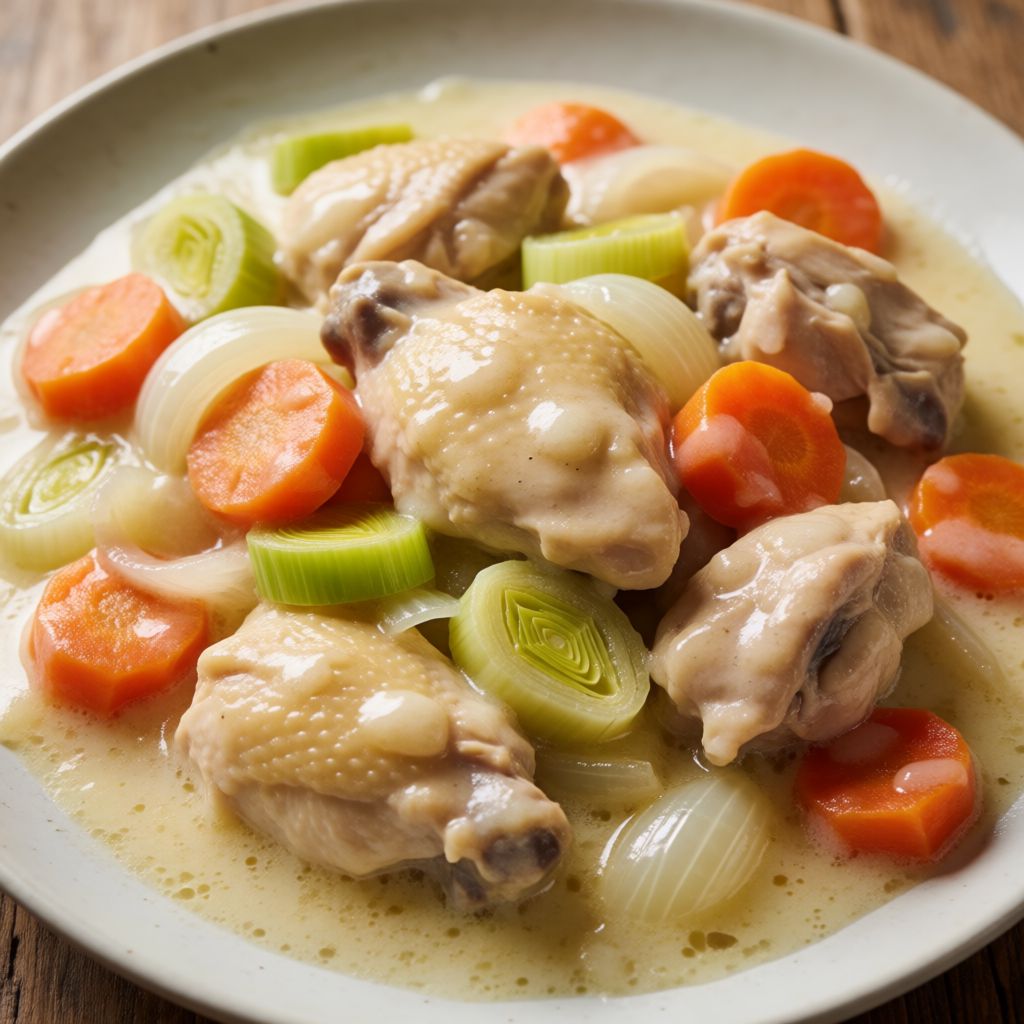
 AI photo
Chicken Fricassee
A classic chicken fricassee: a whole chicken simmered into a rich broth, then folded with vegetables into a creamy sauce.
Labels are worked out automatically from the ingredients and can be wrong. Check the packaging if it matters to you.
Ingredients
- 1 pcs Whole chicken (boiling fowl)
- 1.5 l Water
- 100 ml Wine
- 1 pcs Onion cut into quarters
- 2 pcs Carrot diced
- 1 pcs Leek diced
- 2 pcs Bay leaf
- 4 pcs Parsley
- 10 pcs Black peppercorns
- 1 tbsp Salt
- 50 g Butter
- 4 tbsp Plain flour
- 100 ml Double cream
- Salt to taste
- 250 g Carrot diced
- 1 pcs Leek thinly sliced
- 250 g Peas fresh
- 100 ml Dill fresh
- 1 kg Potato















Steps
Prepare the boiling fowl, put it into a large pot with water and bring slowly to the boil over medium heat.
Skim the foam off the surface a few times so the broth stays clear.
Add the wine, onion, carrot, leek, bay leaf, parsley, peppercorns and salt. Cover with a lid.
Simmer gently for 1 hour, skimming foam and impurities off the surface from time to time with a spoon.
60 minRemove the chicken from the pot. Strain the broth through a fine sieve into a bowl, discarding the vegetables and spices.
Separate the meat from the chicken and set it aside.
Boil the diced carrot and leek in a pot of salted boiling water for 5 minutes, then drain.
5 minAt the same time, boil the potatoes in salted water until cooked through.
Melt the butter in a pot, stir the flour into the melted butter.
Gradually pour in the chicken broth, stirring, until the sauce turns creamy.
Simmer the sauce for a few minutes, add the cream, and season with salt and pepper.
Bring back to the boil and, if needed, adjust the consistency with a little more broth.
Add the leek, carrot, peas and chicken meat to the sauce, and heat through well for 1–2 minutes.
2 minAdd the finely chopped dill and serve with new potatoes.
What was changed
Whipping cream was replaced with Double cream, the cream commonly used in UK kitchens.
A fricassee is a Sunday roast's quieter cousin — the one that doesn't need an oven and doesn't care if the bird is tough. You're not grilling or roasting a chicken here, you're dissolving one. Water, low heat, patience: the connective tissue in an old boiling fowl needs long, gentle simmering to turn to gelatine, and that gelatine is half the reason the final sauce has body instead of being just flour-thickened water. Use a young supermarket chicken and it falls apart stringy before the broth has any depth — this dish wants an old bird, or at least a long cook, because it's built on extraction, not on quick protein coagulation.
What decides whether it works is the broth, full stop. Everything after — the roux, the cream, the vegetables — is dressing. If you rush the first hour, skip the skimming, let it boil hard instead of shiver, you get a cloudy, slightly bitter liquid and no amount of cream fixes that later. "Simmer gently" isn't fussiness; a rolling boil emulsifies the fat and scum back into the liquid instead of letting you lift it off, which is exactly why the surface turns grey and murky. Skimming isn't a chef's affectation, it's garbage removal.
The fowl itself: look for "boiling fowl" specifically if your butcher has it, which in Britain increasingly means asking rather than finding it on the shelf — supermarkets mostly sell young roasters now because a bird bred for quick growth is cheaper to produce. An old laying hen, the kind this method was actually built for, has worked muscle and a different ratio of connective tissue to meat, and that's what gives you a broth with real savour and a bit of natural gelatine, not just chicken-flavoured water. If all you can get is a standard whole chicken, it still works — you just won't get quite the same depth, and the meat will be ready well before the hour mark, so don't leave it in the full hour or it turns to cotton wool. Some say you must use an old fowl or the dish "isn't authentic" — no, because the method was never about ceremony, it was about using up the hens that had stopped laying and were too tough to roast. This is frugality turned into technique, not a rule handed down from on high.
The aromatics — onion, carrot, leek, bay, parsley, peppercorns — are a bouquet, not a soup. They flavour the water and then get thrown away, which feels wasteful the first time you do it until you realise their job was already done the moment the broth took their flavour; cooked-out vegetable at that stage has given everything it has and tastes of nothing. Don't be tempted to keep them for the final dish.
The wine: it's there for acidity and a bit of aromatic lift in the broth, not for alcohol content — by the time it's simmered an hour it's long gone as alcohol. Any dry white does it; you're not looking for a wine worth drinking on its own, you're looking for something without sweetness that won't throw the broth off balance. If you have none, a spoon of wine vinegar or even a squeeze of lemon added with the water does similar work, just gentler — add less, taste as you go.
Butter and flour, equal-ish weight, is just a British roux, the same base under a hundred white sauces this country makes — it's cheap, stable, and doesn't need a culture of long reduction the way a French velouté built from stock alone would. If you want it dairy-free or lighter, any neutral oil with no smell of its own — sunflower, a mild vegetable oil — works for the roux stage, though you lose a little of the roundness butter gives; olive oil would fight the delicate chicken flavour, so leave it for other dishes.
Double cream rather than single or that pourable stuff from the fridge door is about fat content holding together under heat — single cream is more likely to thin out and even split if the sauce gets too enthusiastic near the boil. If you only have single cream, add it off the heat, right at the end, and don't let the pot boil again after.
The second batch of carrot and leek, boiled separately and briefly, is there to stay carrot-shaped and leek-shaped — not stewed to mush in an hour-long broth like their first-round counterparts. You want a bend when you press a piece between fingers, not a snap, and not a collapse either; "5 minutes" in the method is a floor, not a verdict — a kitchen's idea of medium dice varies, so test by feel. Fresh peas, if you're lucky enough to catch a short English pea season, need barely any more than the two minutes of final heating-through the method gives them; frozen peas, which is what most of us reach for most of the year, are already blanched at the factory and need even less — they're there to warm, not to cook.
New potatoes on the side rather than in the pot is a texture decision as much as a traditional one: cooked separately they keep a bite, and more practically, a waxy potato — Jersey Royals when they're in season, Charlotte or Maris Peer the rest of the year — holds its shape in salted water where a floury baking potato would break down and cloud everything it touches. Dill at the very end, off the heat or barely on it, because dill's whole appeal is a fresh, slightly anise-y brightness that a few minutes of simmering turns into something flat and hay-like — treat it like a seasoning you add at the table, not an ingredient you cook.
On equipment: no kazan, no lidded casserole the size of a bucket needed — a wide pan and a big stockpot from under the stairs does the broth stage fine, and any lid that more or less fits counts; a plate over the pot works in a pinch if your lids have all wandered off to other cupboards. The only thing your domestic hob genuinely can't give you that a slow-simmering range can is dead-even, barely-there heat for an hour without you checking it — so check it, turn it down if you see it climbing to a boil, and treat that hour as the one non-negotiable patience charge in the whole dish. Everything after the broth is strained moves fast; the broth itself is where all the waiting lives.