
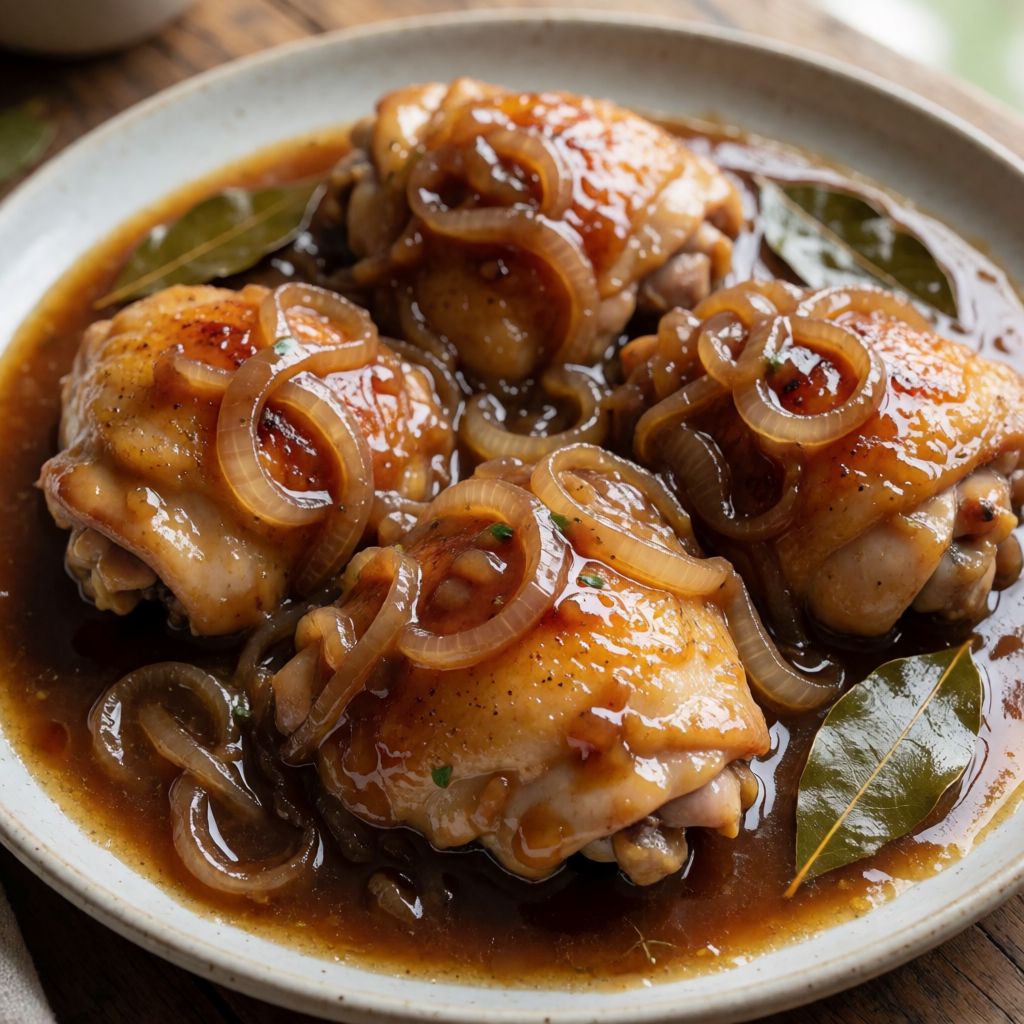
 AI photo
Chicken in Beer Sauce with Caramelised Onions
A cosy braise of chicken drumsticks in dark beer, finished with honey and a pile of sweet caramelised onions.
Labels are worked out automatically from the ingredients and can be wrong. Check the packaging if it matters to you.
Ingredients
- 5 pcs Chicken drumsticks
- 0.5 l Dark beer
- 2 pcs Bay leaves
- 1 clove Garlic
- 2-3 tbsp Honey
- 0.5 pcs Onion for the main sauce
- Salt to taste
- Black pepper to taste
- Olive oil to taste
- 2-3 pcs Onion for caramelising
- Sugar to taste










Steps
Heat olive oil in a pot, add the onion, bay leaves and garlic, and fry until golden
Add the chicken drumsticks, season with salt and pepper, and brown
Pour in the dark beer, let it reduce, then cook covered for 30 minutes
30 minHeat olive oil in a pan, add the sliced onion and fry over high heat
Lower the heat, add salt, and cook the onion gently until soft
Raise the heat, add sugar, and caramelise the onion until done
Add honey to the chicken and raise the heat so a glaze forms
Pour in cold water, stir, then plate the onion and chicken and spoon over the sauce
What was changed
Chicken drumsticks were matched to Chicken drumsticks because the catalogue has no separate drumstick entry, so the closest poultry cut was used.
This is a pot of drumsticks braised in dark beer until the liquid turns into something between a gravy and a glaze, served under a tangle of onions cooked down to a deep bronze. It is not a stew in the thick, flour-bound Sunday-roast sense — there's no roux here, no thickener. The sauce gets its body from reduction and from honey, and that's the whole trick: you are evaporating water and concentrating sugars and bitterness until they bind themselves.
What decides whether this works is heat control at two separate moments, not one. First, when the beer goes in: it has to bubble hard enough to drive off the raw-grain bitterness and the alcohol, but not so hard that it scorches onto the bottom of the pot before the chicken is done. Second, when the honey goes in at the end: this is a deliberate uncovering and raising of the heat, because honey left under a lid just steams and dilutes — it needs open air and visible bubbling to tighten into a glaze that coats rather than puddles.
Dark beer here is doing the job stock would do in a French braise, but cheaper and with its own agenda. It's bitter from the hops and sweetish-roasted from the malt, and thirty minutes of gentle simmering under a lid burns off most of the alcohol and softens the bitterness into something closer to malt syrup. Use a stout or a dark ale with real character — Guinness works, any British dark ale with a roasted-grain smell works. A beer with no flavour of its own, a pale lager, will leave you with a thin, flat sauce; there's nothing there to reduce down to. If you don't drink beer or don't have it, the honest substitute is a dark, slightly sweet stock with a spoon of molasses or dark sugar stirred in — not a perfect copy, but it respects the same logic: bitterness plus sugar, reduced.
The chicken is drumsticks specifically because they survive thirty-plus minutes of simmering without drying into string, thanks to the bone and the connective tissue running through the meat. If you only have breast, you'll need to pull it earlier and finish it in the glaze rather than the long simmer — breast doesn't forgive the same way. Brown it properly before the beer goes in, not for looks, but because that crust is where the sauce gets its savoury backbone; skip it and the sauce tastes like boiled chicken with beer added, which is a different and worse dish.
Honey is not a sweetener in the jam sense here — it's the glazing agent, the thing that lets the sauce cling to the meat instead of running off it like gravy. Any runny honey will do; a very set, crystallised honey just takes longer to dissolve in, so warm it slightly first if that's what you've got. Two to three tablespoons is a guide, not a law — taste the sauce before you commit, because beers vary wildly in bitterness and you're balancing against whatever's in the pot, not against an abstract recipe.
The garlic and bay in step one are there to perfume the oil before anything else touches it — oil carries flavour better than water does, so infusing it first means that aroma rides through the whole dish rather than sitting on top as an afterthought. One clove and two bay leaves is restraint, not stinginess: this isn't a garlic dish, it's a beer-and-onion dish with garlic in the background.
On the caramelised onions: two to three onions will collapse down to what looks like barely enough, and that's correct — raw onion is mostly water, and water is exactly what you're cooking out. Some say you should add sugar at the start to "help" caramelisation — no, because sugar without the onion's own moisture already driven off just scorches on contact with a hot pan while the inside stays raw and sharp. Let it go soft first on a gentler heat, patience spent here is patience you don't get back later, then push the heat up and let sugar do the last, fast work of colouring it properly bronze, not pale gold and not burnt.
The cold water stirred in at the very end, after the honey glaze has tightened, is a small rescue move: honey over high heat can seize up faster than you expect, going from glossy to sticky-tight in under a minute, and a splash of cold water lets you pull it back to a pourable sauce without diluting all the work you just did. Keep a cup of water by the pot for that moment — it's cheaper insurance than scraping burnt honey off a pan afterwards.