
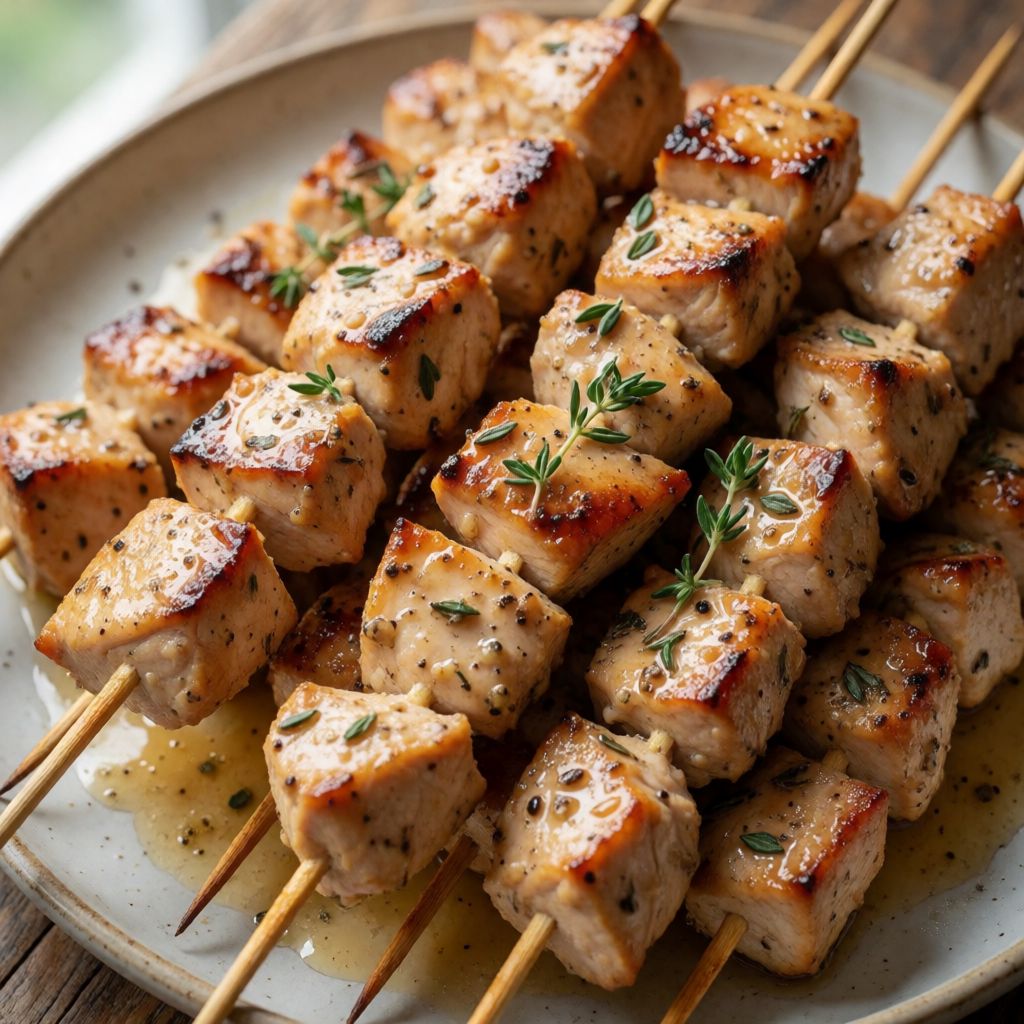
 AI photo
Chicken Skewers in Lemon Marinade with Garlic Butter
Juicy chicken skewers marinated in lemon, thyme and garlic, then brushed with a rich garlic butter sauce.
Labels are worked out automatically from the ingredients and can be wrong. Check the packaging if it matters to you.
Ingredients
- 3 tbsp Olive oil
- ½ pcs Lemon finely grated zest and juice
- 1 tsp Dried thyme
- 2 clove Garlic finely grated
- Salt
- Black pepper freshly ground
- 600 g Chicken breast cut into long thin strips
- 75 g Butter
- 2 clove Garlic finely grated
- 3 tbsp Parsley finely chopped
- Black pepper freshly ground
- ½ pcs Lemon finely grated zest
- 50 g Parmesan freshly grated
- 2 tbsp Parsley finely chopped









Steps
Citrus marinade for the chicken: whisk the olive oil, lemon juice, lemon zest, thyme and garlic until smooth, then season with salt and pepper to taste.
5 minCut the chicken breast into strips, mix well with the marinade, cover the bowl and refrigerate for at least 1 hour, longer if possible.
60 minGarlic butter sauce: melt the butter over low-medium heat, add the garlic, parsley, salt and pepper, and season with grated lemon zest to taste.
3 minThread the chicken strips onto skewers in tight ripples, pressing the meat firmly onto the skewers.
3 minHeat a pan or grill to medium-high, brush with oil and cook the chicken skewers on all sides for 4-5 minutes per side, until cooked through.
4 minBrush the hot, freshly cooked chicken skewers with the garlic butter sauce, sprinkle with Parmesan and extra parsley. Pour over the remaining garlic butter sauce and serve immediately.
1 min
Chicken breast, cut thin and threaded in ripples onto a skewer, marinated in lemon and oil, then finished with a garlic-parsley butter and a dusting of Parmesan. It reads fussy on the page and isn't: it's a breast fillet rescued from its own blandness by acid first, fat second. Two separate jobs, two separate ingredients — don't make the marinade do the butter's work or the butter do the marinade's.
What decides whether this works is the cut and the ripple. Chicken breast is lean muscle with almost no marbling, which means it has no internal fat to baste itself with as it cooks — it goes from raw to dry in the time it takes to answer the phone. Cutting it into long thin strips and then threading it onto the skewer in loose folds, not flat and stretched, gives you surface area for the marinade to actually penetrate and for the heat to brown fast without the centre overcooking. A flat, stretched strip cooks through before it browns; a rippled one chars on the folds while the inside stays just set.
The olive oil in the marinade wants to be something with no flavour of its own loud enough to compete with lemon and garlic — a light, fairly neutral oil, extra virgin if that's what's in the cupboard, but it's doing a carrier's job here, not a seasoning one. Any plain vegetable or rapeseed oil does the same work; you lose nothing but a faint grassiness nobody will taste once the garlic and thyme are in.
Lemon zest and juice are two different jobs wearing one name. The juice is acid and water — it seasons but evaporates its flavour fast once heat hits it. The zest is oil-soluble aromatic, the actual citrus smell, and it survives cooking far better. Using both, split between the marinade and the finishing butter, means the dish smells of lemon at the start and at the end, not just once in the middle. If you've only got a tired lemon with thin juice, lean harder on the zest — it's doing more of the real work anyway.
Garlic finely grated rather than chopped or crushed through a press matters more than it sounds: grating it on a fine microplane breaks the cell walls completely and releases the allicin evenly through the oil or butter, so you get garlic flavour without biting into a raw, bitter chunk of it later. Chopped garlic in a quick-cook sauce like the butter one will still taste sharp and unmellowed; grated, it more or less dissolves.
The chicken breast itself is the one ingredient with no real substitute if you want this exact dish — thigh meat would survive the heat better, since it carries fat and connective tissue breast doesn't, but it won't take the ripple-skewer shape the same way and it cooks unevenly in thin strips. If you're nervous about dryness, thigh fillet, trimmed, is the honest swap; just expect a slightly different, looser texture on the skewer.
Butter, not oil, for the finishing sauce, because butter brings milk solids and a faint sweetness that plain fat can't, and that's what makes the sauce taste like a sauce rather than just grease. A dairy-free margarine with a high fat content will melt and coat the same way, but you lose that background sweetness entirely — worth knowing before you promise anyone it tastes the same.
Parmesan at the end is doing what salt alone can't: a savoury, slightly sharp finish that cuts through the butter's richness. Any hard, aged grating cheese does the job — a mature Cheddar grated fine, or Grana Padano, will stand in without apology. What won't work is a soft or mild cheese; it'll just melt into the butter and disappear instead of giving you that last bite of sharpness.
On skewers themselves: wooden ones need soaking in water first if you don't want them catching under the grill, and in a UK kitchen without a proper grill or kazan, a wide, heavy frying pan on the hob does the job the recipe asks for — you're after a hard, dry heat that colours the meat fast, not a gentle simmer, so don't crowd the pan or the chicken will steam in its own marinade instead of browning. That's the real enemy here, more than any wrong temperature number: too many skewers in too small a pan, and you get grey chicken instead of gold.
And patience is the one ingredient the recipe states a time for and still expects you to ignore: an hour in the marinade is the floor, not the target. Longer, within the limits already mentioned, means the lemon and thyme have actually travelled into the meat rather than just sitting on its surface waiting for you to get hungry.