
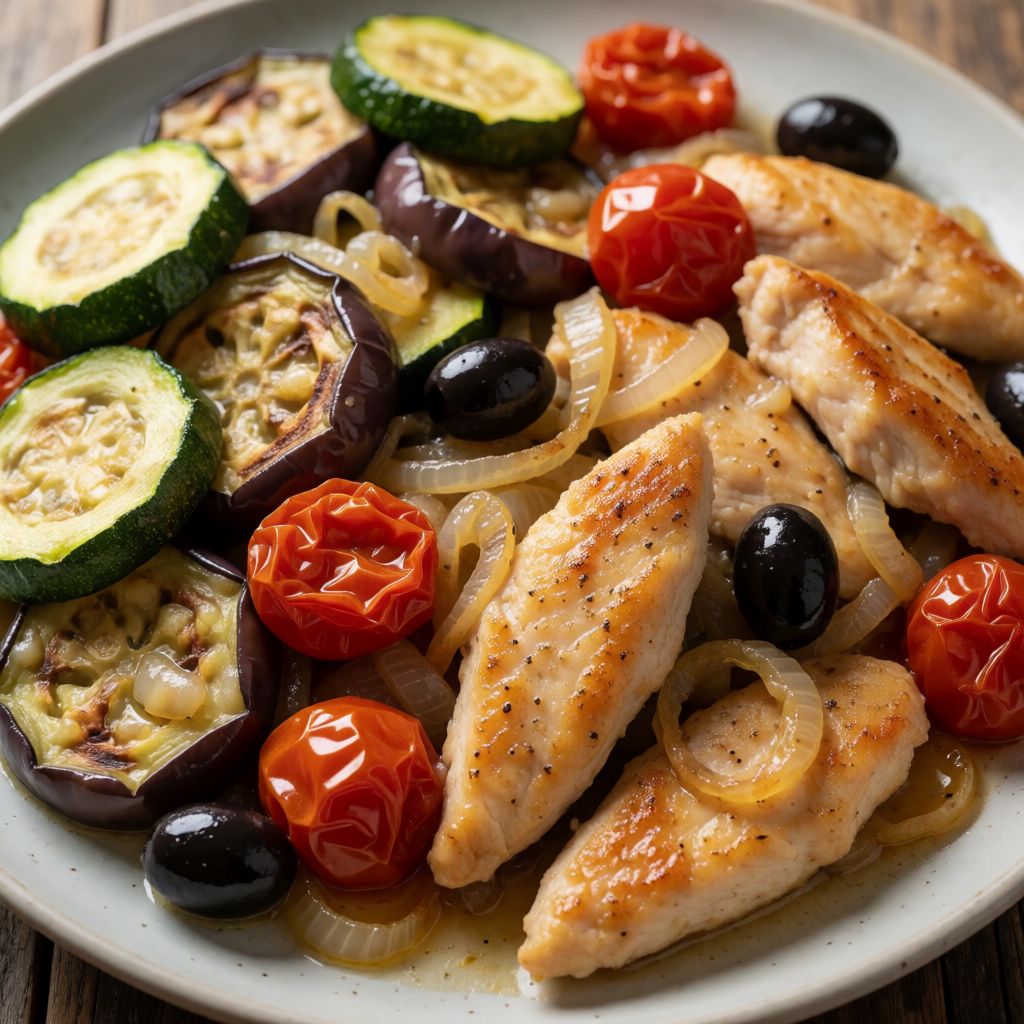
 AI photo
Chicken Strips with Vegetables
Tender chicken breast strips cooked with courgette, aubergine, cherry tomatoes and peppers in a light white wine sauce.
Labels are worked out automatically from the ingredients and can be wrong. Check the packaging if it matters to you.
Ingredients
- 800 g Chicken breast
- 1 pcs Courgette
- 1 pcs Aubergine
- 8 pcs Cherry tomatoes
- 1/2 pcs Onion
- 15 pcs Black olives, pitted pitted
- 1 pcs Bell pepper
- 200 g Mushrooms optional
- Salt to taste
- Black pepper to taste
- Olive oil to taste
- 118 ml White wine
- Plain flour for dusting









Steps
Cut the chicken breast into thin strips and coat in flour.
Cut the courgette and aubergine into cubes, and the bell pepper into thin strips. Cut the mushrooms in half.
Sauté the chopped onion in a little olive oil.
Add the cherry tomatoes, olives, mushrooms and chopped vegetables. Cook for about 8-10 minutes.
9 minAdd the chicken breast, pour in the white wine, season with salt and pepper. Cook until done through (internal temperature 74°C).
Serve hot.
This is a one-pan sauté dressed up as something more complicated than it is: strips of chicken breast, floured, finished in a slosh of white wine, sitting on a heap of courgette, aubergine, pepper, mushroom, olive and cherry tomato that's been cooked down first. It's not a stew and it's not a stir-fry — it sits between the two, and what decides whether it works is sequence, not seasoning.
The vegetables go in before the chicken for a reason that has nothing to do with tidiness. Aubergine and courgette need real time to lose their raw, spongy bite and let their water out; chicken breast needs almost none, and if it goes in alongside the veg it will have given up all its own moisture and turned to cotton wool long before the courgette has softened. So the pan does its slow work first — onion to ginger-gold, not just translucent, because translucent onion still tastes of raw onion — and the chicken arrives late, dusted in flour, to be the quick part of the dish, not the slow part.
The flour on the chicken isn't breading. It's a thin barrier that sets the moment it hits hot fat, sealing the strip so the wine that follows builds a light sauce around it instead of boiling the chicken from the outside while the wine thins out into nothing. Without it you get wet chicken swimming in watery wine; with it you get strips with a little cling to them and a sauce with some body.
Chicken breast: cut into strips, not chunks, because surface area is what cooks it evenly in a short time without the centre lagging behind. If you've only got thigh in the freezer, use it — it's more forgiving of the odd overcooked minute and won't sulk about it, though it won't go pale and tidy the way breast does.
Courgette and aubergine in cubes, not slices: cubes give you a cut face that releases water into the pan rather than a flat side that just sits there steaming in its own skin. Aubergine especially holds a lot of bitterness in its seeds and skin when young pieces are rushed — cutting it small and giving it the full 8–10 minutes (that's a floor, not a target; stop when the cube gives under a spoon instead of resisting) is what gets rid of that, not salting it for an hour first, which is a separate job for a separate dish.
Bell pepper goes in strips because it's the one vegetable here that benefits from staying slightly firm — all-the-way-soft pepper loses its sweetness and turns vegetal in a way nobody's after. Mushrooms halved, not sliced, so they keep some texture against the softer veg; they're marked optional here mainly because mushroom in a UK kitchen means chestnut mushroom from a punnet, fine as it is, but any firm mushroom that isn't watery works — avoid the very white button ones with high water content if you want halves that hold shape rather than collapse to nothing.
Olives and cherry tomatoes are not there for bulk, they're there for acid and salt landing in small bursts rather than mixed through evenly — that's why they go in near-whole. Buy olives already pitted unless you enjoy picking stones out of a hot pan; it changes nothing about the dish, only your patience with it.
White wine: it's doing two things — lifting the flour-fond off the base of the pan into a thin sauce, and adding acid that a tomato-light dish otherwise lacks. Use anything dry and unsweet you'd actually drink a glass of; there's no need for "cooking wine," a category invented mostly to sell bottles that have gone slightly off. If there's no wine in the flat, a splash of dry cider or a squeeze of lemon with a bit of water gets you the acid without the alcohol, though it's a different dish, not a disguised version of this one.
Olive oil: any oil with no smell of its own and a reasonable smoke point does this job — "to taste" here really means "enough to stop things sticking," not a flavour decision, so a light olive oil or a neutral vegetable oil both work; save the good peppery extra virgin for drizzling after, if at all.
On the hob itself: this is a wide pan job, not a kazan job, and that's fine — you want surface area so the vegetables sauté and reduce rather than stew in their own steam in a crowded, deep pot. If your widest pan still feels crowded, do the vegetables in two batches rather than piling them in; a overloaded pan drops its heat and you end up simmering instead of sautéing, which is the actual cause of grey, water-logged veg, not the courgette's fault.