
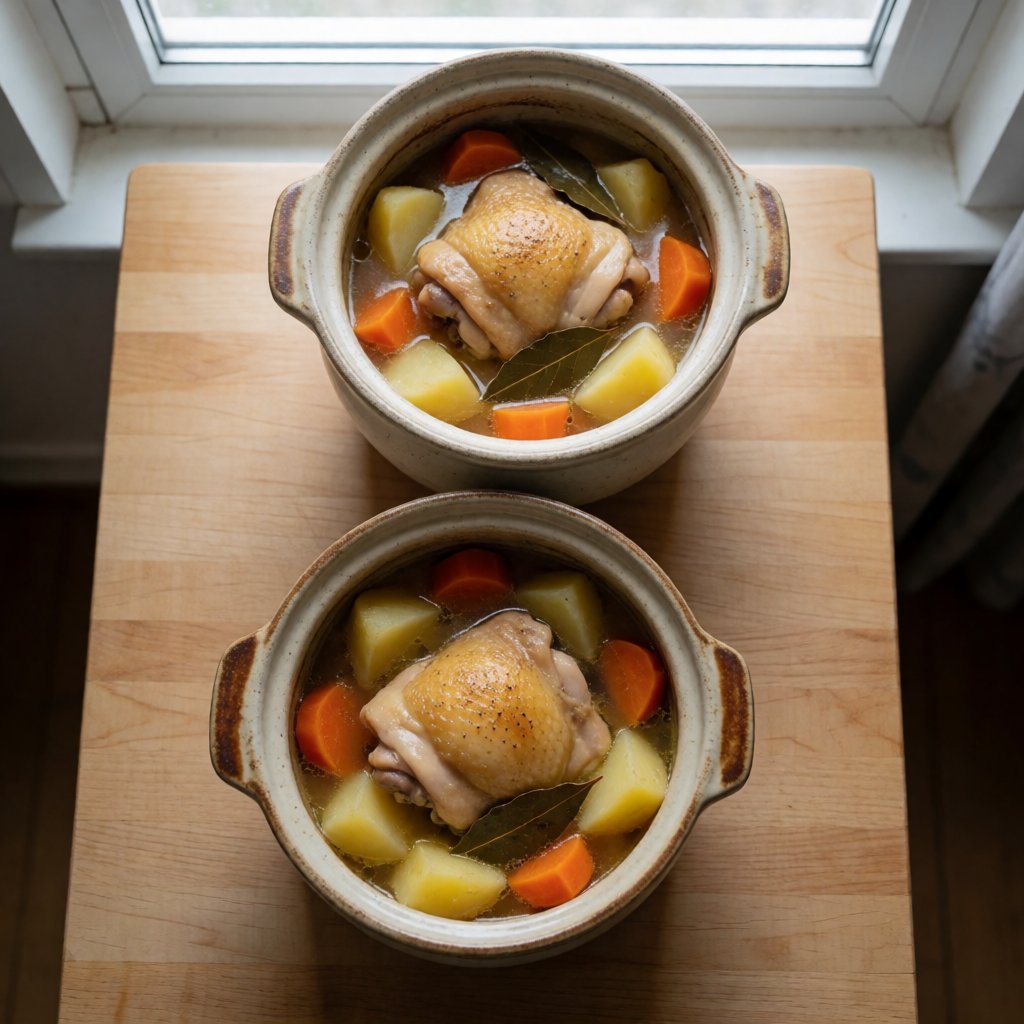
 AI photo
Chicken and Potato Bake in Clay Pots
A comforting bake of chicken thighs, potatoes, carrot and onion, slow-cooked in individual oven pots.
Ingredients
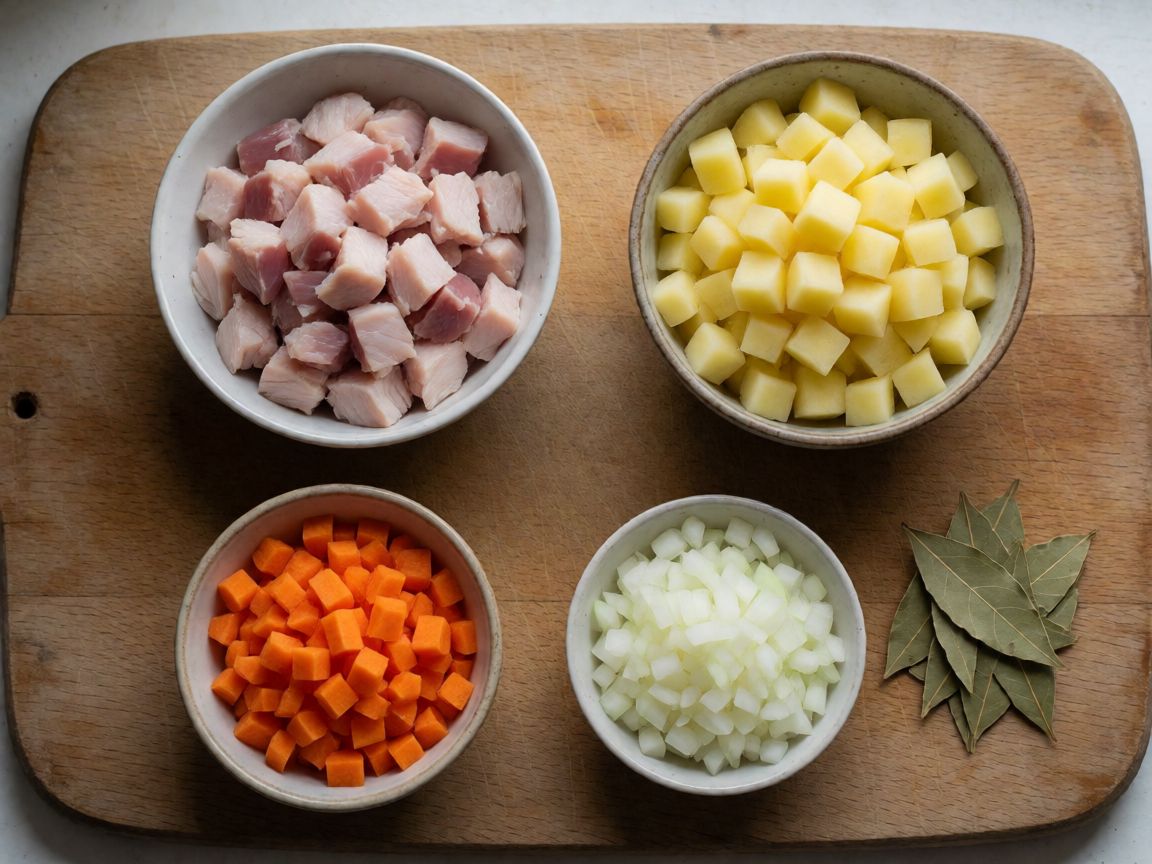
- 300 g chicken thighs boneless, diced
- 300 g potatoes diced
- 1 pcs carrot diced
- 1 pcs onion diced
- 1 pcs bay leaf
- 100 ml water
- 1 pinch salt
- 1 pinch black pepper
- 1 tbsp sunflower oil








Steps
Dice everything, mix with the oil and seasonings, then divide between the pots.
Add the water and cover with the lids.
Put the pots in the oven for 55 minutes, until the chicken reaches 74°C inside.
55 minTake the pots out of the oven.
Do not put pots straight from the fridge into a hot oven — let them come to room temperature first.
This is a braise disguised as a bake. Each little clay pot is its own sealed world: raw chicken, potato, carrot and onion go in together, a splash of water goes in with them, the lid goes on, and the oven does nothing clever except keep everything hot enough for that water to turn to steam and stay there. The chicken never meets dry air — it poaches in its own juices and the vegetables' juices, held in by fired clay and a tight lid instead of by a stock pot and a watchful cook.
What decides whether it works is the seal, not the number on the oven dial. Lose the seal — a loose lid, a chipped rim, a gap you didn't notice — and the steam escapes before it has finished its job. The outside of the meat dries while the middle stays pale, and you've made a slow, dull roast instead of a braise. Keep the seal, and an hour of gentle, trapped heat does what frying and basting usually do by hand: the thigh gives up its fat and connective tissue slowly, the potato goes soft from the inside out, the carrot stops snapping and starts bending.
The warning about not putting a cold pot straight into a hot oven isn't fussiness, it's physics you can't argue with. Clay is baked earth, full of tiny pores holding moisture and air; heat one side faster than the other and it expands unevenly and cracks. Letting the pot come up to room temperature first isn't a step you can skip to save ten minutes — skip it and you lose the pot, not just the dinner.
Thigh, not breast, and that's not a preference, it's arithmetic. Thigh carries fat and connective tissue that needs time and moisture to break down into something soft; by the point its core hits 74°C, that fat has rendered and the collagen has turned to gelatine, so the meat stays wet even after an hour shut in a hot pot. Breast has almost none of that cushion — it would already be dry and stringy well before the hour is up. If breast is what's in the fridge, cut the time back by roughly a fifth and start checking the internal temperature early; don't wait for the clock.
Potato, carrot and onion want cutting to roughly the same size as the chicken, for one plain reason: everything in the pot finishes together, nothing is pulled out early or left to catch up. Dice too small and the potato turns to mush before the carrot has softened; too large and you'll be waiting on a stubborn lump of carrot while the chicken is already done and drying out under the lid.
The bay leaf is doing quiet, slow work — released into steam rather than fried into oil, its flavour is gentler here than in a pan, which suits a dish built on patience rather than quick heat. The water is not a stock and doesn't need to be one; 100 ml is only the seed for the steam, because the chicken and vegetables will add their own moisture as they cook, and that mixture becomes the sauce you spoon out at the end. The oil's job is simply to coat the dice so nothing sticks to clay and to help heat move evenly through the mix — any oil with no smell of its own will do, sunflower, rapeseed, groundnut; save the olive oil for something where you want its taste in the final dish, because here it would fight the bay leaf for attention.
If you don't own small clay pots — most kitchens in this country don't — the principle, not the pot, is what you're copying: something that holds heat evenly and can be properly sealed. Ovenproof ramekins or small dishes with a double layer of foil crimped tightly round the rim will do the same job, or one single lidded casserole if you'd rather cook it as one dish for two instead of two separate portions. The history behind individual clay pots is mostly economics, not ceremony: fired earthenware was cheap and common long before most households could afford enough metal cookware to go round, and it needs no attention once sealed, which suited households where the cook had other things to do.
Think of it as the quiet, undemonstrative cousin of a Sunday roast — no carving, no basting, no gravy to make separately, because the liquid that collects under the lid already is the gravy. What it asks for instead is patience: the hour is not a suggestion you can shorten by turning the oven up, because a hotter oven won't push steam through a sealed pot any faster, it will only risk the seal and the clay. Let the time run, let the pot cool enough to open safely, and check the chicken the only way that actually tells you anything — by temperature, not by the clock.
·