
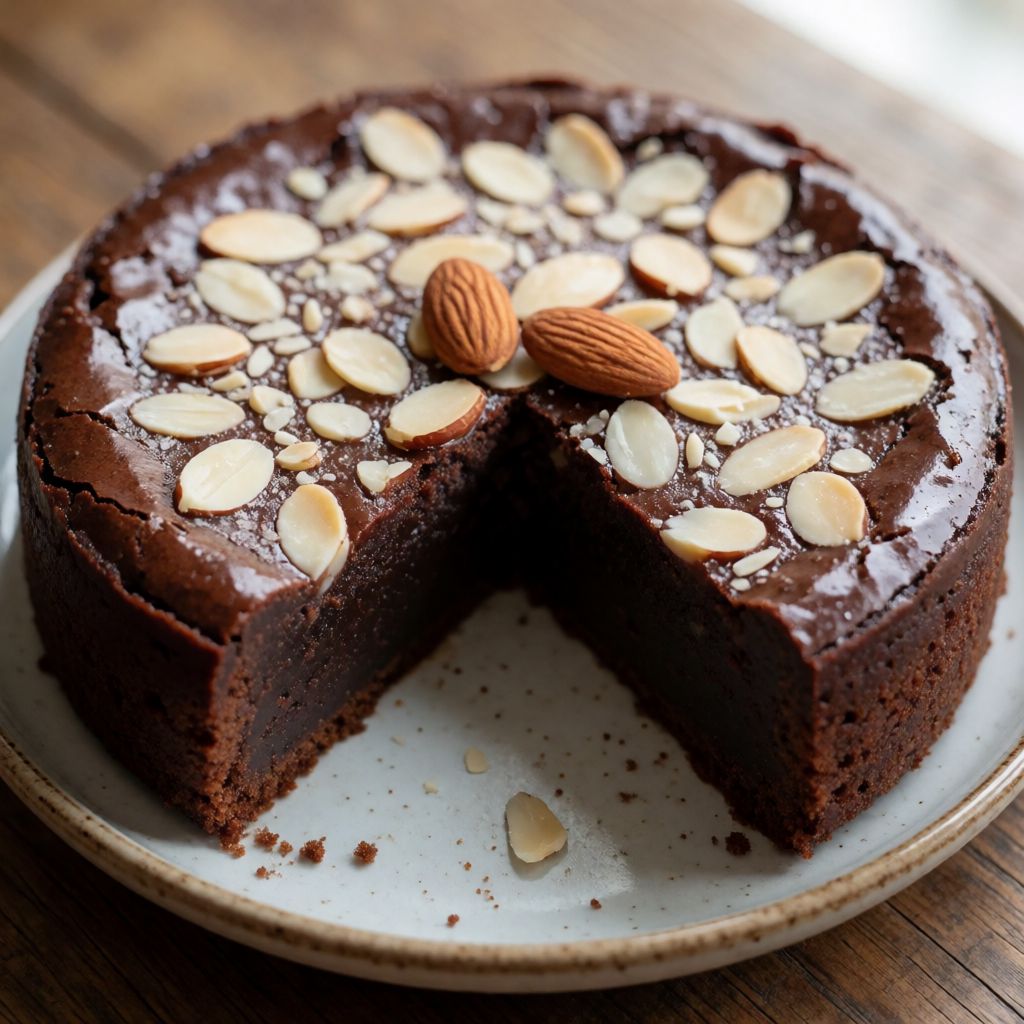
 AI photo
Chocolate Almond Cake
A rich chocolate almond cake with a glossy chocolate glaze, finished with almond flakes and whipped cream if you like.
Labels are worked out automatically from the ingredients and can be wrong. Check the packaging if it matters to you.
Ingredients
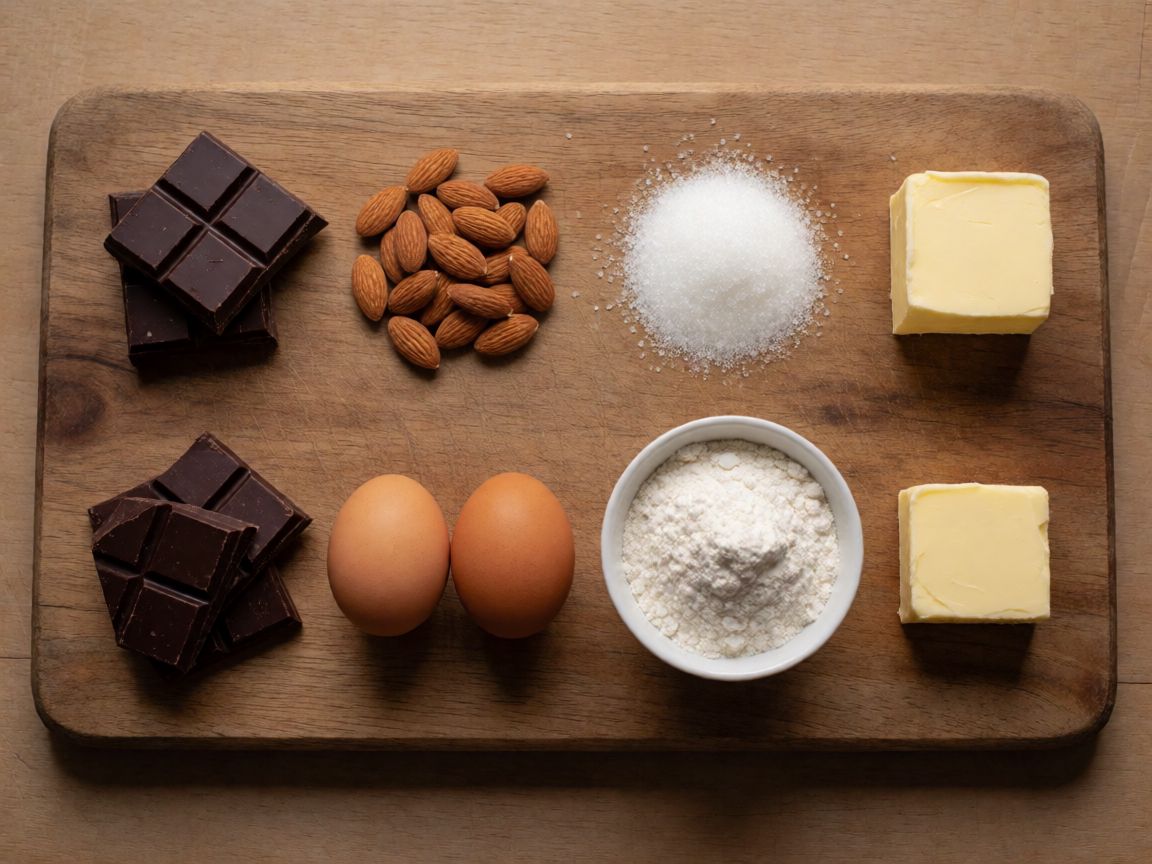
- 100 g Dark chocolate
- 140 g Almonds finely chopped
- 120 g Sugar
- 100 g Butter
- 3 pcs Eggs
- 2 tbsp Plain flour
- 200 g Dark chocolate
- 70 g Butter
- 2 tbsp Water







Steps
Melt 100 g of dark chocolate in a bain-marie, add 100 g of butter and stir until smooth. Leave to cool.
Separate the egg yolks from the whites. Whisk the yolks with 120 g of sugar until light and fluffy.
Add the finely chopped almonds, 2 tbsp of flour and the melted chocolate-butter mixture to the yolk mixture. Stir until smooth.
Whisk the egg whites to stiff peaks. Gently fold the whites into the batter with a top-to-bottom motion.
Pour the batter into a buttered 18-20 cm cake tin.
Bake in a preheated oven at 180°C for 35 minutes.
35 minMake the glaze: put 200 g of dark chocolate, 70 g of butter and 2 tbsp of water in a bowl set over a bain-marie. Heat gently, stirring often, until smooth and glossy.
Pour the glaze over the top of the finished cake and smooth it out with a spatula.
If you like, decorate with almond flakes and whipped cream.
This is a flourless-in-spirit cake — there's a token two tablespoons of flour in there, but the real structure comes from whipped egg whites and ground almonds. That's the mechanism to understand before you touch the oven: the almonds give body and a faint grittiness instead of the smooth crumb of a sponge, and the egg whites are doing the lifting a proper flour cake would get from gluten and raising agent. Fold them wrong, and nothing saves you.
What decides whether this works is temperature discipline in two places that have nothing to do with the oven dial. First: the chocolate-butter mixture has to be cool — not cold, not warm, properly room-temperature cool — before it meets the yolks. Pour it in hot and you scramble the yolks a little, which won't ruin the cake outright but will tighten the crumb and dull the richness you're after. Second: the egg whites go in by folding, not stirring, not beating. Folding keeps the air pockets whole. Stir, and you knock the air back out — the same air that's meant to be your rising agent, since there's barely any flour to do that job.
The almonds aren't a flavour add-on, they're structural — finely chopped (not a shop-bought ground-almond flour, which is too fine and turns the crumb pasty) they hold moisture and give the cake its particular dense, slightly fudgy bite that a flour-heavy sponge never gets. If you genuinely can't get almonds, hazelnuts do the same mechanical job — fat content and grit — though the flavour shifts; walnuts are too oily and bitter for this and will fight the chocolate rather than support it.
Dark chocolate twice, in two different roles, is worth separating in your head. In the cake itself, any dark chocolate with no added flavourings beyond cocoa and sugar works — 70% is a reasonable middle ground; go higher and the cake turns bitter against the sweetened yolk mixture, go much lower (milk chocolate territory) and it won't set the structure the same way once cooled, because cocoa solids are what give that mixture body. In the glaze, chocolate quality actually shows — it's sitting on the surface with nothing to hide behind, so this is where you spend a bit more if you're going to spend at all.
Butter here is doing a plain job: fat for richness and moisture, nothing more exotic. Unsalted is the standard choice so you control seasoning yourself; if you've only got salted, don't panic, just don't add extra salt elsewhere in the recipe — there isn't any called for, which tells you the dish is built to be sweet-forward, not salt-balanced the way some chocolate desserts are.
Eggs do the actual lifting. Three eggs split into yolks and whites is not a lot of egg for this volume of almonds and chocolate, so the whisking matters more than usual — whisk the whites to stiff peaks properly (they should hold a shape when you lift the beater, not just go foamy) because a weak whip here means a flat, dense cake rather than one with any lightness at all. Some say room-temperature eggs whisk better than cold ones — this one's actually true, not a myth: cold egg whites take longer to build structure and are more prone to collapsing once sugar or folding disturbs them, so if you've time, let them sit out twenty minutes first.
The two tablespoons of flour are there mainly to give the batter just enough grip to hold the almonds and chocolate in suspension rather than letting them sink while the egg whites do their work — it's a binding dose, not a rising one. Plain flour is correct; self-raising would be a mismatch, since the whole point of this cake is that air comes from whisked whites, not from baking powder working against a liquid batter.
The water in the glaze is the detail people skip and then wonder why their glaze seizes into a grainy paste instead of staying glossy — chocolate and butter alone can split or tighten when melted together over heat, and a splash of water (not milk, not cream) smooths the fat and cocoa into each other without thinning the glaze or dulling the shine the way dairy fat would. Keep the bain-marie gentle — simmering water underneath, not boiling hard, bowl not touching the water — because chocolate scorches and seizes above roughly 45-50°C, well before your pan of water is even properly boiling, and once it seizes there's no stirring it back to smooth.
Patience shows up twice and both times it's easy to skip. Let the chocolate-butter mixture cool before it meets the yolks — rushing this is the single most common way to ruin the texture. And let the cake cool before you glaze it — pour glaze onto a warm cake and it slides straight off instead of setting into that smooth, holdable layer; it needs the cake's surface to be cool enough that the chocolate sets on contact rather than just running down the sides.