
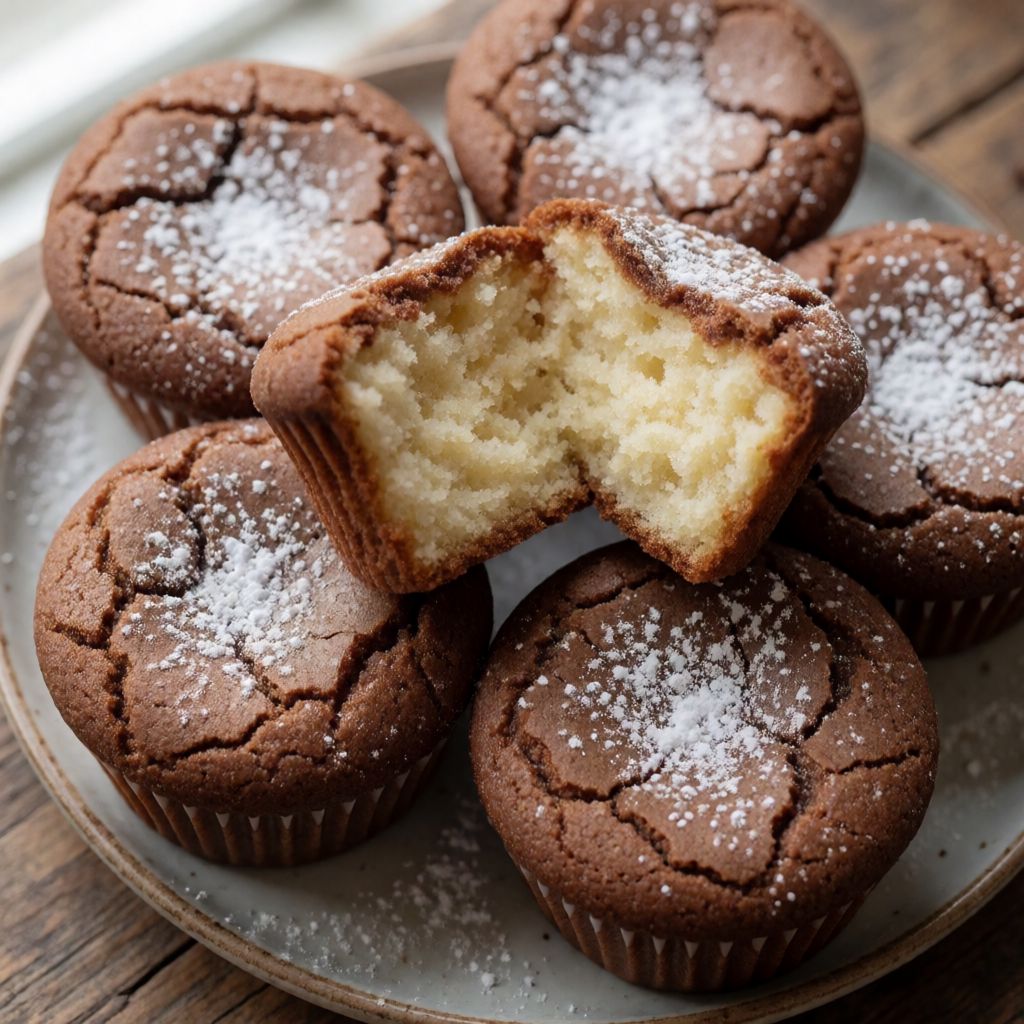
 AI photo
Chocolate Cookie Cupcakes
Soft marzipan cupcakes studded with crushed Oreo biscuits, topped with a fluffy cream cheese frosting.
Labels are worked out automatically from the ingredients and can be wrong. Check the packaging if it matters to you.
Ingredients
- 100 g Butter room temperature
- 125 g Marzipan grated
- 160 g Sugar
- 0.5 tsp vanilla sugar
- 3 pcs Eggs
- 150 g Flour
- 1 tsp Baking powder
- 1 pinch Salt
- 60 g Oreo crushed







Frosting and decoration
- 150 g Butter room temperature
- 150 g icing sugar
- 150 g Cream cheese
- 10 pcs Oreo or 20 mini Oreos


Steps
Beat together the butter, marzipan, sugar and vanilla sugar until the mixture is light and fluffy.
Add the eggs one at a time, beating well after each addition.
Mix the flour, baking powder and salt together and sift into the batter.
Stir until smooth, then fold in the crushed Oreos.
Divide the batter between the muffin cases.
Bake in a fan oven preheated to 175°C for about 20 minutes, until the cupcakes are cooked through.
20 minLet the cupcakes cool on a wire rack.
For the frosting: beat the butter with the icing sugar until the mixture turns pale and fluffy.
Quickly fold in the cream cheese.
Transfer the frosting to a piping bag fitted with a large star nozzle and decorate the cupcakes with the frosting and mini Oreos.
This is a muffin-tin cake, not a biscuit — marzipan is doing the work you'd expect from almond flour or ground nuts, and it's the reason the crumb stays damp two days later instead of drying out like a plain sponge. Grate it, don't cube it: cold marzipan sitting in lumps won't break down into the butter no matter how long you beat it, and you'll bite into a sweet rubbery knot later. Room-temperature butter is non-negotiable here for the same reason — cold butter and cold marzipan together just smear instead of aerating.
What decides whether these rise properly or sit flat and dense is the "light and fluffy" stage in step one. That's not a time, it's a texture: the mixture should go pale, almost white, and visibly increase in volume as you beat. That change is air getting folded into fat, and those air pockets are what the baking powder later inflates in the oven. Skip that stage because you're impatient, and no amount of baking powder rescues it — chemical leavening expands existing pockets, it doesn't create structure from nothing.
The crushed Oreo folded into the batter is textural confetti, not a flavour you're chasing hard — cocoa biscuit and a thin layer of filling, broken small enough to distribute but not so fine it disappears. Fold, don't beat, at this stage: beating develops gluten in the flour you've just added, and gluten is what turns a cupcake chewy and tough instead of tender.
On the marzipan: some say any almond paste will do. No — proper marzipan (the kind sold in a block, mostly ground almonds and sugar, no egg white binding it like a soft icing-paste) grates into a fine shred that melts into the batter. Almond-paste substitutes with a high sugar ratio behave more like fondant — they go gluey rather than disappearing. If you genuinely can't find marzipan, ground almonds plus a touch more sugar gets you closer than reaching for a sugarpaste substitute.
Butter appears twice, and the two jobs are different. In the batter, butter beaten with sugar and marzipan is there to trap air — that's the fluffy stage doing structural work. In the frosting, butter beaten with icing sugar is there for stability: it sets up a fat structure stiff enough to hold a star-nozzle shape at room temperature, which plain whipped cream cheese on its own can't do — it's too soft and too wet. That's also why the recipe tells you to fold the cream cheese in "quickly" rather than beat it at length: overworking it melts that structure back down, and you end up with frosting that slides off the cupcake instead of standing in peaks.
Eggs go in one at a time for the same reason you don't dump flour in all at once — a fully emulsified batter (fat and egg bound together smoothly) holds the air you've beaten in; add three eggs at once to a thick butter-marzipan mix and it can split, curdling into a grainy mixture that bakes dense no matter how good your oven is. If it looks slightly curdled anyway, a spoonful of the measured flour beaten in will often pull it back together — that's a rescue, not a step to skip to.
Baking powder and salt are sieved in with the flour, not because sieving is ritual, but because baking powder clumps and a pocket of it hits your tongue as a bitter, metallic burst in one bite while the rest of the cupcake tastes of nothing. Sieving distributes it evenly through the flour before it ever meets the wet mixture.
On the 175°C fan and the 20 minutes: treat the time as the point where you start checking, not the point where you stop baking. A domestic fan oven varies more than you'd think tray to tray and oven to oven — the real cue is a skewer or thin knife coming out without wet batter clinging to it, and the top springing back rather than leaving a dent when you press it lightly. Cooked through and overcooked are close together in a small cupcake case, and dry cupcake is the commonest casualty of "I'll just leave it five more minutes to be safe."
Finally, the whole Oreo on top is decoration and a textural contrast — crunchy biscuit against soft frosting — not an ingredient carrying real flavour weight, so mini Oreos or a different plain chocolate biscuit broken in half work just as well if that's what's in the cupboard. Ten cupcakes, one muffin tray's worth, feeds a Sunday-roast-sized gathering with tea afterwards rather than a party.