
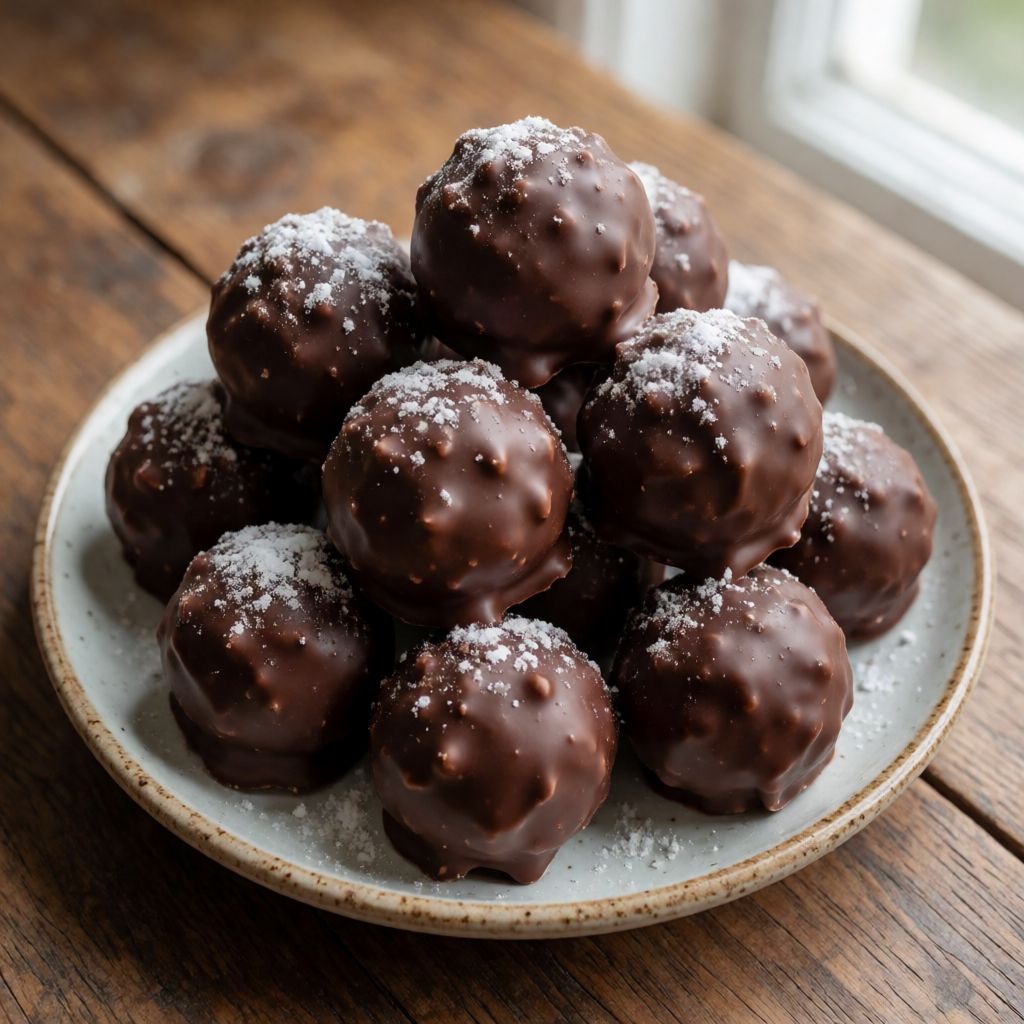
 AI photo
Chocolate-Dipped Peanut Nougat Bites
Chewy peanut nougat bites coated in dark chocolate, a sweet treat for sharing.
Labels are worked out automatically from the ingredients and can be wrong. Check the packaging if it matters to you.
Ingredients
- 275 g Sugar
- 125 g Glucose syrup
- 150 g Honey
- 150 g Water
- 2 pcs Egg whites
- 3 tbsp Icing sugar
- 150 g Peanuts salted
- 300 g Dark chocolate tempered






Steps
Put the sugar, honey, glucose syrup and water into a saucepan and bring to the boil. Cook until the temperature reaches 150°C.
Whisk the egg whites to stiff peaks.
Slowly pour the hot sugar syrup into the whisked egg whites, whisking constantly. Keep whisking until the mixture is warm and fluffy.
Spread the mixture onto a sheet of parchment dusted with icing sugar. Dust the top with icing sugar and smooth the nougat with a palette knife.
Leave to cool overnight and cut out rounds with a round cutter.
1440 minPress the peanuts into the nougat so they hold lightly in place, then coat with the tempered dark chocolate.
This is nougat — not the chewy supermarket slab, but the Italian-style kind made with cooked egg white, held together by caramelised sugar instead of butter or cream. What decides whether it works is a single number: 150°C. Below that, your syrup still carries water, and water is what makes nougat sticky and short-lived — fine for a sauce, useless for something you want to bite without it following your teeth. At 150°C you're at hard-crack: drop a spoonful of this syrup into cold water and it snaps, not stretches. That snap is the whole structure of the finished sweet, waiting to happen.
Some say any sugar syrup will do, you just need it hot. No — because glucose syrup and honey are doing a second job here, nothing to do with sweetness. Plain sugar wants to recrystallise the moment it cools, and it will, in jagged little grains that turn your smooth nougat gritty. Glucose and honey get in the way of that — they're "foreign" sugar molecules that stop the crystals lining up. Leave them out and you'll get rock candy with attitude, not nougat.
The second thing that decides this dish is the whisking. You pour boiling syrup straight into whisked egg white, which sounds reckless until you see what it does: it cooks the white in place, inside the foam, so the protein sets around the air bubbles instead of collapsing. That's why this version holds its shape at room temperature for weeks, while a raw meringue wouldn't survive the afternoon. Keep whisking until the bowl itself cools to warm — that's your sign the cooking is finished and the foam has stabilised, not a clock.
Sugar is the scaffold — plain granulated, nothing special, because its only job is to melt, boil and set. Glucose syrup is the quiet workhorse: a thick, almost flavourless syrup sold for baking, and its sole task is to stop sugar crystals lining up as the mixture cools. If you can't find it, golden syrup or liquid glucose from a baking aisle will do the same job in roughly the same quantity — just expect a slightly different colour.
Honey earns its place twice over. It's partly flavour, obviously — a floral note plain sugar can't give you — but it's also an invert sugar, meaning it has the same crystal-blocking effect as the glucose syrup, and it's hygroscopic, which is the real reason shop nougat stays soft for months: honey holds onto water and refuses to let the sweet go hard and dry. Use a honey you'd actually put on toast — a bland supermarket blend works fine, but a stronger one will come through in the finished bite.
Egg whites give you the foam, and here freshness matters less than you'd think, because the hot syrup cooks them as it's poured in — this is why you can eat this nougat without the usual nervousness around raw egg. Two whites is a guide, not a law; weigh them if your scales allow it and you'll get more consistent results than counting eggs, since egg size varies more than people admit.
Icing sugar on the parchment and on top isn't there to sweeten anything — it's a release agent, the thing standing between your nougat and a sheet of paper it would otherwise bond to permanently. Dust generously; too little and you'll tear the surface lifting it off, which is a cosmetic fault rather than a fatal one, but annoying all the same.
Salted peanuts are the budget cousin of a tradition built on almonds. Torrone and turrón, the Mediterranean ancestors of this sweet, used almonds because that's what grew there; peanuts turned up in cheaper versions once they became cheap and plentiful, and the salt is there to argue with all that sugar, not just to season. Swap in any roasted nut — almonds, hazelnuts, pistachios — unsalted if you'd rather control your own salt, same weight, same method: press them into the cut surface while it's still slightly tacky, or they won't hold.
Tempered dark chocolate is doing a job most people assume is decorative, and it isn't. Tempering lines up the cocoa butter's fat crystals so the chocolate sets with a snap and a shine and stays that way at room temperature, instead of turning dull and streaky — that streaking, bloom, is exactly what you get melting chocolate and letting it set without tempering. In a flat without a marble slab, the easiest route is the seeding method: melt most of the chocolate, then stir in a handful of unmelted chopped chocolate off the heat until it's smooth and glossy again, checking a smear on the back of a spoon — it should set matte-free within a couple of minutes at room temperature. If that's too much fuss for one Sunday, use a good compound chocolate instead; it never needs tempering, it just won't have quite the same crack when you bite through it.