
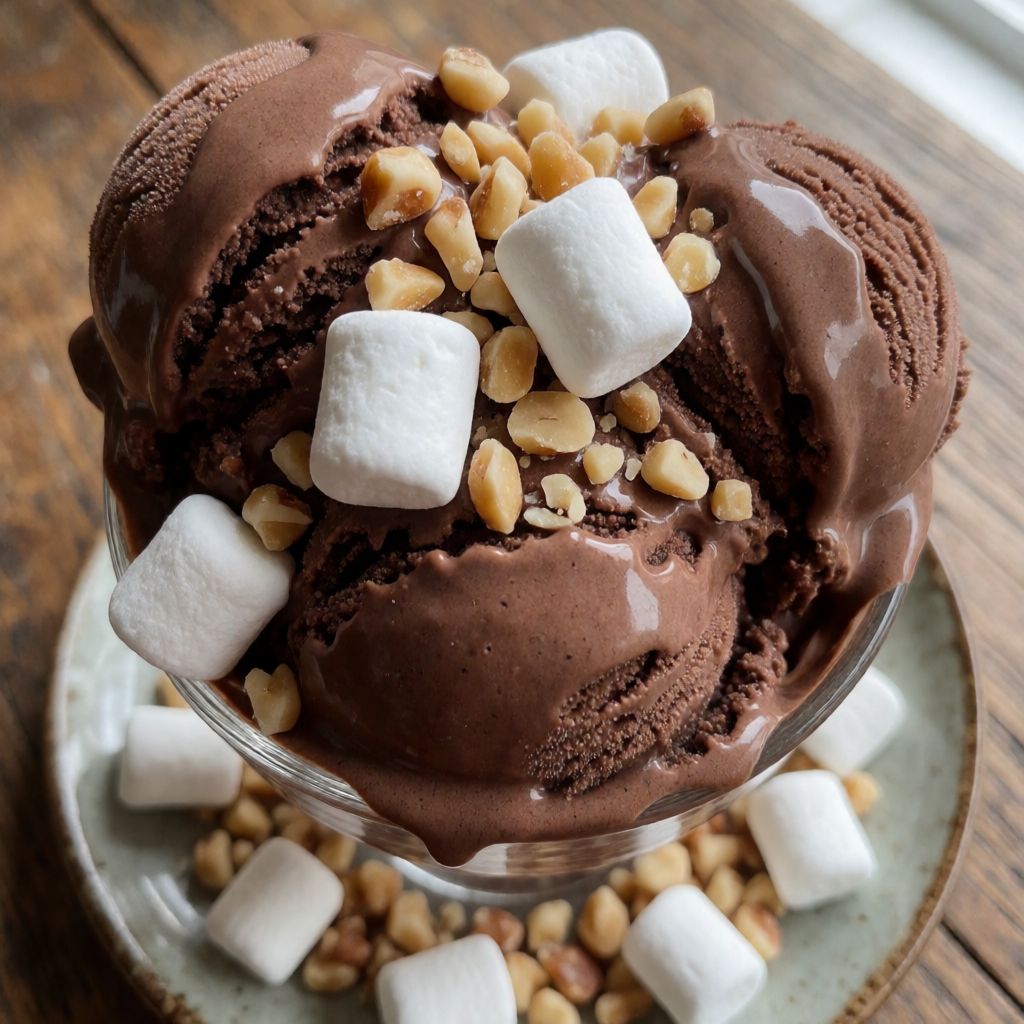
 AI photo
Chocolate Ice Cream with Marshmallows and Nuts
A rich dark chocolate custard ice cream studded with marshmallows and nuts, served in waffle cones.
Labels are worked out automatically from the ingredients and can be wrong. Check the packaging if it matters to you.
Ingredients
- 1 pcs Vanilla pod
- 175 g Caster sugar
- 8 pcs Egg yolks
- 300 ml Milk whole milk
- 700 ml Whipping cream
- 100 g Dark chocolate finely chopped
- 100 g Dark chocolate roughly chopped
- 50 g Hazelnuts roughly chopped
- 50 g Pecans roughly chopped
- 50 g Marshmallows
- 4 pcs Waffle cones







Steps
Split the vanilla pod lengthwise and scrape out the seeds. Mix them with the sugar and whisk together with the egg yolks until pale and fluffy.
4 minPut the empty vanilla pod in a saucepan with the milk, cream and chocolate, and bring to 90°C. Remove the vanilla pod and slowly pour the hot chocolate mixture into the egg mixture in a thin stream, whisking constantly.
Pour the mixture back into the saucepan and heat gently, stirring, until it reaches exactly 80°C (check with a sugar thermometer).
Pour the ice cream base into a lidded container and chill in the fridge for at least 1 hour, or overnight. Then churn it in an ice cream maker until it reaches a thick, soft-serve consistency.
25 minTransfer the chocolate ice cream to a container and fold in the chocolate pieces, nuts and marshmallows. Freeze for at least 2 hours before serving.
120 minFill the waffle cones with the ice cream and serve immediately.
2 min
This is a custard-based chocolate ice cream - what the French would call a crème anglaise, with chocolate melted straight into it before it goes into the machine, then studded afterwards with broken chocolate, toasted nuts and marshmallow and served in a cone like something off the seafront. The custard is what separates it from "frozen chocolate milk": egg yolks hold the fat and water together so you get something smooth, not a brick of ice with a chocolate smell.
Some say ice cream is just cream, frozen. No. Freeze sweetened cream as it is and you get a hockey puck, because the water in it is free to form big ice crystals with nothing stopping them growing. Three things stop that here: fat from the cream and the yolks, sugar, and air beaten in while it freezes. Skip the custard stage and just whip cream with melted chocolate into a tub for the freezer, and you'll taste exactly why each of those is doing real work.
Two temperatures decide this dish, and nothing else matters as much. 90°C melts the chocolate and warms the milk and cream without them catching on the base of the pan. The real hinge is 80°C for the custard itself. Yolk proteins start tightening around 70°C and are fully set - grainy, rubbery - by about 85°C. 80 sits you in the narrow gap between the two: thick enough to coat the back of a spoon, not hot enough to curdle. Overshoot by a careless few degrees while stirring and you don't get custard, you get sweet chocolate scrambled egg, and there's no undoing it - only straining out the worst and saying nothing.
The vanilla pod does two jobs and the recipe makes you use it twice: the seeds go into the sugar at the start so they rub through every grain and reach the eggs evenly, and the scraped-out pod itself still has plenty of aroma left in its walls, so it goes back into the milk to infuse while everything heats. If you've only got vanilla extract, use it, a teaspoon is plenty, but add it once the custard's off the heat and cooling - heat drives off the volatile part of vanilla's smell, which is most of what you're paying for.
The sugar isn't only sweetness. Whisked with the yolks until pale, it's starting to dissolve into them and coating the proteins, which is part of what stops the custard seizing later when the hot liquid hits it. And in the freezer it's doing chemistry: sugar lowers the freezing point of the mix, which is why a properly sweetened ice cream stays scoopable at freezer temperature while a low-sugar version sets like concrete.
Eight yolks are the emulsifier here - the fat and lecithin in them are what bind the watery milk and the fatty cream into one phase instead of letting them separate into an icy layer and a greasy one. That's why it's yolks only, not whole eggs: whites bring stretchy protein and extra water with nothing to show for it, and can leave the ice cream rubbery. Short of yolks, you can get away with fewer plus a spoon of cornflour as backup thickener, but understand that's a repair, not the same dish.
Milk and cream together, 300ml to 700ml, set the fat content, and fat content is most of what separates a smooth ice cream from an icy one - cut the cream back for the milk and you'll feel it on the tongue as grain rather than silk. The two batches of dark chocolate are doing different jobs: the melted 100g becomes the flavour backbone of the custard itself, so use something you'd actually eat off a bar - 50 to 70% cocoa solids is the useful range, any lower and the cream drowns it, any higher and it turns bitter against all that sugar and fat. The second 100g, roughly chopped and folded in after churning, survives the freezer as discrete chunks rather than melting into the base, so chop it properly, don't shave it to dust.
Hazelnuts and pecans follow one rule: any nut with a flavour of its own and enough body to hold a light toast will do - walnuts, almonds, whatever's in the cupboard. Toast them briefly before folding them in; raw nuts taste flat even before the cold dulls them further, and cold dulls flavour hard, which is why ice cream recipes lean on toasting and strong chocolate rather than subtlety. Marshmallow is there purely for texture, not taste - its sugar-and-gelatin structure stays soft and chewy at freezer temperature in a way that sweets with more water in them, jellies and the like, won't; those just turn into ice shards. Waffle cones are the vessel, not the mechanism - homemade ones are a performance for a Sunday afternoon, a decent shop-bought cone does the same job of giving you something to crunch against the smooth.
On an ordinary UK worktop, the limiting factor is usually the machine, not the recipe: most domestic ice cream makers have a bowl you need in the freezer a full day ahead, so plan for that rather than discovering it with custard already made and nowhere cold to put it. No machine at all - pour the chilled base into a shallow container, freeze it, and beat it hard with a fork or whisk every thirty to forty-five minutes over a few hours to break up the crystals as they form. It's more work and less fine a texture, but it is ice cream, not a failed experiment. Either way, don't rush the chill before churning or the freeze after folding - both of those two-hour-plus waits are listed as minimums for a reason, and patience here is simply the last ingredient on the list that nobody writes down.