
 AI photo
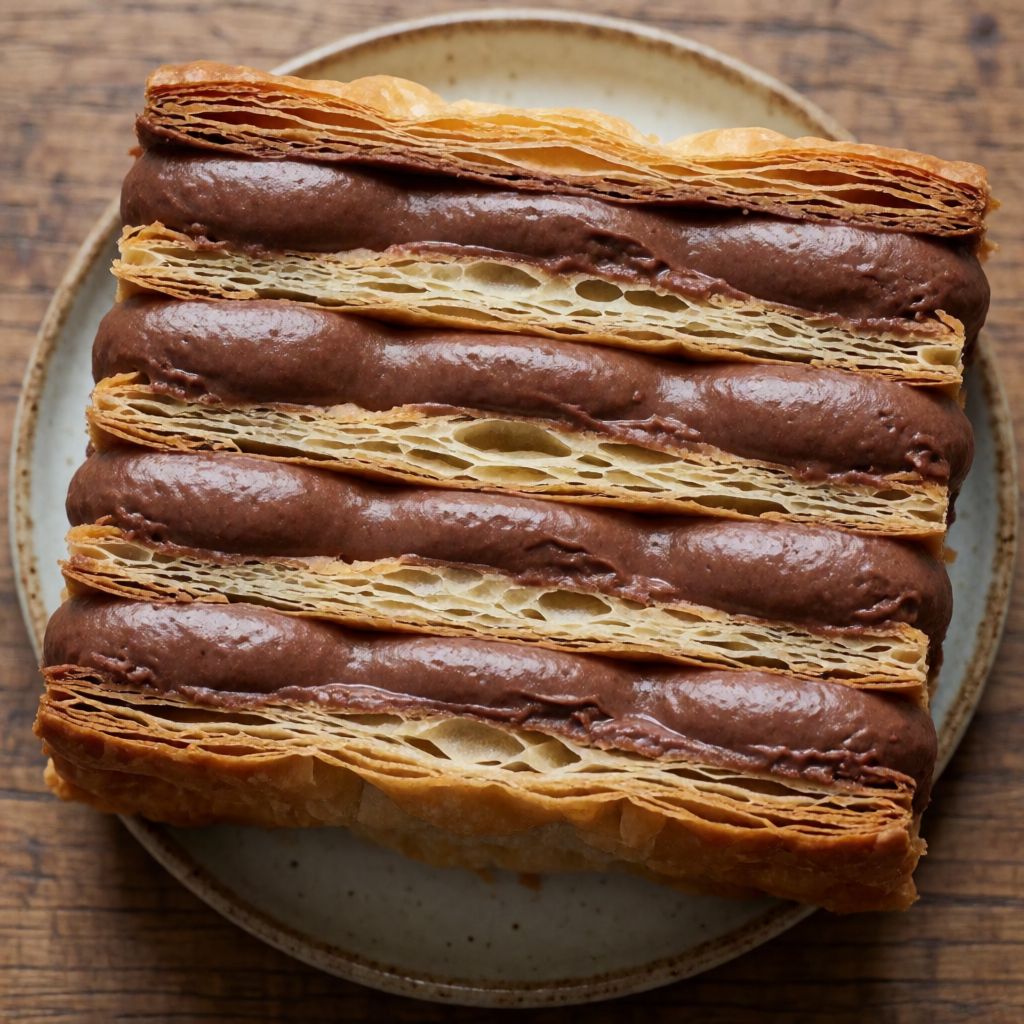
Mille-feuille with Chocolate Cream
A layered puff pastry dessert filled with a rich chocolate custard cream.
Labels are worked out automatically from the ingredients and can be wrong. Check the packaging if it matters to you.
Ingredients
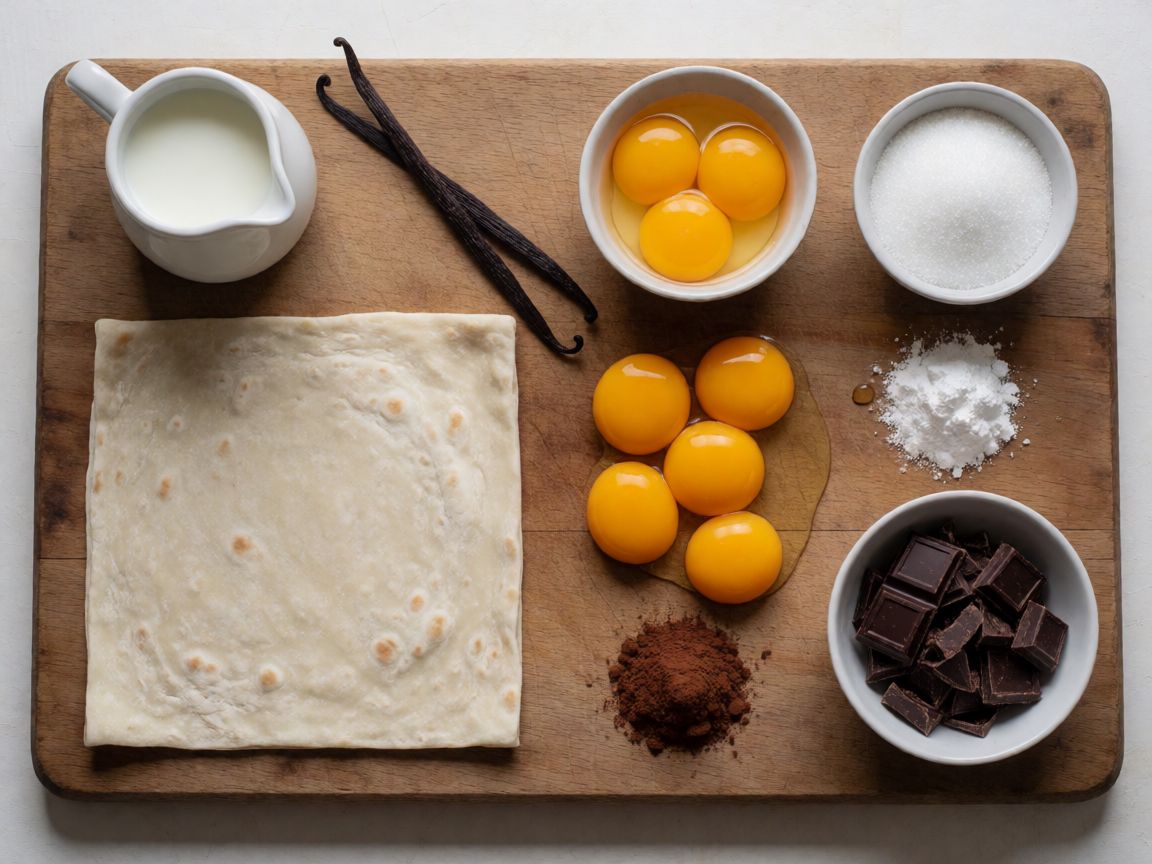
- 1 pcs Ready-rolled puff pastry
- 750 g Milk
- 0.5 pcs Vanilla pod
- 8 pcs Egg yolk
- 200 g Sugar
- 65 g Cornflour
- 25 g Cocoa powder
- 250 g Dark chocolate








Steps
Pour the milk into a saucepan and bring to the boil, flavouring with the vanilla pod.
In a bowl, combine the egg yolks with the sugar and whisk together.
Add the cornflour and cocoa powder, mixing well.
Pour the mixture into the boiled milk and cook, stirring constantly, until the cream thickens.
Add the chopped chocolate and stir until melted.
Transfer the cream to a bowl, cover with cling film and chill.
Unroll the puff pastry on a baking tray and prick it with a fork.
Bake in a preheated oven for 15-20 minutes at 190°C fan or 20 minutes at 200°C.
18 minAs soon as the pastry is baked, trim the edges and divide it into three parts.
Arrange small mounds of cream on a plate to hold the first layer.
Place the first pastry sheet, cover with cream and repeat until the last layer.
Chill in the refrigerator to let it set before serving.
Mille-feuille is three things stacked, and the whole argument of the dish is the fight between them: crisp pastry, soft dark cream, and the knife that has to go through both without turning the top layer to crumbs. Get that fight right and you have something worth the name. Get it wrong and you have soggy biscuit with chocolate custard, which is a perfectly nice thing to eat but not this.
What decides it is timing in two directions. The pastry has to be properly dry and crisp before anything touches it — not just coloured, but crisp through, because any residual damp in the layers is what the cream will find and exploit over the next few hours. And the cream has to be fully cold and fully set before you build, because warm cream doesn't sit in layers, it slides and soaks.
The name itself is a bit of a tease — "a thousand leaves" — and no, puff pastry does not actually have a thousand layers, it has whatever number of folds the lamination gave it, usually a few hundred at most, but "a thousand" is just how French bakers talk about "a lot, and thin." Ready-rolled pastry from a UK supermarket will already have done that folding for you industrially; you are not missing a skill by buying it, you are buying someone else's morning.
The cream here is a crème pâtissière with cocoa and chocolate folded in, not a mousse and not a ganache, and that distinction matters because it's the egg yolk and cornflour together that let it set firm enough to hold its shape between two sheets of pastry without a scrap of gelatine. The yolks give richness and some of the thickening; the cornflour does the real structural work, swelling and gelling as it cooks. Skip the cornflour or skimp on it and the cream stays pourable — fine for a jug, useless for a stack.
Cooking that cream "until it thickens" is not a mystery if you watch what cornflour actually does: it stays thin right up until a point, then goes from loose to coating the spoon within maybe thirty seconds, because starch granules burst and lock water all at once rather than gradually. That's why you stir constantly rather than leave it — a pan left alone at that moment scorches on the bottom before the top even feels warm. Some say custard has to be made in a bain-marie or it will always catch; no — it catches when the heat under it is higher than the rate at which you're moving it, which is a stirring problem, not a vessel problem.
The vanilla pod in the milk is there to perfume, not decorate — split it, scrape what you can into the milk, and if you don't have a pod, a good vanilla extract added off the heat does the job; vanilla sugar does not, it's mostly sugar. The cocoa powder and the chopped dark chocolate are doing two different jobs though they taste similar: cocoa, being mostly starch and fat with little actual fat-fat, deepens colour and bitterness without loosening the set; the melted chocolate adds the fat and the gloss and a rounder sweetness. Leave out the chocolate and use double the cocoa and you'll get a flatter, chalkier cream — cocoa alone can't replace the texture chocolate's fat gives.
For the pastry: any all-butter puff will behave better than a vegetable-fat one, because butter sets harder and crisper as it cools and vegetable fat tends to leave things a touch greasy and limp. Pricking it with a fork before baking isn't decoration either — it lets steam escape through small vents instead of forcing the whole sheet up into one uneven blister, so you get an even, flat crisp instead of a hollow dome that collapses when you try to stack cream on it.
In an ordinary flat kitchen, your oven is almost certainly fan, so trust the 190°C fan figure over the 200°C conventional one, and judge doneness by colour and sound, not the clock: it should be deep gold, not pale, and if you tap it, it should sound hollow and dry, like a biscuit, not dull like bread. Eighteen minutes is where to start checking, not where to stop.
The little dabs of cream under the first pastry sheet are a trick worth understanding, not just copying: they're glue, stopping the bottom sheet from sliding on the plate while you work, because a bare pastry sheet on a bare plate has nothing to grip. And the final chill isn't optional patience for its own sake — it's the time the cream needs to firm back up after handling, so that your first slice doesn't collapse sideways the second the knife meets it. Cut it with a serrated knife, sawing rather than pressing, or the crisp layers will crush under a straight blade instead of parting.