
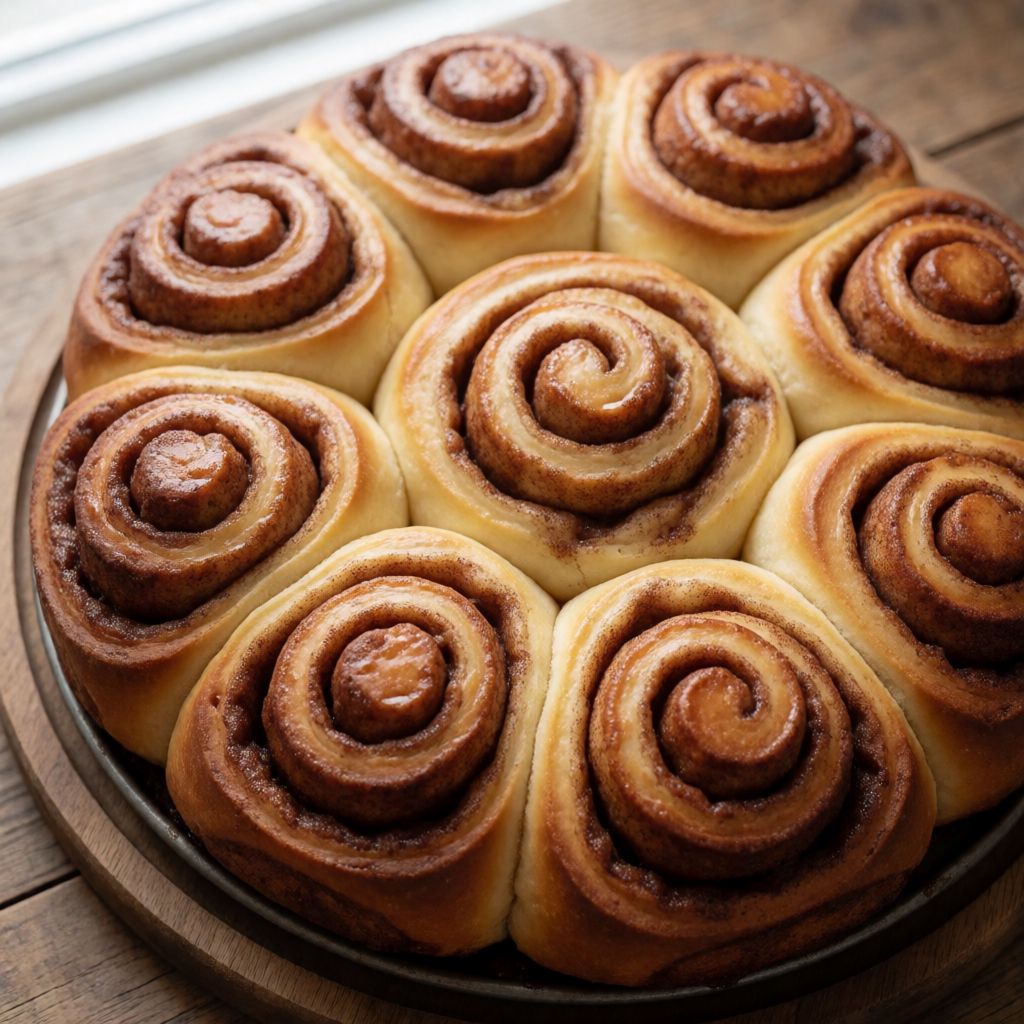
 AI photo
Cinnamon Buns
Soft, cardamom-scented yeasted buns rolled with a buttery cinnamon-sugar filling.
Labels are worked out automatically from the ingredients and can be wrong. Check the packaging if it matters to you.
Ingredients










Steps
Stir the yeast into the milk, then add the egg, cardamom, sugar and salt, along with half the flour. Mix well into a dough.
Add the butter, cut into small cubes, and the rest of the flour to the dough and knead with a mixer for 10 minutes, until the dough is soft.
10 minLeave the dough to rise in a bowl covered with a clean towel for 2 hours.
120 minMix the filling until the butter, sugar, brown sugar and cinnamon form a smooth paste.
Roll the dough out into a rectangle and spread the filling evenly over the surface.
Fold one third of the dough over, then the other third, so the dough forms 3 layers.
Roll the dough out again into a rectangle and cut into 12 equal strips, then twist into cinnamon buns.
Place all the buns on a baking tray lined with parchment paper and leave to rise for another 40 minutes.
40 minBake in a preheated oven at 175°C (fan) for about 15-18 minutes.
17 minLet the buns cool slightly on the tray so the filling has time to set.
A cinnamon bun is a loaf that argues with itself. You build a soft, slightly sweet milk dough, then you cut it into a shape designed to fail — a twist, not a tight spiral — so that when the butter inside melts, it has somewhere to go rather than pooling into a soggy middle. What decides whether this works is not the recipe but two separate waits: the dough needs two hours to swell because the yeast is doing real work, not decoration, and the butter in the filling needs to be soft enough to spread but not so warm it turns to oil and runs straight through the dough before it even hits the oven.
Some say a cinnamon bun is a cinnamon roll with a different fold. No — the fold is the whole point. A roll is wound tight into a spiral, so the filling bakes trapped in the centre, often gluey. A bun, folded in thirds like a letter then cut into strips and twisted, exposes the filling along the cut edges. Those edges caramelise in the oven's heat, which is where the actual flavour comes from — not the raw cinnamon paste, but what happens to its sugar once it meets 175°C and air.
This feeds twelve, which sounds like a lot until you remember a tray of these vanishes at a slower rate than a fruit cake but faster than you'd like to admit, especially next to a pot of tea. Make them for a Sunday where people are coming and going all afternoon — they hold their texture for a few hours and are built to be picked up, not plated.
Start with the yeast and the milk. Room-temperature milk matters more than people think: yeast is alive, and it eats sugar and produces gas at a pace that depends on warmth. Too cold and it sulks, barely rising in your two hours. Too hot — and this is the real danger, not a folk warning — and you kill it outright, because yeast cells die well below boiling, long before the milk feels "hot" to a careless hand. If you only have fridge-cold milk, give it ten minutes on the counter; don't microwave it to speed things up, you'll just as likely scald part of it while the rest stays cold.
The egg and sugar in the dough aren't there to sweeten it much — 50g across the whole batch is restrained. They're there for colour and softness: egg proteins and natural sugars brown and tenderise the crumb in the oven, which is why this dough bakes up closer to brioche than to a dinner roll. Cardamom is the quiet one in the ingredient list — it's doing for the dough what vanilla does in a cake, a background note you'd miss if it vanished but wouldn't necessarily name if it was there. If you don't have it, don't chase it with something stronger; a little extra cinnamon in the dough itself, or nothing at all, is fine. The dish survives without cardamom. It does not survive without patience.
Flour: plain flour, not bread flour, which tells you this dough is meant to be soft and slightly cakey rather than chewy. Bread flour's higher protein would fight the butter and give you something closer to a dinner roll with delusions. If plain flour is what's in your cupboard already — it usually is in a UK kitchen — you're set.
The 80g of cold-ish cubed butter kneaded into the dough is the laminating shortcut. A proper croissant dough gets butter folded in through repeated layers over hours; here, you cheat by kneading small cubes straight into the dough with a mixer for ten minutes. It won't give you paper-thin layers, but it breaks up the gluten just enough that the baked bun stays tender rather than dense. Any neutral butter works here — unsalted is the safer default so you control the salt yourself, which the recipe already measures separately.
The filling butter — 150g, soft, almost spreadable like good jam — is a different job entirely. It needs to be soft enough to go on in an even layer without tearing the rolled-out dough, which is the real reason behind "room temperature" here, not texture for its own sake. Cold butter rips dough; melted butter floods it and runs off the edges onto your tray, burning before the buns are even cooked through. Brown sugar alongside white sugar isn't decorative either — brown sugar carries molasses, which holds moisture and gives you that darker, slightly sticky caramel at the twisted edges, where white sugar alone would just crisp and dry.
On a UK hob and oven: "preheated oven, 175°C fan" is non-negotiable as a starting point, because an unheated oven means the dough finishes rising haphazardly in the first few minutes of baking instead of baking evenly from the start — that's the usual cause of a bun that's pale on top and gluey in the middle. If your oven runs hot or cold against its dial, as most domestic ovens honestly do, treat 15 minutes as the floor and judge the rest by colour: a proper amber-gold on the exposed cut edges where the filling caramelises, not just the top surface browning, which can lie to you. Let them sit on the tray a few minutes after baking — the filling is molten sugar and butter straight out of the oven, and it needs that short rest to firm back into something you can actually pick up without it running down your wrist.