
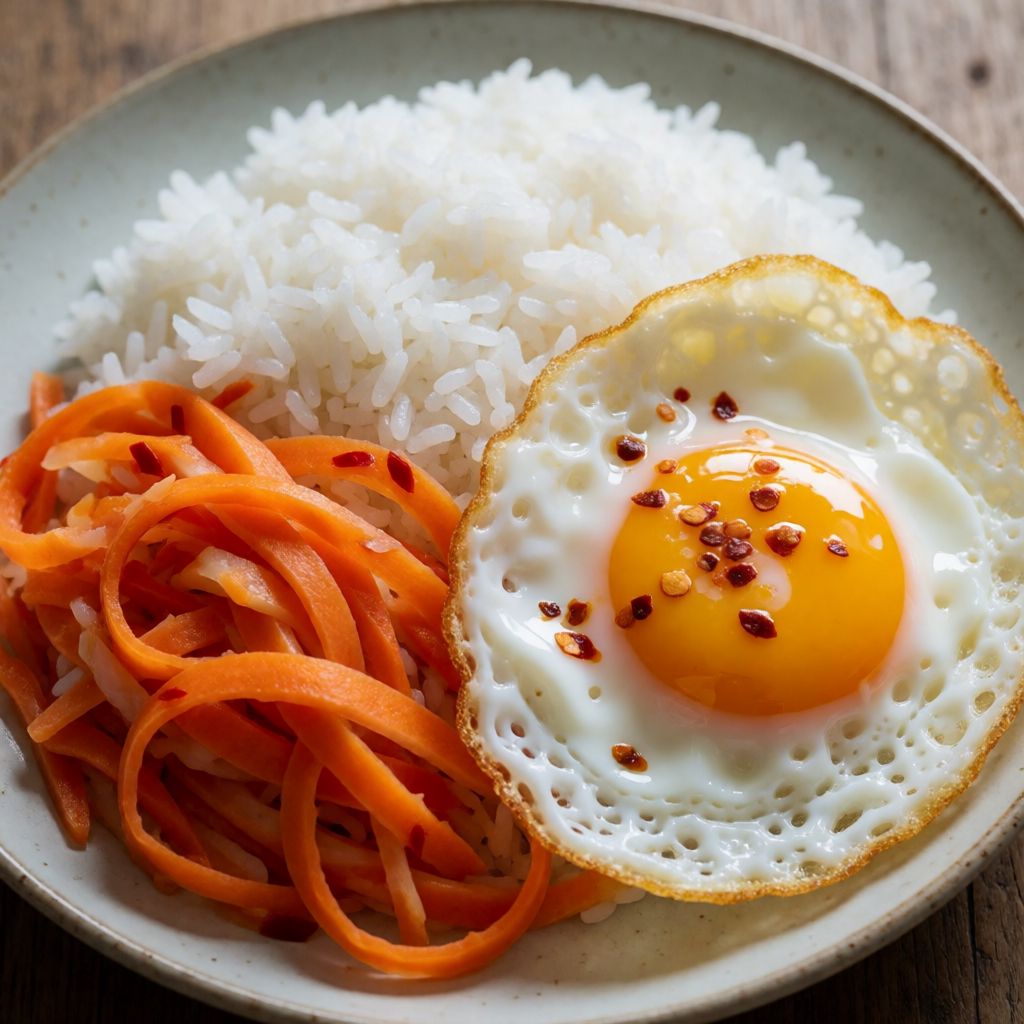
 AI photo
Coconut Rice with Vegetables and Fried Eggs
Coconut rice topped with pickled carrot, garlicky spinach and a sunny fried egg, finished with a spicy dressing.
Labels are worked out automatically from the ingredients and can be wrong. Check the packaging if it matters to you.
Ingredients
- 20 g Sesame seeds
- 1 tsp Chilli flakes to taste
- 1 bunch Parsley roughly chopped
- Salt and freshly ground pepper




Pickled Carrot
- 4 pcs Carrot
- 100 ml Water
- 100 ml Rice vinegar
- 30 g Sugar
- ½ tsp Chilli flakes




Coconut Rice with Ginger
- 1 tsp Ginger finely grated
- 25 g Sesame seeds
- 300 ml Basmati rice
- 100 ml Water
- 400 ml Coconut milk
- ½ tsp Salt
- 1 tsp Sesame oil for frying




Vegetables and Fried Eggs



Dressing
- 2 tbsp Sesame oil
- 30 g Mayonnaise
- 100 ml Crème fraîche 18%
- 1 tbsp Sriracha



Steps
Peel the carrot into long thin ribbons with a vegetable peeler. Put the water, sugar, chilli flakes and rice vinegar in a pan and bring quickly to the boil so the sugar dissolves.
Take the pan off the heat, add the carrot to the hot pickling liquid, transfer to a jar, cover with a lid and chill in the fridge while you prepare the rest of the dish.
Put the oil, sesame seeds and ginger in a pan; fry the ginger gently until lightly fragrant but not coloured.
Add the water, coconut milk, basmati rice and salt, stir, cover with a lid and bring slowly to the boil.
Cook the rice covered over a low heat for 10 minutes.
Take off the heat and let the rice stand, covered, for a further 10 minutes.
Put the onion and garlic in a pan with oil and fry over a medium heat until the onion is soft.
Add the spinach and stir until just wilted. Transfer to a plate and drizzle with a little soy sauce.
Heat a pan with a little extra oil and crack in four eggs.
Fry the eggs until the white is set, the edges are crisp and the yolk stays soft and runny.
In a bowl mix the mayonnaise, crème fraîche and sriracha, and season with salt and pepper to taste.
Divide the rice between plates, top with the spinach, pickled carrot and fried egg. Garnish with sesame seeds, chilli flakes and parsley, and serve the dressing on the side.
This is rice built in three unrelated acts that only meet on the plate: a quick-pickled carrot that needs nothing but heat and vinegar, a pan of basmati that cooks itself in coconut milk, and a fried egg sitting on wilted spinach like it owns the place. Nobody stirs a single pot for forty minutes here. That's the whole point — it's a dish for a weeknight, not a vigil.
What decides whether it works is the rice, and the rice is decided by one thing: you do not lift the lid. Basmati in coconut milk behaves differently from basmati in water — the fat and sugar in coconut milk slow the water's ability to get into the grain, so if you peek, stir, or fuss, you knock the steam out and end up with a pan half-cooked on top and gluey underneath. Ten minutes on the heat, ten minutes off, lid staying shut the whole time — that off-heat rest is not an optional nicety, it's when the grains finish absorbing what's left in the pan. A plate on top works as a lid if you don't own one that fits a wide domestic pan, and a folded tea towel under it stops it rattling.
Start with the carrot, because it benefits from time you'd otherwise waste standing around. A vegetable peeler run the length of the carrot gives you ribbons, not discs — more surface for the pickle to reach, and they go limp and pliable quicker than a chunk ever would. You're looking for the ribbon to bend without resistance, not for a clock. Rice vinegar here isn't swappable for malt or balsamic just because they're vinegar too — you want something sharp but clean, with no deep flavour of its own fighting the ginger and chilli. White wine vinegar, cut slightly with water, is the honest substitute if rice vinegar isn't in the cupboard; cider vinegar at a pinch, though it brings its own fruitiness along for the ride.
The coconut milk is doing two jobs at once in the rice: it's the cooking liquid, and it's the fat that stops the basmati clumping into a solid block the way it can in plain water. Buy the full-fat tinned kind, the sort that separates into a thick cap and thinner liquid when it sits — shake the tin before opening so you get both in the rice rather than pouring off the best part. The "lite" coconut milks are mostly water with a coconut memory; use them and the rice turns out thin and the reward for not stirring disappears, because there's not enough fat there to protect the grains in the first place. Basmati specifically, not just "long grain," because basmati's long, dry grain is what separates out into those distinct strands rather than fusing into porridge — it's the one place in this recipe where the ingredient genuinely isn't interchangeable without changing the dish.
Spinach wilts in the time it takes to say so — thirty seconds in a hot pan with garlic already soft from the onion, and you're done the moment it goes from upright to collapsed and glossy. Keep it on the heat after that and it starts weeping water everywhere, turning watery and grey rather than staying bright, because spinach is almost entirely water held in cell walls that heat breaks open fast. The soy sauce goes on after it's off the heat for exactly this reason — add it to the pan while cooking and the salt pulls out even more liquid, same mechanism as salting a cucumber for pickling.
For the sauce, mayonnaise and crème fraîche together give you fat and tang without the sharpness of mayonnaise alone or the thinness of crème fraîche alone — you can use Greek yoghurt instead of crème fraîche if that's what's in the fridge, it brings the same tang with a bit less richness, nothing lost that you'll miss. Sriracha is doing chilli-plus-acidity in one bottle; any hot sauce with a vinegar base will do the same job, just taste as you add it since they're not equally hot.
Garlic and onion fried gently until the onion turns soft and translucent — not browned — because browning here would mean you've gone past "flavour base for spinach" into "caramelised onion flavour," which fights the coconut rather than supporting it. Sesame oil toasting the ginger at the start of the rice is the same logic as toasting spices before a curry: heat wakes up oils that are otherwise locked in and barely noticeable raw, but it's a gentle toast, not a fry — ginger scorches fast and turns bitter the moment it goes from fragrant to brown, so pull it the second you can smell it rather than waiting to see colour change.
Four portions, four eggs, one wide pan doing all the frying in batches if your hob won't run two pans at once comfortably — which, on most British kitchens with a four-ring hob already carrying a rice pan and a vegetable pan, it usually won't. Do the eggs last, while the rice rests off the heat under its lid; that resting time isn't dead time, it's exactly the ten minutes you need for the frying.