
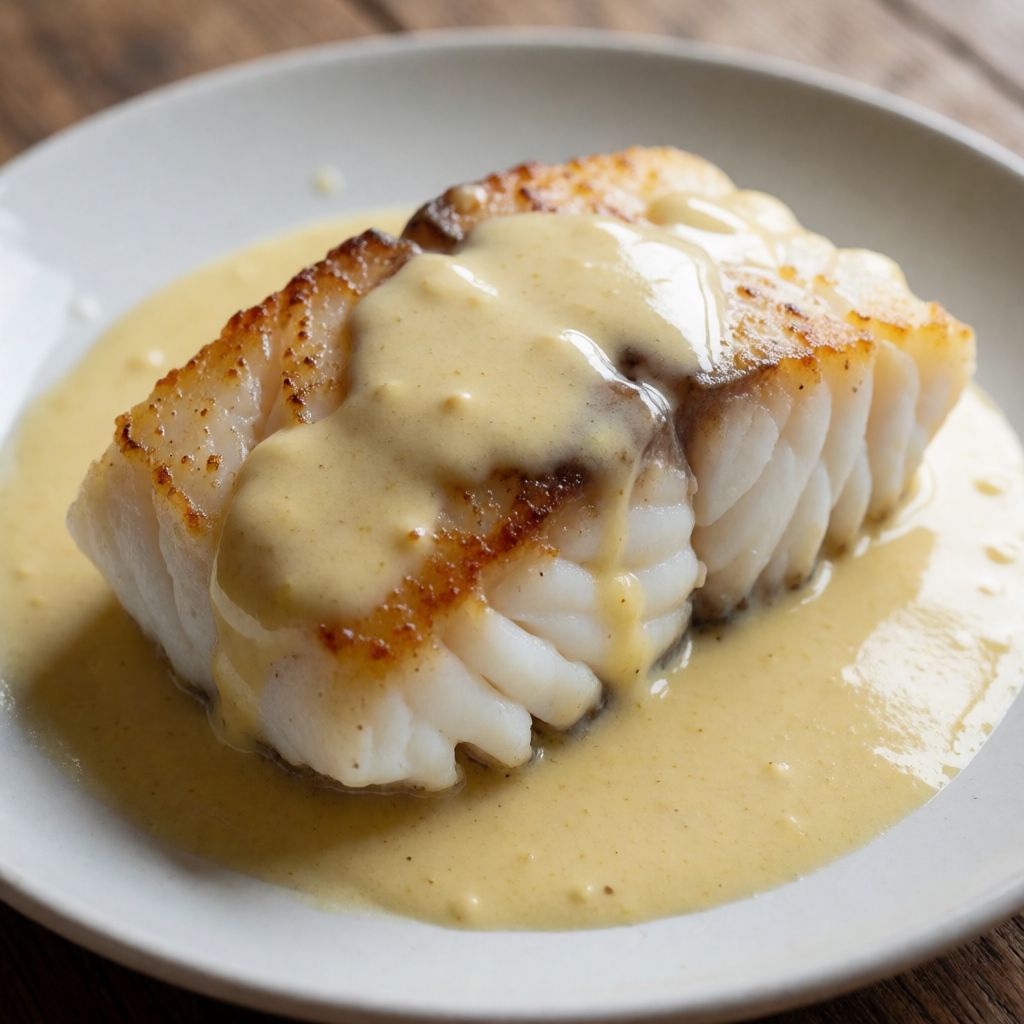
 AI photo
Cod with Mustard Sauce
Oven-baked cod fillet with a creamy mustard sauce, served with potatoes, crispy bacon, egg, pickled beetroot, horseradish and fresh dill.
Labels are worked out automatically from the ingredients and can be wrong. Check the packaging if it matters to you.
Ingredients
- 800 g Cod
- 30 g Butter
- Salt
- Black Pepper freshly ground
- 30 g Butter
- 2 tbsp Plain Flour
- 300 ml Milk
- 100 ml White Wine
- 2 tbsp Mustard
- 1 tsp Honey
- ½ pcs Lemon juice and finely grated zest
- 1 kg Potato
- 200 g Bacon fried until crisp and diced
- 3 pcs Eggs hard-boiled and roughly chopped
- 150 g Pickled Beetroot finely diced
- 20 g Horseradish freshly grated
- 1 bunch Fresh Dill
















Steps
Prepare the garnish in small bowls and set the potatoes to cook in lightly salted water.
Cut the cod fillet into 8 pieces, or bake it in one whole piece.
Dot the fish with small pieces of butter and season with salt and pepper.
Bake the fish in a fan oven preheated to 175°C for 10–12 minutes.
Check after 10 minutes — the fish should be just cooked and tender.
For the mustard sauce, melt the butter and whisk in the flour to form a smooth paste.
Pour in the milk and white wine and bring to the boil, stirring until the sauce is creamy.
Whisk the mustard into the sauce and season with honey, lemon juice, zest, salt, pepper and extra mustard to taste.
Serve the hot baked cod with warm potatoes, mustard sauce and the garnish, sprinkled with fresh dill.
This is a fish dinner built on a basic kitchen trick: a roux-thickened sauce doing the heavy lifting while the fish itself stays almost untouched. Cod is a lean, flaky fish with almost no fat of its own, so it dries out the moment you overcook it — the whole dish is designed around protecting that one weak point. Everything else: the potatoes, the bacon, the beetroot, the egg, is there to give you things to put a spoonful of sauce on, because mustard sauce on its own, with nothing to carry it, is just sauce in a jug.
What decides whether it works is restraint in two places. First, the fish — you are baking it, not roasting it, and the difference matters: roasting wants colour and time, baking at a gentler setting with a knob of butter melting over the top wants moisture kept in and nothing else. Second, the sauce — a béchamel base (butter, flour, milk) loosened with wine and then turned savoury-sharp with mustard, honey and lemon. Get the roux stage wrong — rush it, or burn the flour — and every spoonful after tastes of raw flour or scorched butter, no matter how good the mustard is.
Some say fish needs a hot oven to "seal in the juices." No — fish has no juices to seal, not in the way meat does; its fibres are short and its fat layer thin, so a hot blast just cooks the outside to rubber before the inside catches up. A moderate, steady heat gets there slower but evenly, which with something this delicate is the only kind of gentle that counts.
Start with the cod itself — 800 g, enough for four people if you're serving it alongside potatoes and a sauce doing real work, not as the sole event. Buy it thick-cut if you can; thin tail-end fillets cook through in minutes and give you no margin for error, which with an oven that doesn't communicate its actual internal temperature (most domestic ovens drift 10–15°C from the dial) is exactly the margin you need. Any firm white fish — haddock, pollock, even a thick hake fillet — substitutes here on one criterion: lean flesh that flakes rather than melts. Salmon, with its own fat, will survive heat you weren't planning for and masks whether you got the technique right, so it's not a fair stand-in if you're learning the dish.
The butter dotted over the fish before baking isn't decoration — it's the only fat source the cod has, and as it melts it bastes the surface, which is the nearest thing to insurance against the dryness lean fish is prone to. Don't skip it and expect the sauce to compensate; sauce poured over dry fish just sits on top, it doesn't rehydrate anything.
For the sauce: butter and flour in equal-ish weight, cooked together into a paste before any liquid goes in — this is a roux, and its job is to coat the starch granules in fat so they swell smoothly in the milk rather than clumping. Any flavourless fat works for the base in principle, but butter's dairy fat marries with the milk that follows, so don't swap in oil here, it's one of the few places in this recipe where the substitution rule actually has a hard boundary. The milk plus wine gives you body and a faint acidity before the mustard even arrives — wine here is doing what vinegar does in other sauces, cutting the richness of butter and milk so the whole thing doesn't sit heavy. If you don't drink or don't keep wine open, a spoon of cider vinegar in the milk achieves the same edge, though you lose a little depth.
Mustard, honey, lemon — three opposing forces balanced against each other: sharp, sweet, sour. This is not a sauce you can eyeball once and leave; taste as you add, because mustards vary wildly in heat (English mustard is far sharper than a French Dijon-style, and if that's what's in your cupboard, start with half the amount and build up). The honey isn't there to make it sweet, it's there to round off the mustard's bite so it doesn't read as aggressive on cod's mild flesh.
The potatoes want nothing fancy — boiled in salted water until a knife or the point of a fork goes in without resistance, no bend-test needed here since they're whole and going straight to the plate, not into a mash. Bacon fried until it's properly crisp, not just cooked, because soft bacon in this dish just goes limp and sad sitting next to boiled potato; crispness is the only texture contrast you're bringing to a plate that's otherwise soft, flaky, and creamy. Horseradish wants grating fresh if you can get the root — the jarred creamed kind has already lost most of its bite to vinegar and preservation, and here you want it sharp enough to cut through the sauce, not just along for the ride.
Patience shows up twice and only twice: in the few minutes the roux needs at low heat so the flour cooks out before liquid hits it, and in checking the fish a touch early rather than trusting a timer blindly, because the exact number of minutes depends on the thickness of your particular piece, not on the clock.