
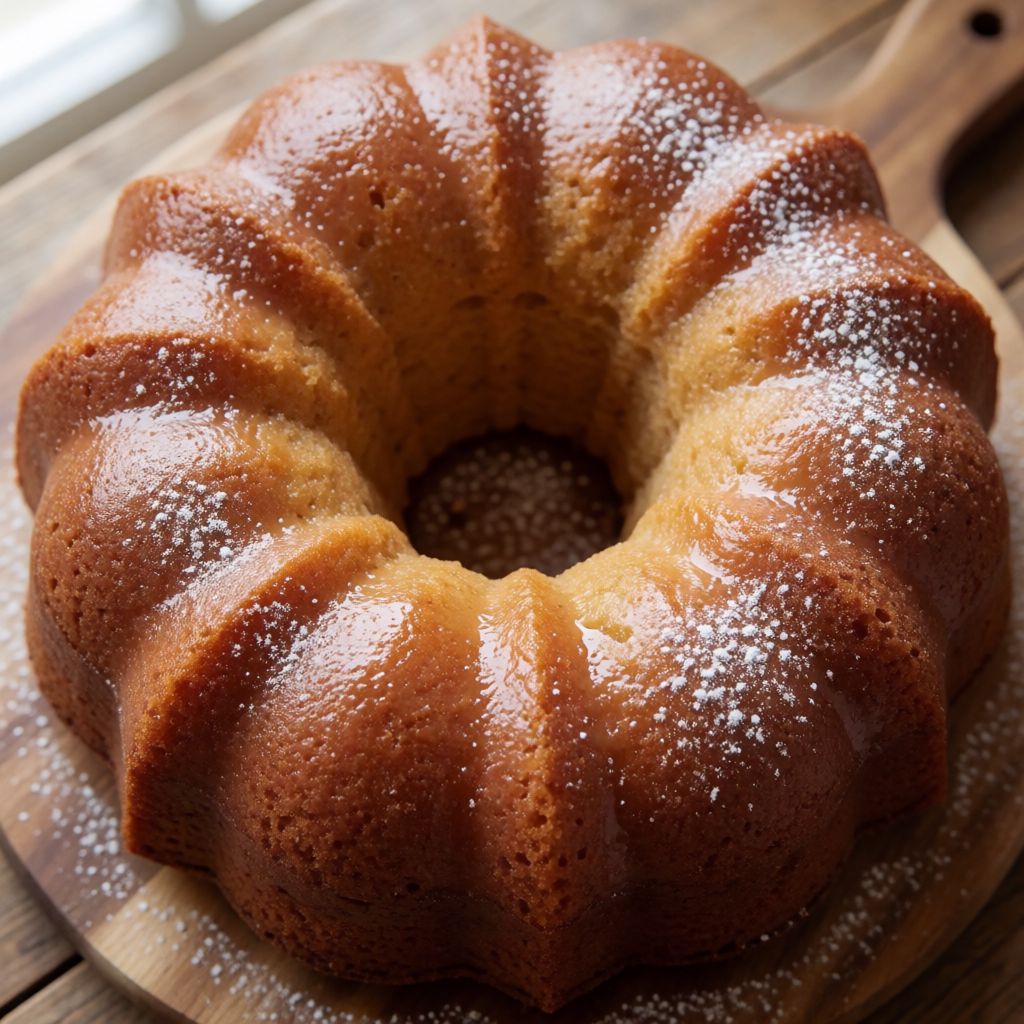
 AI photo
Coffee Bundt Cake (Ciambella)
A coffee-flavoured bundt cake, light and fragrant, perfect for afternoon tea.
Labels are worked out automatically from the ingredients and can be wrong. Check the packaging if it matters to you.
Ingredients
- 3 pcs Eggs
- 200 g Sugar
- Lemon zest to taste
- 1 tsp Vanilla extract
- 1 pcs Baking powder 1 sachet
- 150 g Butter
- 350 g Durum flour
- 300 ml Coffee
- Icing sugar to taste
- Drinking chocolate to taste
- Coffee beans to taste











Steps
In a bowl, beat the eggs with the sugar until pale and fluffy.
Add the lemon zest, vanilla extract, baking powder and melted butter. Mix well.
Gradually add the sifted durum flour, mixing into a smooth batter.
Add the coffee and mix well until the batter is smooth and pourable.
Grease a 24 cm bundt (ciambella) tin and dust with flour, then pour in the batter.
Bake at 180°C for 35 minutes in a conventional oven.
35 minRemove the cake from the oven and let it cool completely.
Decorate the cake with icing sugar, drinking chocolate and coffee beans.
What was changed
Replaced Vanilla extract with vanilla extract, as it is the form British shoppers commonly use instead of vanillin sachets.
A ciambella is the ring cake Italian nonnas bake when they want something to go with coffee in the afternoon, not something to show off at a party. The hole in the middle isn't decoration — it's engineering. A solid 24cm block of this batter would cook to a dry crust on the outside long before the centre set, because heat has to travel all the way to the middle from every side. Put a hole through it and there's no "middle" anymore — everything is close to a hot surface, so it bakes evenly and faster. That's the whole reason bundt tins exist, not because rings look pretty.
What decides whether this works is the eggs-and-sugar stage, not the oven. Beating eggs with sugar until they go pale and triple in volume is you building the cake's only real structure — thousands of tiny air bubbles trapped in egg protein. Durum flour (the hard, high-gluten wheat used for pasta, not your usual soft cake flour) adds backbone but almost no lift of its own; it leans entirely on what you whipped in at the start and on the baking powder. Skip the whisking, or rush it, and you get a flat, dense ring no amount of oven time fixes — a cake problem is almost always a mixing-bowl problem, not a baking one.
Some say you must use a stand mixer for this — no, because what matters is time and friction, not horsepower. A hand whisk and a bit of patience gets you the same pale, thick ribbon; it just takes longer and your arm notices.
On ingredients: the coffee is not flavouring, it's your only liquid — 300ml against 350g flour is what makes this a pourable batter instead of a stiff dough, so use coffee you'd actually drink, even instant is fine if it's strong, because weak coffee just gives you a wetter, blander cake with nothing to show for the extra water. Lemon zest does a specific job too — it cuts the slight bitterness of coffee and butter with a top note, the way a squeeze of lemon lifts a rich sauce. Leave it out if you don't have it; the cake survives, it just tastes flatter.
Durum flour is the one ingredient worth seeking out rather than substituting blind. It's the coarse, pale-yellow semolina-type flour Italians use for pasta — higher in protein than your standard plain or cake flour, which is exactly why it gives a ciambella its slight chew instead of the crumbly softness of a Victoria sponge. If you can't find it, fine plain flour works, but know you're trading a bit of structure for a bit of tenderness — not a disaster, just a different cake. Don't reach for strong bread flour as a "closer" substitute — too much gluten here makes the crumb tough rather than toothsome.
Butter should be melted, not softened and creamed as you'd do for a Victoria sponge — this is a different method, oil-cake logic borrowed for a butter cake, which is why it comes together faster than a classic creamed cake. Any neutral oil can stand in for some or all of the butter if that's what's in the cupboard; you lose a little richness and the faint dairy smell, but the cake still rises and still holds together, because the lift here comes from eggs and baking powder, not from butter whipped full of air.
On the tin: a 24cm bundt tin is specific for a reason — too small and the batter overflows or takes forever to cook through; too large and you get a thin, pale ring that dries out before it colours. If you only own a plain round tin, you can still bake this — just know it'll behave like the "solid block" problem above, needing longer, gentler heat, and the centre is the part to watch. Greasing and flouring the tin properly isn't a ritual, it's what stops the delicate crumb tearing itself apart when you try to unmould a cake with no flat base to grip.
180°C for 35 minutes is a reasonable start, not a guarantee — ovens lie, especially domestic ones with hot spots. The real test is the one every Italian grandmother uses and no thermometer beats: a skewer or thin knife into the thickest part of the ring comes out clean, with no wet batter clinging to it. If it comes out streaked, give it more time rather than trusting the clock — the 35 minutes is your floor, not your ceiling.
Let it cool completely before you dust it with icing sugar and cocoa or drinking chocolate. This isn't patience for its own sake dressed up as a rule — icing sugar on a warm cake just melts into damp patches instead of sitting as a clean white dusting, and a warm ring is softer and more likely to break when you finally turn it out of the tin. Coffee beans on top are purely for show, telling the eye what the cake tastes like before the fork arrives — skip them without any loss to the cake itself. Alongside tea with milk this works fine too, despite being built for coffee; the cake doesn't know what's in your cup.