
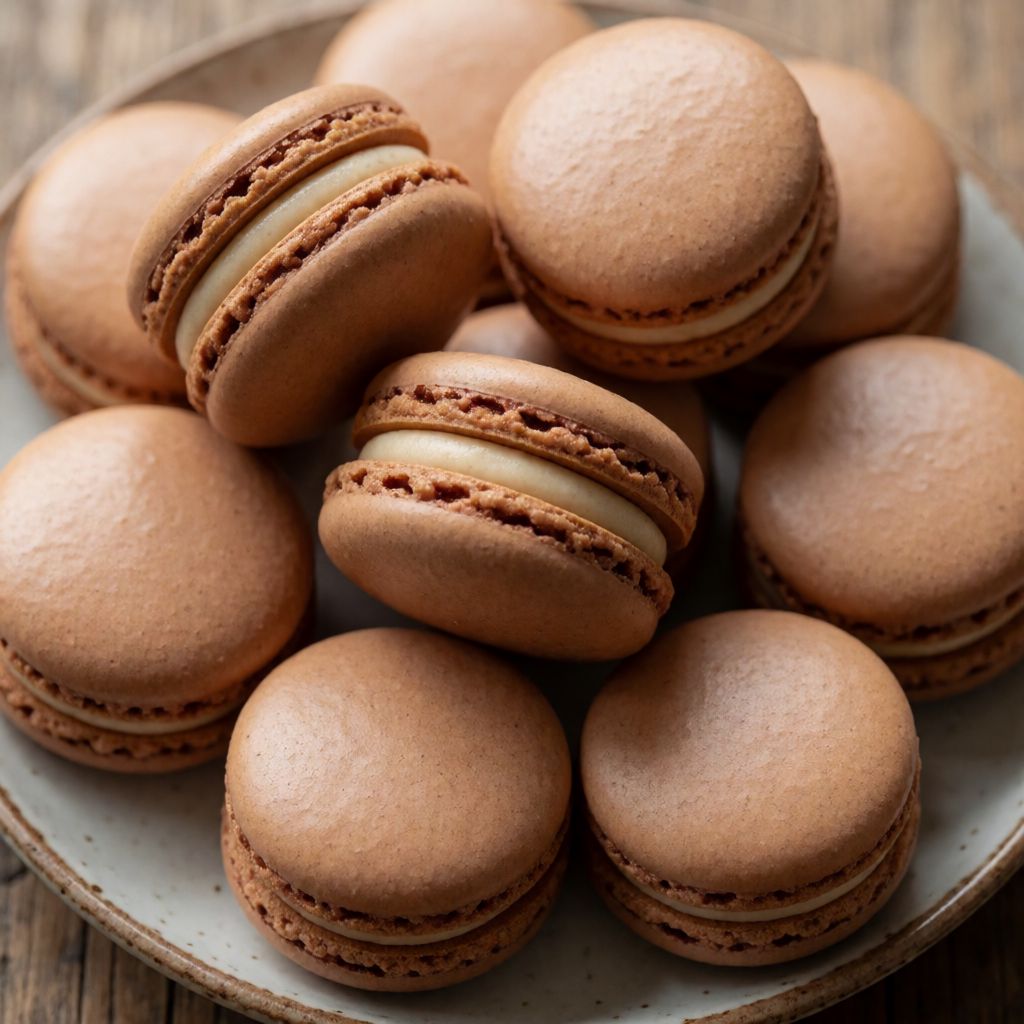
 AI photo
Coffee Macarons
Delicate almond macaron shells filled with a smooth white chocolate and coffee cream.
Labels are worked out automatically from the ingredients and can be wrong. Check the packaging if it matters to you.
Ingredients
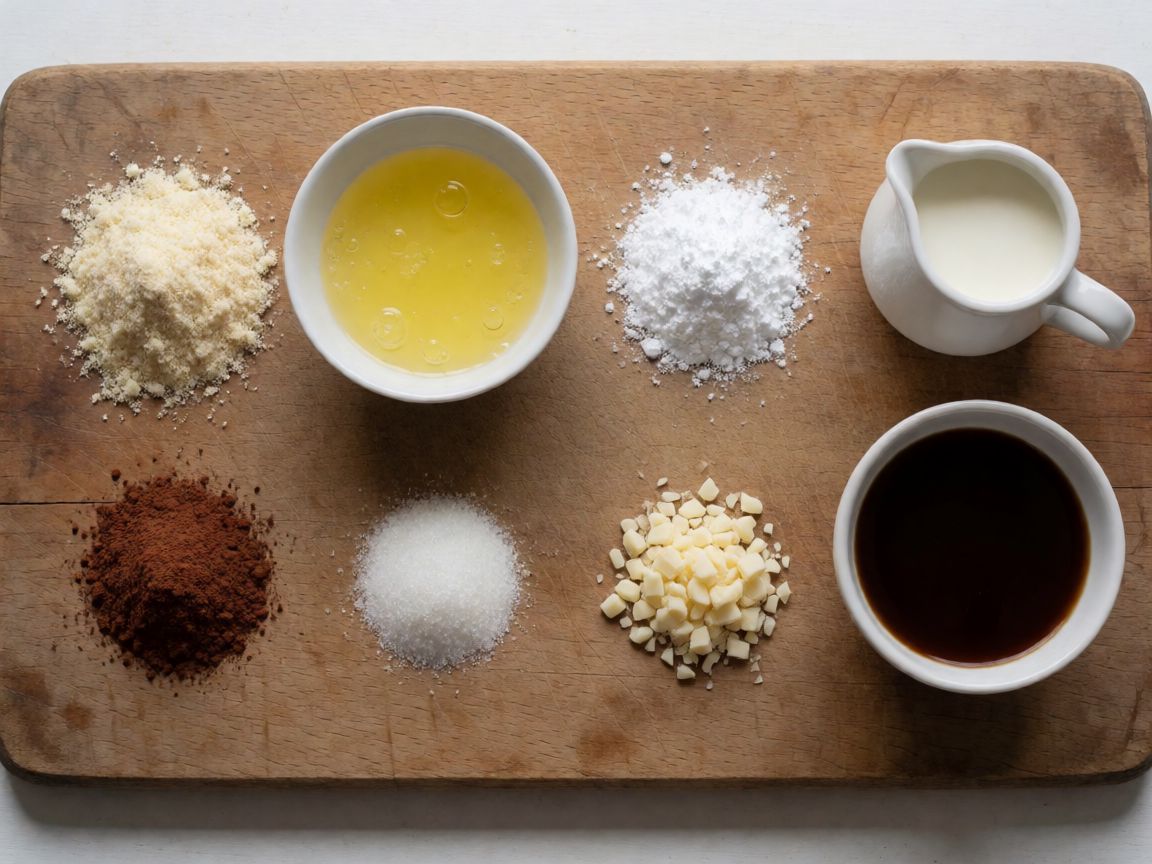
- 110 g Almond flour
- 90 g Egg whites
- 200 g Icing sugar
- 10 g Cocoa powder
- 40 g Caster sugar
- 100 ml Double cream
- 200 g White chocolate
- 1 pcs Coffee strong brewed, 1 small cup







Steps
Sift the almond flour, cocoa powder and icing sugar together and combine.
Whisk the egg whites to a stiff foam and gently fold into the dry mixture with bottom-to-top strokes.
Keep folding until the batter is smooth and flowing, but not too runny.
Transfer the batter to a piping bag and pipe rounds about 2 cm across onto a parchment-lined baking tray.
Leave the shells at room temperature to form a skin.
30 minBake at 140°C.
22 minLet the finished macarons cool completely.
Melt the white chocolate over a bain-marie or in the microwave, let it cool, then combine with the double cream and coffee.
Mix the cream and chill it.
60 minWhisk with a mixer until thick and smooth.
Fill half of the macaron shells with the cream using a piping bag.
Decorate with coffee powder.
Let the macarons rest in the fridge for a full day.
A macaron is not a cookie that happens to be round — it's a meringue holding sugar and almond flour in suspension, baked just enough to set a shell while the inside stays soft. Everything that goes wrong with macarons — cracking, hollow feet, no "pied", chewy-to-the-point-of-rubbery shells — comes down to one thing: how much air is in that meringue and how patiently you let it go.
Folding is the real recipe here, not baking. "Macaronage" — the French call it that, which sounds fancier than it is — means you deliberately knock some air out of a stiff foam by folding it into the almond-sugar mix, bottom to top, until the batter moves like thick lava and a ribbon of it dropped back into the bowl disappears into the surface in about ten seconds. Stop too early and the shells sit domed, cracked and craggy because there's still too much trapped air expanding unevenly in the oven. Go too far and the batter spreads flat and footless on the tray, because you've beaten all the structure out of it — there's nothing left to hold a shape. There is no fixed stroke count. You watch the batter, not the clock.
An ordinary UK kitchen handles this fine — you don't need a stand mixer shaped like spaceship equipment, just a hand whisk or electric beaters, a tray lined with parchment (greaseproof paper works, just don't use anything shiny and non-stick-coated that the batter might slide off), and a piping bag. If you've never piped anything, a strong sandwich bag with the corner snipped off does the same job — the macaron doesn't care about your equipment budget, only about consistent-sized blobs about 2cm across, because shells of different sizes bake at different rates and you'll be matching halves by eye later, cursing the big one that won't fit its small other half.
Almond flour here is doing a job regular flour can't: it has no gluten, so it won't toughen the shell, and its fat content gives the meringue something to cling to as it dries. Buy it finely ground — the coarser almond meals sold for frangipane will leave a bumpy, cracked shell because the egg white can't coat the larger particles smoothly. If you genuinely have none, ground hazelnuts sieved fine are the nearest stand-in, though the flavour shifts.
Icing sugar and caster sugar are both doing different work, which is why the recipe uses both rather than one or the other in double quantity. Icing sugar goes into the almond mix dry, where its fine grain means it dissolves into the batter without leaving grit. Caster sugar goes into the egg whites while whisking, where its slightly coarser crystal helps stabilise the foam as it beats — fine sugar added too early to whites can actually slow the foam from forming properly, because the crystals need just enough resistance from the whisk to help unfold the egg proteins.
Egg whites: use them at room temperature, not fridge-cold — cold whites take longer to whip and hold air less willingly, because the proteins are stiffer and slower to unfurl. Any trace of yolk fat in the bowl will stop the whites from foaming at all; fat and air don't share a bowl happily. Whisk to "stiff foam" means the peak holds its shape when you lift the whisk out and doesn't slump — under that, your batter will be too wet to hold a dome.
Cocoa powder goes into the dry mix purely for colour and a faint bitterness against the sweet shell — it's not doing the coffee flavour's job, so don't be tempted to skip it thinking the coffee cream will cover for it; the shell and filling are two separate flavour layers meant to contrast, not duplicate.
White chocolate in the filling is mostly cocoa butter and sugar with almost no cocoa solids, so it melts into the cream smoothly and sets up firm again once chilled — that's the structural backbone of your ganache. Dark or milk chocolate would behave very differently, setting harder and tasting far less sweet, so don't swap it in without expecting a different filling altogether. Melt it gently — a bain-marie (a bowl over, not in, simmering water) or short bursts in the microwave — because chocolate scorched even slightly seizes into a grainy paste that no amount of cream will smooth back out. Let it cool before adding the cream and coffee, or the heat will thin the cream and you'll be waiting even longer in the fridge for it to firm up.
The "1 small cup of strong coffee" is deliberately vague on method because it doesn't matter how you make it — espresso, strong filter, even a concentrated instant — as long as it's strong and it's cooled before it meets the chocolate. Hot coffee poured into warm chocolate and cream is how you end up with a filling that separates instead of thickening.
Six servings assumes a modest macaron-eating sitting — a small plateful with Sunday tea, not a dessert course on its own. Macarons are rich in small bites; nobody needs twelve of them after a roast dinner.