
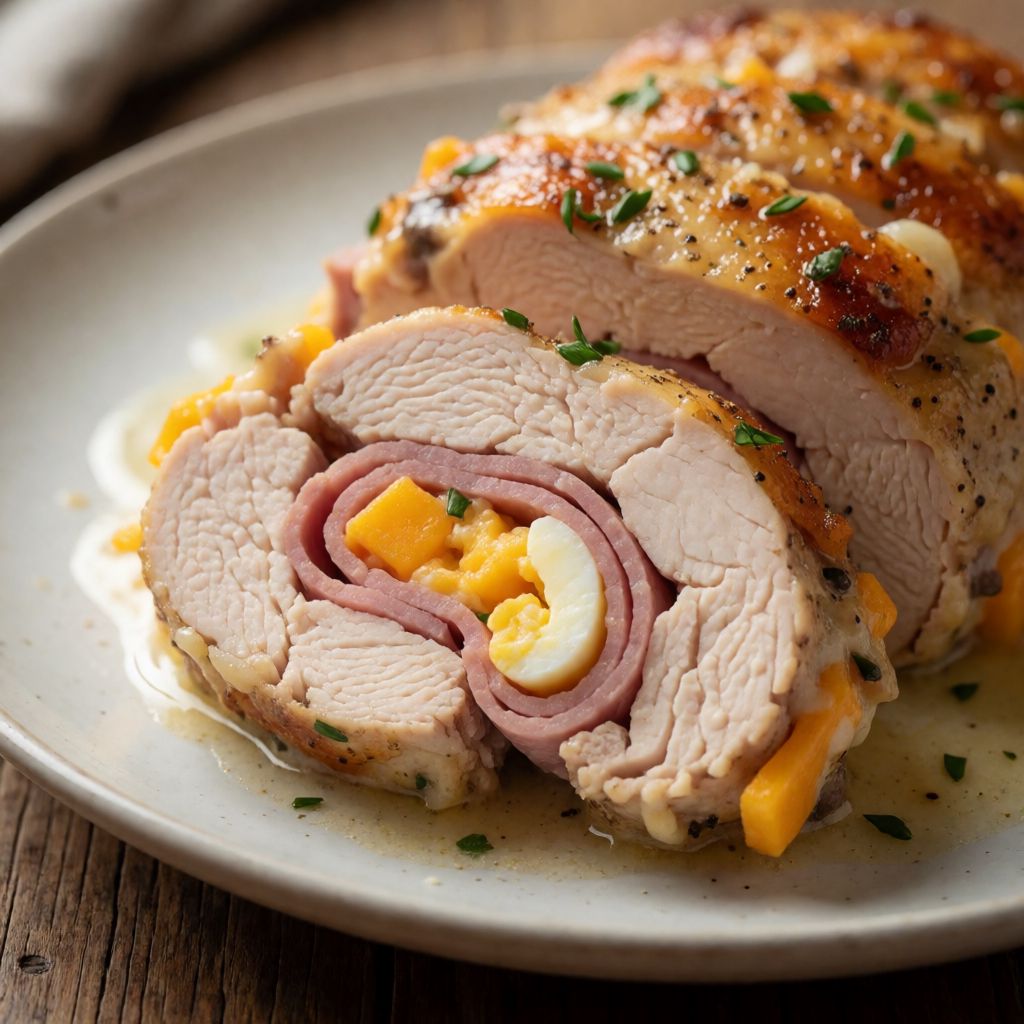
 AI photo
Chicken Cordon Bleu
Chicken escalopes stuffed with ham and melted cheese, breaded and fried until golden.
Labels are worked out automatically from the ingredients and can be wrong. Check the packaging if it matters to you.
Ingredients
- 8 pcs Chicken escalopes
- 4 pcs Ham
- 4 pcs Mature cheddar slices
- 2 pcs Eggs
- Salt to taste
- Black pepper to taste
- Breadcrumbs for coating
- Peanut oil for frying







Steps
Pat the chicken escalopes dry with paper towel. If too thick, pound with a meat mallet to make them thin and tender.
On 4 of the 8 escalopes, place a slice of ham and a slice of mature cheddar, leaving a couple of centimetres free at the edge.
Cover each stuffed escalope with a second one, pressing the edges firmly so they seal well.
Coat the escalopes first in egg beaten with salt and pepper, then in breadcrumbs. Repeat twice if you like.
Heat plenty of peanut oil in a pan and fry the escalopes one or two at a time, browning both sides until cooked through.
15 minPlace the escalopes on paper towel to drain excess oil, and serve immediately.
What was changed
The chicken escalopes were used as the author described Chicken escalopes, and the stretchy cultured cheese was replaced with Mature cheddar, a melting cheese familiar to British shoppers.
Cordon bleu is a sealed parcel, not a stuffed cutlet. You're building a small bag: ham and cheese zipped shut between two thin sheets of chicken, armoured in a crust of egg and crumb. The pounding, the double coating, the pressed edges — none of it is decoration, it's all there to keep that bag shut once it hits hot oil. A leak is the only real way this dish goes wrong.
Some recipes tell you to cut a pocket into one thick escalope instead of sandwiching two thin ones. Don't — a pocket has a single thin wall holding the filling in, and chicken breast splits along its grain, so that wall tends to tear right where the cheese is waiting to escape. Two escalopes pressed edge to edge give you a double rim to seal instead of one weak one. Twice the insurance, same amount of trouble.
The crust has exactly one job: set before the cheese inside melts its way out. Pat the chicken properly dry first — a damp surface won't hold egg, and wherever the egg slides off is exactly where oil will get in later. If the first coat feels thin under your fingers, do it twice; a thin crust behaves like a sieve, not a seal. The oil has to be properly hot before anything goes in — drop a crumb in and it should sizzle and rise straight away. Go in too cool and the crust soaks up oil like a sponge instead of crisping, which is the greasiness people blame on "too much oil" when the real fault is oil that was never hot enough.
The name sounds borrowed from some French kitchen with a medal on the wall, and that's roughly the trick of it — "cordon bleu" lends prestige to what is, underneath, an economical idea: take a flat, cheap piece of meat, pad it out with ham and cheese so one escalope reads as a full meal, and sell it as something grander than fried chicken. Most food historians point to Switzerland, mid-20th century, not Versailles — a place that never ran short of cheese and ham. No aristocracy in the pan, just sound arithmetic.
Use chicken breast for the escalope, not thigh — breast is even in thickness once pounded, pale, and takes the mallet cleanly, where thigh, looser in its fibres, tends to fall apart under it. Pat it dry before anything else happens to it: a damp surface refuses egg, and refused egg means refused crumb, and that's your seal gone before you've started.
Ham is there for salt and cure, no particular pedigree required — whatever thinly sliced ham is in your fridge, cooked or air-dried, will do the job. What matters is a slice that won't weep water into the sandwich once it warms up. Mature cheddar earns its place too: it melts into a slow, thick pool rather than running thin and fast the way a soft cheese like mozzarella would, finding every gap the mallet left. No cheddar — reach for anything with enough body to hold its shape right up until it finally gives: Gruyère, an aged Gouda, a sharp Comté.
The egg does two jobs at once. It's the glue the crumb sticks to, and since nothing inside the parcel gets seasoned directly, the salt and pepper beaten into it is the only seasoning the chicken meets before it reaches your plate. Breadcrumbs, dried rather than fresh if you have the choice — dried packs tighter and drinks up less oil. A loose, fresh crumb leaves air gaps, and air gaps are exactly where fat finds its way through.
On the oil, the real rule is "any oil with no smell of its own" — peanut, sunflower, rapeseed, whatever sits in the cupboard that isn't olive oil. Olive oil has its own voice and a lower smoking point, so under the heat this frying needs it scorches and argues with the ham and cheese instead of staying quiet.
A domestic kitchen has no deep fryer and usually no thermometer, so you read the oil by eye and ear — a shimmer on the surface, a sizzle that starts the instant a crumb lands in it. A wide pan, not a kazan, means frying one or two escalopes at a time rather than crowding four in cold — crowd it and the oil temperature drops the moment the chicken goes in, and the crust soaks instead of crisping. Watch colour, not the clock: pale gold going to deep amber on both sides is the real signal, though fifteen minutes is roughly what a properly thinned escalope needs to cook through before the crust burns. Eight thin escalopes make four sandwiches, which feeds four — one each, alongside whatever usually sits next to a Sunday roast. This isn't a dish that asks for much company on the plate.