
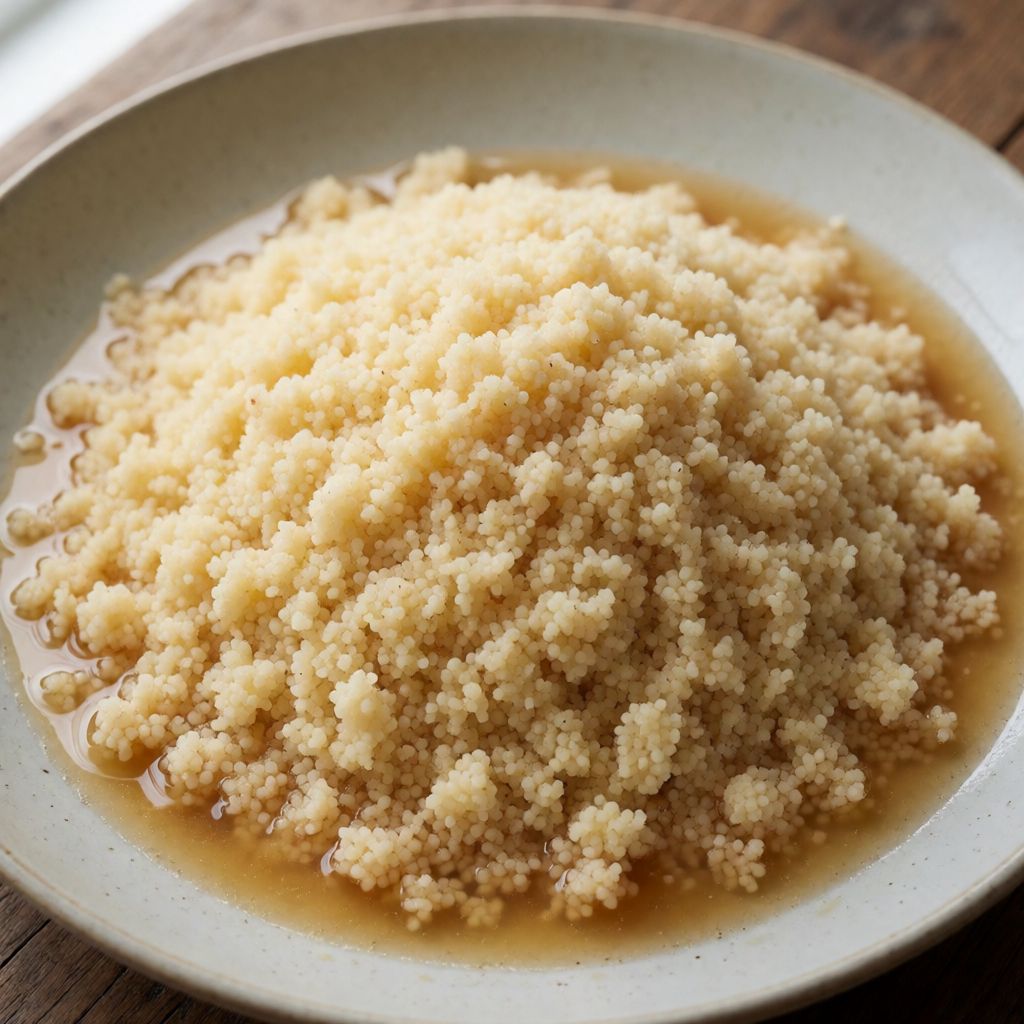
 AI photo
Couscous with Seafood
A hearty couscous dish with clams, mussels, prawns, swordfish and squid in a light tomato and white wine sauce.
Labels are worked out automatically from the ingredients and can be wrong. Check the packaging if it matters to you.
Ingredients
- 250 g Couscous
- 400 ml Fish stock
- 300 g Clams
- 200 g Mussels
- 300 g Prawns
- 200 g Swordfish
- 250 g Squid
- 200 g Cherry tomatoes
- Olive oil to taste
- Chives to taste
- Salt to taste
- Black pepper to taste
- 0.5 pcs Onion
- 120 ml White wine












Steps
Fill a bowl with cold salted water, add the clams and soak for about 30 minutes.
30 minIn a non-stick pan, fry the finely chopped half onion for a few minutes.
Cut the swordfish into chunks and the squid into thin rings, add to the pan and fry for a few minutes until it reaches 63°C.
Pour in the white wine, add the cherry tomatoes cut in half, and cook for about 10 minutes.
10 minRinse the prawns, remove the head, legs, tail and shell, and devein.
Add the peeled prawns to the pan together with the fish stock.
In another pan, cook the clams and mussels over high heat until the shells open, then remove from the shells.
Add the shelled clams and mussels with the strained liquid to the pan with the prawns and swordfish.
Season with salt and pepper, add the chives, and cover with a lid.
In a pot, put the couscous, add the fish stock and stir until the liquid is fully absorbed, then fluff with a fork.
Transfer the couscous to a bowl, add the dressing, garnish with mussels and clams, and serve hot.
This is couscous doing what couscous was always meant to do for a fisherman's family in the Maghreb and across the Mediterranean rim where it travelled: soak up whatever the sea gave that day. It is not a pasta dish with couscous subbed in for penne. Couscous here is a sponge with a specific thirst — it drinks exactly its own volume of hot liquid and no more, and that single fact decides whether your plate is fluffy grain or wet porridge.
What decides this dish is layering, not timing in any single step. You build three things in parallel: a seafood ragù that gets its depth from fond and wine, a quick steam-open for the shellfish that gives you a clean stock, and the couscous that just sits there absorbing. None of these needs more than ten minutes of real attention. What they need is to happen in the right order so nothing overcooks while something else catches up.
The swordfish and squid go in first because they're the ones that punish you for rushing — squid turns to rubber band if you chase it past the point of no return, and the only honest marker is texture, not a clock. The prawns and shellfish come later because they cook in a minute or two, full stop; drop them in early and by the time the tomatoes have softened, your prawns are already sawdust.
Start with the clams: that half-hour soak in salted cold water is not optional theatre, it's dumping grit. Clams filter sand through their shells as they sit; fresh salted water at roughly seawater salinity convinces them to open up and expel it. Skip it and the defect doesn't announce itself until you're chewing — a gritty bite is the one thing that makes people put the fork down. If you only find frozen pre-cleaned clams or mussels (very common on UK supermarket shelves), you can skip the soak; they've already been through this.
The fish stock is doing two jobs — it's both the braising liquid for the ragù and the rehydrating liquid for the couscous — so don't reach for a stock cube dissolved in boiling water out of habit. A thin, salty cube stock will make bland couscous and an over-salted sauce at the same time, because you're using it twice. If you can't get proper fish stock, simmer the prawn shells and squid trimmings in water with a bay leaf for twenty minutes — you're paying nothing extra and you get real flavour from parts you'd otherwise bin.
Swordfish is here for its firmness — it holds its shape in chunks the way a flakier white fish won't. If your fishmonger (or the fish counter at a bigger Tesco or Waitrose) doesn't have it, use another dense, meaty fish — tuna loin or a thick cod loin cut generously — anything that won't disintegrate into the sauce when you stir. The squid should be cut into rings thin enough to cook through in the same couple of minutes as the fish chunks; cut it thick and you'll either undercook the fish waiting for the squid, or turn the squid leathery waiting for the fish.
The white wine isn't for flavour alone — it deglazes the fond stuck to the pan from frying the fish and onion, lifting it back into the sauce instead of leaving it burnt on the metal, and the alcohol cooks off while the tomatoes break down, leaving acidity that cuts through the richness of the shellfish liquor. Any dry white works; you're not meant to taste "wine," you're meant to taste what the wine dissolved.
Olive oil here should have no strong personality of its own at this stage — you want it as a cooking medium and a finishing note, not competing with brine and chive. Extra virgin for the finish if you like a grassy top note, a plainer olive oil for the frying. Chives at the end are freshness against all that soaked-up stock and shellfish iodine; don't let them cook, just scatter them in once the heat's off.
Patience here isn't about long cooking — this whole dish is under an hour — it's about not rushing the clam soak and not rushing the fish past 63°C into dryness. That's the one number worth watching in the whole method; everything else is reading the pan, not the clock. And the couscous itself needs a few quiet minutes under cover, off the heat, before you fork it loose — disturb it too early and it clumps instead of separating into grains.