
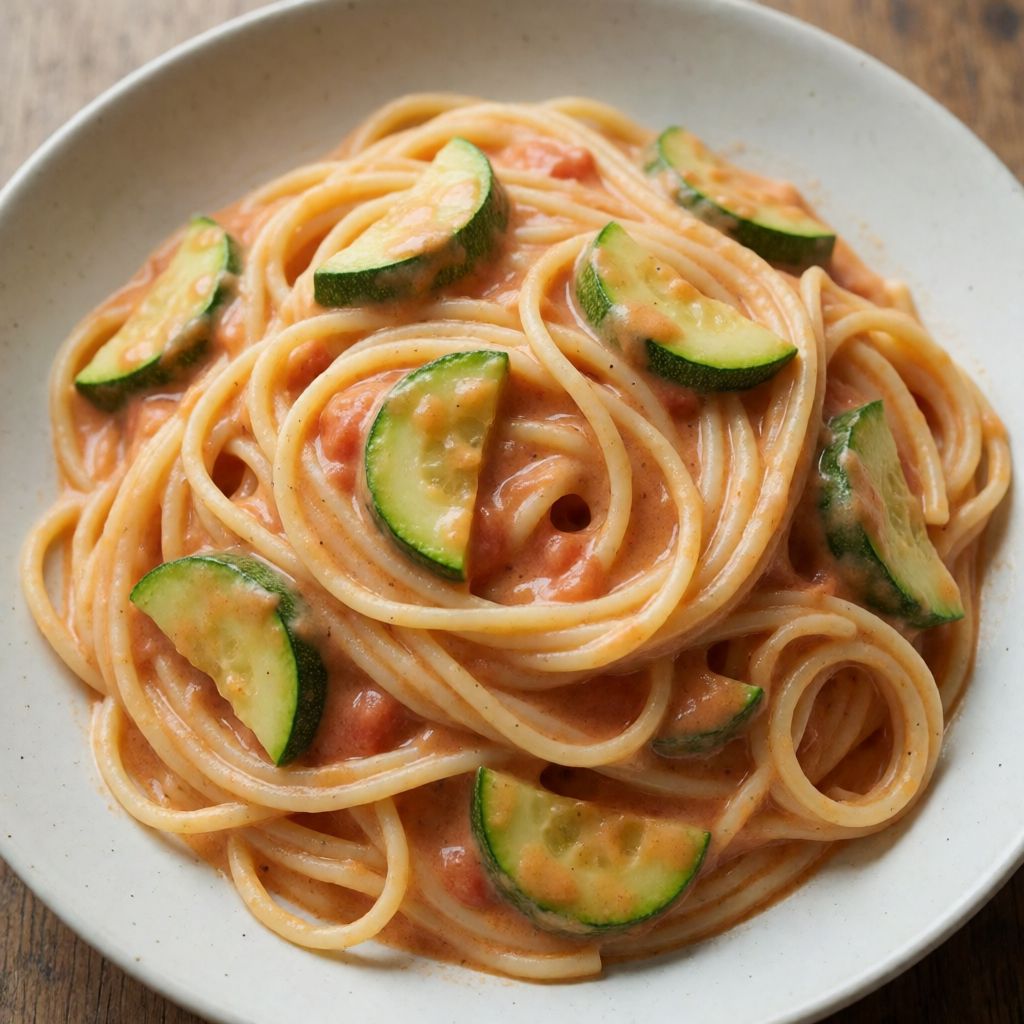
 AI photo
Creamy Courgette and Tomato Pasta
A creamy pasta dish with courgettes and tomato, finished with cream and parmesan.
Labels are worked out automatically from the ingredients and can be wrong. Check the packaging if it matters to you.
Ingredients
- 360 g Pasta
- 2 pcs Courgette approx. 300g
- 180 g Tomato passata
- 100 ml Double cream
- 0.5 pcs Shallot
- Salt to taste
- Black pepper to taste
- Olive oil to taste






Steps
Wash the courgettes and cut them into small pieces.
In a pan, fry half the shallot in olive oil, then add the courgettes.
Cover with a lid and cook, stirring occasionally.
15 minBring a pot of water to the boil and cook the pasta.
Season the courgettes with salt and pepper, then add the tomato passata and cream, and stir.
Transfer the cooked pasta to the pan and mix well with the sauce.
Sprinkle with grated Parmesan and serve.
What was changed
Tomato passata was used instead of tomato paste, to match the creamy sauce described in the original steps.
This is a quick weekday pasta, not a showpiece: courgette cooked down until it's soft enough to disappear into a pink sauce, bound with cream and tomato. What decides whether it works isn't the cooking of the pasta — that's just boiling water — it's what happens to the courgette before the sauce ever touches it.
Courgette is almost all water, something like 95%, and it has no sugar worth speaking of to caramelize quickly. So you don't fry it hard the way you'd fry an onion or a potato. You cover it. The lid in step 3 traps the steam the vegetable gives off and lets it cook in its own liquid, gently, on a hob that — let's be honest — can't produce the fierce, even heat of a professional burner anyway. That released water doesn't get poured away. It stays in the pan and becomes part of the sauce once you add the passata and cream, which is why the dish doesn't need stock or a splash of pasta water to loosen it. Fifteen minutes is the lower bound here, not the answer — you're waiting for the courgette's skin to lose its matte shine and the flesh to go slightly translucent at the edges, soft enough to give under the back of a spoon. Rush this and you get crunchy courgette sitting in a sauce that's trying to be smooth around it — the texture argument of the whole dish, lost.
Courgette: buy it firm, with skin that still has a shine to it — a dull, slightly wrinkled courgette has already started giving up its water in storage, and you want that water released in your pan, under your control, not before you've even started. Cut the pieces small and roughly even; too big and the centre stays raw while the outside collapses, too small and you get mush with nothing left to bite. There's no real substitute for courgette here — marrow is the closest relative, but it carries even more water and less flavour, so expect a longer wait under the lid and a blander result.
Shallot, and only half of one: a shallot is sweeter and softer than a storage onion, with less of that sharp bite that fights with cream. Half is enough because this sauce is meant to taste of courgette and tomato, not onion — the shallot is there to round things off, not to lead. If you've no shallot, use a small mild onion, or the white part of a couple of spring onions, sliced thin — the criterion is mildness, not a specific vegetable.
Tomato passata: this is tomato that's already been through a sieve — no seeds, no skin, no watery runoff, just a smooth, fairly thick liquid that coats instead of pooling. That body matters, because it's what gives the sauce substance without you having to reduce it for twenty minutes. If you only have tinned chopped tomatoes, blitz them smooth first; a tomato purée (the concentrated kind) thinned with a little water will also do, as long as you thin it to the consistency of double cream itself, not thinner.
Double cream: chosen for its fat content, not out of habit. Around 48% fat is enough to keep the sauce stable once it meets the acid of the tomato and the heat of the pan. If you reach for single cream or crème fraîche because that's what's in the fridge, lower the heat right down once you add it and don't let it bubble hard — less fat means less protection, and a hard boil is exactly when it'll split.
Olive oil here is doing more than lubricating the pan — it's meant to be tasted, giving the shallot a faint nutty background note under everything else. If you don't want that flavour, any oil with no smell of its own will fry the shallot just as well; you'll just lose that one quiet layer.
Pasta and cheese are the practical end of this. 360 g for four people works out to 90 g a head — a reasonable portion where the pasta is a carrier for sauce, not the main event, so a shape with ridges or hollows (penne, fusilli) will hold the little courgette pieces better than a long strand, though a long strand won't fail you either. Parmesan at the end is salt, savoury depth, and a cheese that melts into the dish using nothing but the pan's own leftover heat — no extra flame needed. Grana Padano is a cheaper stand-in with a milder edge; Pecorino will push the whole dish saltier and sharper, which isn't wrong, just a different dish wearing the same name.