
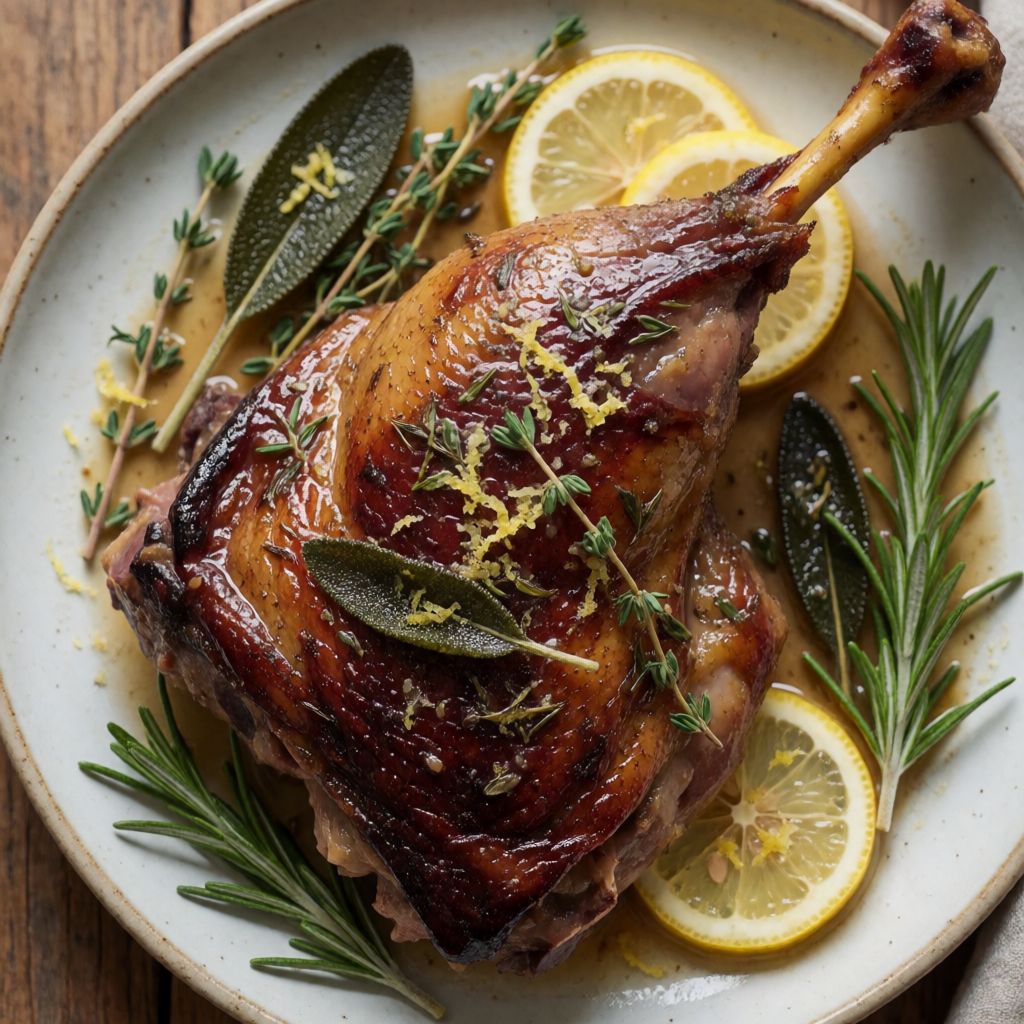
 AI photo
Duck Leg Confit in Its Own Fat
Duck legs slowly cooked in their own fat until melt-in-the-mouth tender, then crisped before serving.
Ingredients









Steps
Put the salt, pepper, sage, rosemary, lemon zest, garlic, sugar and thyme in a mortar and grind to a fragrant spice mix.
5 minRub the duck legs with the spice mix and leave them overnight in a covered bowl in the fridge.
540 minThe next day, wipe the spice mix off the duck legs. Melt the duck fat in a pan over low heat, add the legs so they're well covered in fat. Cover with a lid and let them cook gently on low heat for 3–4 hours.
210 minThey shouldn't boil, just barely simmer — this way the meat turns as soft as butter, not crisp like a roast.
Check the legs after a few hours. Once the meat is completely tender, they're ready. If not, give them a little longer.
Lift the legs out of the pan once the meat is perfectly tender, like butter.
To store until serving, place the legs in a clean bowl that's been rinsed with boiling water and dried well.
2 minStrain the sediment out of the duck fat and pour the clean, clear fat back over the legs in the bowl so they're fully submerged.
5 minTo serve, fry the confit legs in duck fat in a pan until the skin is crisp, or lay them on a parchment-lined baking tray. Sprinkle the skin with flaky salt and roast in a preheated fan oven at 220°C for about 10–15 minutes, until the skin is crisp.
12 min
What was changed
The oven temperature was rounded to 220°C to fit this kitchen's temperature steps.
Confit is a preservation trick that turned into a luxury. Centuries ago in Gascony, nobody had a fridge — so you salted the duck, then poached it slowly in its own rendered fat, which sealed it from air and let it sit for weeks without turning. You're not doing it to keep the duck for a month. You're doing it because the method happens to produce meat that falls apart like butter, with a skin that goes glass-crisp the moment it meets real heat. Keep the history, drop the need for it.
What decides whether this works is temperature control during the long cook, and it has nothing to do with "low heat" on a dial — every hob lies about what that means. What you want is fat that trembles, not fat that bubbles. A true simmer in fat (not water) sits somewhere around 90–95°C; anything hotter and you're frying the duck slowly instead of poaching it, and the meat tightens and dries exactly the way a roast does, just over four hours instead of one. The tell is visual: tiny, lazy bubbles rising here and there, never a rolling boil. If your pan is cranking out bubbles like a kettle, pull it off the heat for a minute and start again lower — there's no fixing overcooked confit, only underestimating how little heat it takes.
The duck fat is the main ingredient here, not a cooking medium you can swap out carelessly. A kilo sounds like a lot for four legs, but the legs need to be fully submerged — fat conducts heat evenly and gently in a way air in an oven never does, and any bit of leg poking out above the surface will dry and toughen while the rest goes soft. If you're short, you can top it up with a neutral fat that carries no flavour of its own — a plain sunflower or a mild vegetable oil will do in a pinch, though you lose some of the richness duck fat gives back to the meat. Don't use olive oil; its own flavour fights the duck rather than carrying it.
The herbs — sage, rosemary, thyme — are there for aroma that clings to the surface and perfumes the fat as it melts, which is why grinding them with the salt in a mortar matters: a knife-chop leaves the leaves too whole, and they won't release their oils properly into the rub. If you haven't got fresh herbs, dried will work at roughly a third of the volume, since drying concentrates them — but fresh rosemary and thyme are common enough in UK supermarkets year-round that it's rarely worth the substitute.
Lemon zest and sugar are the quiet workers in the cure. The zest's oils cut through the fattiness of the duck without making anything taste of lemon — you want brightness, not citrus. The sugar helps the salt draw moisture out of the meat faster and more evenly overnight, and balances the saltiness once the cure is wiped off; don't skip it thinking it's for sweetness, it isn't.
Garlic goes in raw and crushed into the rub, not cooked — its sharpness mellows over the long contact with the salted meat and the slow cook, turning soft rather than burning, which is what would happen if you tried to fry raw garlic cloves directly in the fat later.
On storage: the bowl rinsed with boiling water isn't fussiness, it's sterilising against the one real risk with any fat-submerged food — bacteria that get in before the fat sets and seals everything off from air. Strain the fat properly too; the bits of herb and spice sediment left behind are exactly what will spoil first if they're sitting in the fat with the meat for days.
For the finishing fry or roast — a domestic fan oven at 220°C is honest and hot enough to crisp duck skin that's already cooked through; you're not cooking the meat any further, you're just driving the moisture out of the skin fast so it shatters. Watch it rather than trust the clock: the skin goes from matte to glossy-blistered, and that change happens in its own time depending on how thick your skin is and how hot your oven genuinely runs, which on most UK ovens is a good few degrees off whatever the dial claims.