
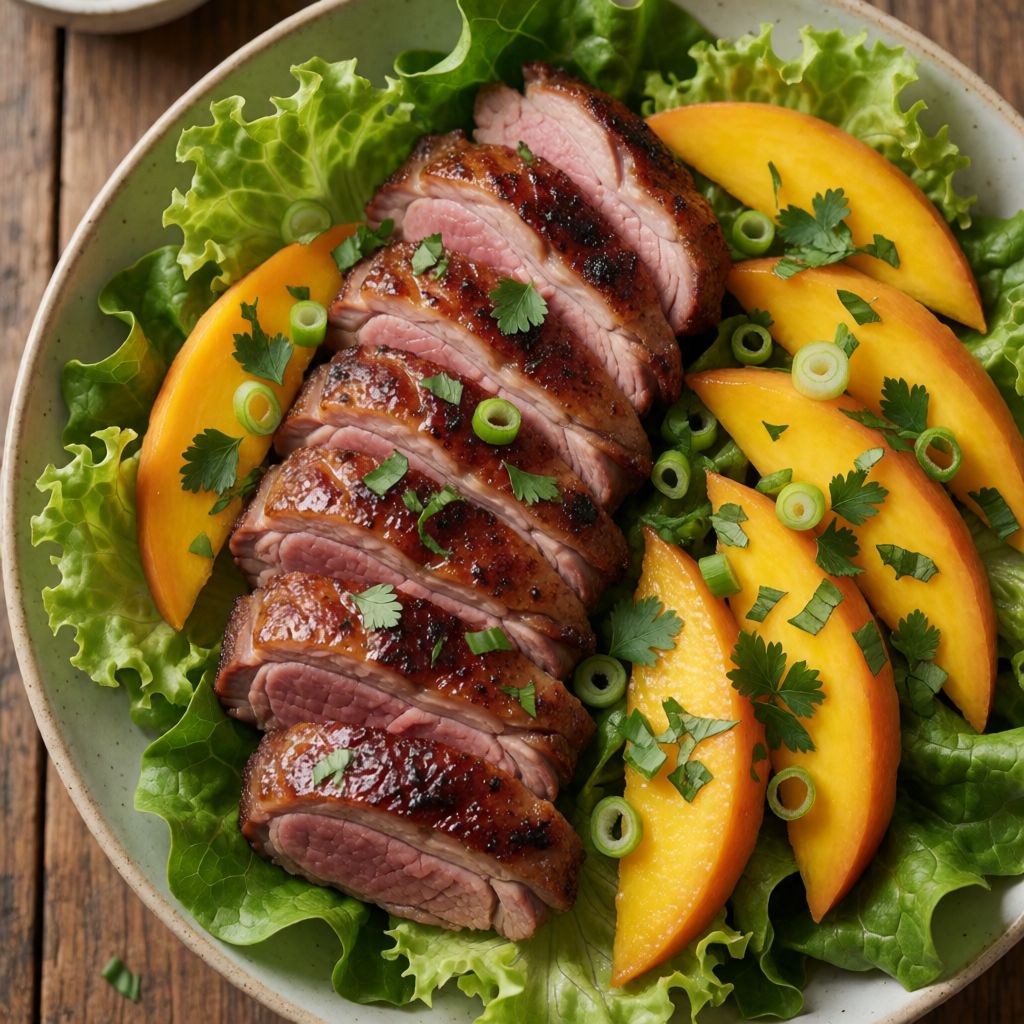
 AI photo
Duck and Mango Salad
A fresh duck and mango salad with crunchy peanuts, herbs and a creamy sweet chilli dressing.
Labels are worked out automatically from the ingredients and can be wrong. Check the packaging if it matters to you.
Ingredients
- 250 g Mixed salad leaves
- 2 pcs Duck thigh pre-cooked confit, or 300g cooked duck meat
- 4 pcs Spring onion thinly sliced
- 1 pcs Mango sliced
- 1 bunch Parsley finely chopped
- 1 bunch Coriander finely chopped
- 1 bunch Mint leaves
- 1 pcs Red chilli finely chopped
- 100 ml Peanuts roughly chopped
- 100 ml Crème fraîche
- 2 tbsp Mayonnaise
- 3 tbsp Sweet chilli sauce
- 1 tbsp Fish sauce
- 1 tsp Chilli flakes














Steps
Reheat the pre-cooked confit duck thighs in a dish in an oven preheated to 230°C for about 20 minutes, until the skin turns crisp.
20 minMix the crème fraîche, mayonnaise, sweet chilli sauce, fish sauce and chilli flakes, season to taste and let the dressing rest while the salad is prepared.
5 minToss the salad leaves and spring onion with the dressing and arrange on a plate, then scatter over the duck meat with the sliced mango, parsley, coriander, mint and peanuts.
2 min
What was changed
The oven temperature was adjusted to so it matches the display step used here; the duck thigh remains pre-cooked confit, simply reheated.
This isn't a green salad with a bit of duck dropped on top. It's a hot-cold salad — crisp duck meat straight out of the oven landing on cool leaves and raw herbs, with a dressing that works more like a dipping sauce than a vinaigrette. The whole point is the contrast: warm fat against cold crunch. If everything arrives at the table lukewarm and even, you've lost the dish before you've eaten a forkful.
What decides it is the duck skin, not the duck. Confit duck is already cooked — properly cooked, slow, in its own fat, sometimes days before it ever reaches your kitchen. So the oven here isn't cooking anything, it's drying and rendering a surface that's gone soft and rubbery from sitting in that fat. Some say reheat it gently so it doesn't dry out — no, because the meat underneath is protected by all that fat, it can't dry out in twenty minutes. What it can do is stay flabby, if the heat's too timid or the dish too deep and the fat has nowhere to run except back onto the skin. You want the fat gone from the surface and the heat aggressive enough that the skin shatters a little under a fork. That's the cue — not a timer, a sound and a give.
Start with the duck, because it explains the whole economics of this dish. Confit — salting meat then cooking it slowly submerged in its own rendered fat — was never a flavour decision first, it was a storage decision: no fridge, no freezer, but a pot of set fat the meat could sit in for months. Nobody in a British flat needs that anymore, which is exactly why confit duck now turns up ready-made, in a tin or a vacuum pack at the supermarket — you're buying the flavour the old preservation method happens to produce, without doing any of the preserving yourself. If you haven't got confit, any fully cooked fatty duck or chicken will do the same trick under high dry heat — leftover Sunday roast duck or chicken, even a shop rotisserie bird, reheated skin-up until it crisps. Same logic, different Sunday.
Use a shallow dish or tray for the reheating, not a deep casserole. A deep dish traps the fat that renders out right around the skin, and the skin sits there steaming in it instead of drying — that's the single most common reason confit comes out soft when it should snap. Shallow and wide, so the fat can run off and the air gets to the surface.
For the leaves, you want something with enough backbone to survive a few minutes under dressing without collapsing — rocket, little gem, watercress, that kind of thing, not a bag that's three-quarters baby spinach, which goes to wet rag the moment dressing touches it. The spring onion is there for raw bite and a bit of sulphur sharpness to cut through the duck fat and the mayonnaise — a few rings of mild shallot do the same job if that's what's in the fridge.
Mango wants to be ripe but still firm enough to hold its slice — too soft and it collapses into the dressing, and you lose the one bit of sweet-acid contrast the whole salad is built around. Nectarine, pineapple, even firm papaya will stand in, as long as it keeps its shape under a knife. The three herbs aren't there for decoration — parsley for green freshness, mint for the cooling note, coriander for a citrus lift that the other two don't have. If coriander tastes of soap to you, that's not fussiness, it's a known genetic quirk in how some people register it — leave it out and lean harder on the other two, nothing's broken.
Fresh chilli and chilli flakes are doing different jobs, so don't swap one for the other and call it the same — the flakes dissolve into the dressing for a steady background warmth, the fresh chilli sits on top for a sharper, crunchier hit each time you bite into it. The peanuts want to stay roughly chopped, not fine — the point is crunch against soft duck and juicy mango, and if they're ground down they vanish into the dressing instead of doing their job.
Fish sauce is the one thing here with no honest substitute — it's not just salt, it's fermented depth, and soy sauce gives you the salt without the depth. Use it anyway if that's what you've got, just know the dressing will taste flatter. Crème fraîche brings the acid that stops the mayonnaise reading as heavy; soured cream or thick plain yogurt with a squeeze of lemon gets you most of the way there. And the sweet chilli sauce — shop-bought, not homemade — exists for the same reason the confit duck does: it's a shortcut to a balance of sugar, acid and chilli that would otherwise take you an hour and three pans to build from scratch. Patience here isn't about effort, it's about not rushing the bits that need five quiet minutes — the dressing resting, the duck resting a moment out of the oven before it meets the cold leaves, so it doesn't wilt them on contact.