
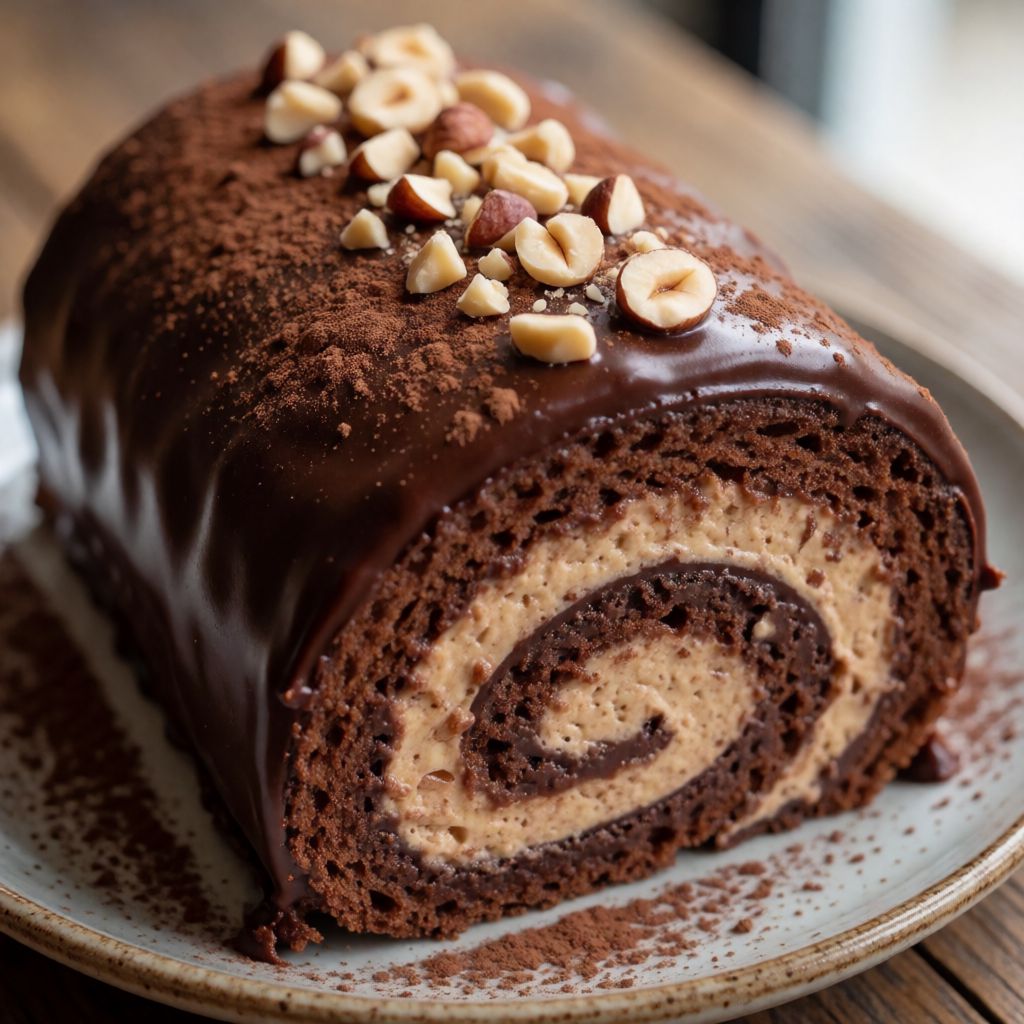
 AI photo
Rocher Roulade
A chocolate-hazelnut sponge roulade filled with a Nutella cream and finished with a glossy chocolate-hazelnut glaze.
Labels are worked out automatically from the ingredients and can be wrong. Check the packaging if it matters to you.
Ingredients
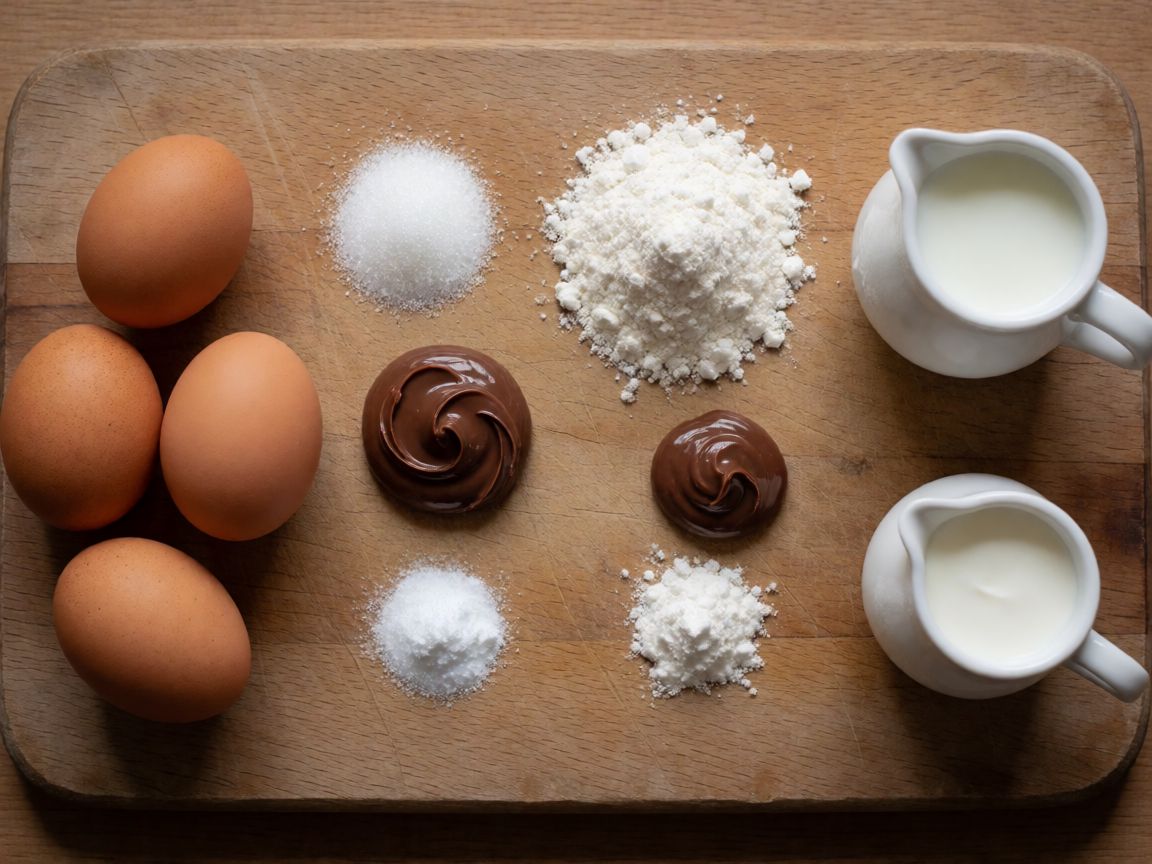
- 4 pcs Eggs
- 130 g Caster sugar
- 40 g Nutella
- 100 g Plain flour
- 8 g Baking powder
- Milk to taste, for brushing
- 100 g Nutella for the filling
- 250 ml Double cream for whipping, unsweetened
- 250 ml Double cream for the glaze
- 150 g Milk chocolate
- 60 g Chopped hazelnuts








Steps
Combine the eggs with the sugar and whisk with a mixer until light and fluffy.
Add the Nutella and mix.
Sift in the flour and baking powder, folding in gently.
Pour the batter into a tin lined with baking paper and smooth with a spatula.
Bake in the oven at 180°C: 10 minutes with fan or 15 minutes without.
Remove the sponge, cover with paper and leave to cool completely.
Whip the cream to stiff peaks, add 100 g of Nutella and fold in gently.
Turn the cooled sponge over, carefully peel off the paper and trim the edges.
Brush the surface with milk or sugar water.
Spread the filling over the surface, leaving a one-centimetre border from the edge.
Roll up the roulade from the short side and secure with baking paper.
Chill the roulade in the fridge.
120 minMelt the milk chocolate over a bain-marie or in the microwave.
Add the warmed cream and mix thoroughly until smooth.
Add the chopped hazelnuts and mix.
Place the roulade on a wire rack, pour the glaze over the top and let the excess drip off.
Chill the roulade in the fridge until the glaze sets.
A roulade is a sponge that's been persuaded to bend. That's the whole mechanism, and it's also the whole risk — a cake built thick and dry to hold its shape on a plate will crack the moment you roll it, while this one is built thin, moist and egg-heavy specifically so it flexes instead of snapping, the way a green branch bends and a dry one doesn't. The Nutella in the batter isn't just flavour — its fat and sugar keep the crumb soft and slightly dense, which is what gives you the bend.
What decides whether this works isn't the baking, it's everything around it. Whisking the eggs and sugar until pale and thick builds the air that makes the sponge light; skip that and you get a flat, eggy pancake that won't lift at all. Rolling while the memory of "flat" is still fresh — meaning as soon as it's cool enough to handle, not cool and set — is what teaches the sponge to curl rather than fight you. And the fridge time at the end isn't idle waiting: it's the cream filling going firm enough that the roll holds its shape when you cut it, and the glaze setting into something you can slice through cleanly instead of smearing.
Some say you must roll a roulade sponge while it's still hot, straight from the oven, or it'll crack no matter what. No — because what actually prevents cracking is moisture and structure, not heat. A sponge this soft, brushed with milk so the surface doesn't dry and crisp, will roll at room temperature just fine. Heat just makes it more forgiving; it's not the mechanism.
Eggs here are doing two jobs, not one: structure and lift. Four eggs for 100g of flour is a lot of egg relative to flour — that ratio is what makes the sponge thin and elastic rather than cakey. Don't swap in fewer, larger eggs and call it close enough; the whisking time to get "light and fluffy" depends on egg volume, and a short-changed whisk means a short-changed rise.
Nutella appears twice, and it's doing different work each time. In the batter, 40g is there for softness and that faint hazelnut-chocolate note running through the sponge itself, so the roulade doesn't taste like plain cake with filling — it tastes like one thing. In the filling, 100g folded into whipped cream is there for flavour you actually bite into, not just smell. If you're out of Nutella, any hazelnut-chocolate spread with a similar fat content will behave the same way; plain chocolate spread without nuts works too, you just lose the crunch-adjacent flavour, not the mechanics.
Baking powder at 8g for 100g flour is a brisk amount — it's compensating for the weight of the Nutella and eggs, giving the sponge the extra lift it needs to stay thin and open rather than dense. Sift it with the flour, not after, so it's distributed evenly; a pocket of unmixed baking powder shows up as a bitter spot and an uneven crumb, which you'd then wrongly blame on the oven.
The milk (or sugar water) brushed over the sponge before filling is a small step that prevents a real problem: a bare sponge surface dries and toughens slightly as it sits, and a tough surface is exactly where a roll wants to crack. A thin coat of liquid keeps that surface pliable right up until you've rolled it. Tea-with-milk households will have milk open anyway — use what's in the fridge, it doesn't need to be anything special, it just needs to be wet.
Double cream for both the filling and the glaze is doing structural work, not just richness — it's the fat content that lets it whip to stiff peaks for the filling and lets it melt smoothly into the chocolate for the glaze without splitting. Lower-fat cream will whip softer and won't hold the roll's shape as firmly, and in the glaze it can separate instead of binding with the melted chocolate. If you're substituting, look for cream at or near 48% fat — that's the criterion, not the brand.
Milk chocolate in the glaze matters for melting behaviour as much as sweetness: it has enough cocoa butter to melt smoothly with warmed cream into a pourable glaze rather than seizing. Dark chocolate will set harder and taste sharper against the sweet filling; if that's what you have, add a touch more cream to keep it pourable rather than stiff. The hazelnuts folded in last aren't decoration — they're there to be felt, the one place in the whole dessert where something actually crunches against all that soft cream and sponge, which is the point of calling it "Rocher" at all.
On an ordinary UK hob and oven: the 180°C fan/non-fan split in the steps already accounts for the fact that your oven runs one way or the other, so follow whichever applies and trust the look of it over the clock — pale gold, just set, slightly springy when pressed, not browned at the edges. And patience is the real missing ingredient twice over here: the 120 minutes in the fridge isn't a suggestion you can shorten because you're hungry, it's the time the cream needs to firm against the sponge's own weight, and rushing it gets you a roulade that oozes the second you slice it rather than holding a clean spiral.