
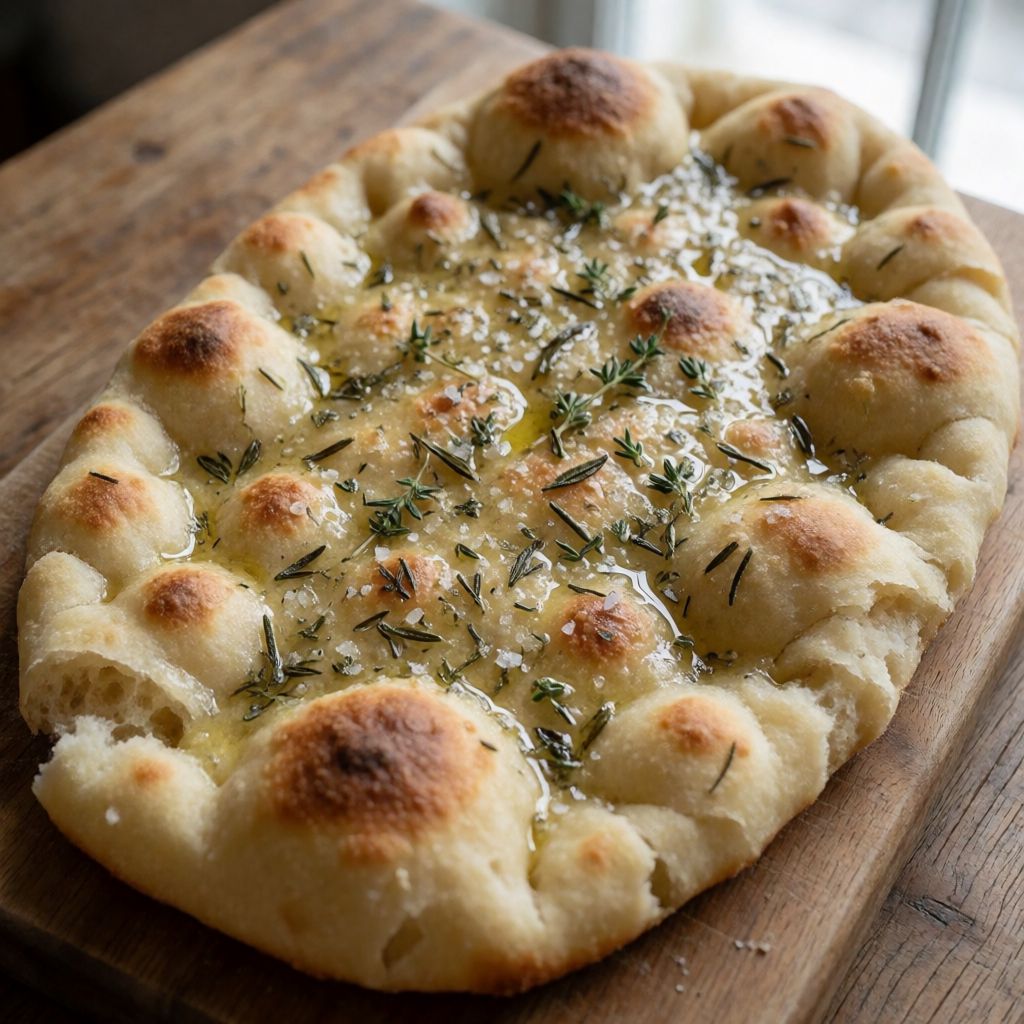
 AI photo
French Flatbread with Thyme and Rosemary
A rustic French-style flatbread, slow-fermented overnight for a crisp, airy crumb and a leaf-like pattern of slashes.
Labels are worked out automatically from the ingredients and can be wrong. Check the packaging if it matters to you.
Ingredients
- 450 ml Water room temperature
- 10 g Yeast
- 50 g Wholemeal flour
- 500 g Plain flour
- 1 tsp Salt
- 1 tbsp Olive oil
- 0.5 tsp Salt
- 1 tsp Dried thyme
- 1 tsp Dried rosemary






Steps
Dissolve the yeast in a bowl with room-temperature water, add the wholemeal flour and sifted plain flour, and mix briefly until the dough is smooth.
Leave the dough covered to autolyse for 45 minutes.
Add the salt and knead the dough on low-medium speed for about 5 minutes, until smooth and glossy.
Transfer the dough to a bowl greased with olive oil.
Cover the bowl with a lid or a clean tea towel and leave to rise on the counter for 1 hour.
Then place the dough in the fridge overnight, or for at least 8-12 hours.
The next day, put a steel baking surface on a rack in the oven and preheat the oven to 275°C with the fan on, an hour before baking.
Take the dough out of the fridge and divide it in half.
Gently roll out each piece of dough into a slightly triangular oval shape, narrower at one end, trying not to knock out too much air.
Place each oval on its own sheet of baking parchment.
Make a cut through the centre of the oval, then 3-4 cuts on each side.
The cuts should stay within the edges of the bread — see photo — so a leaf-like pattern forms.
Gently stretch the bread so the cuts open into holes in the dough.
Leave the bread to rise on the tray for 30 minutes.
Brush the bread with olive oil and sprinkle with the dried herbs (thyme and rosemary) and flaky salt.
Lower the oven temperature to 225°C and use a peel or pizza pan to transfer the bread into the oven.
Bake one bread at a time for 10-12 minutes, until golden and crisp.
Watch the bread closely, as baking time may vary depending on the oven.
This is fougasse, the leaf-shaped bread from Provence that gets slashed open before baking rather than after. The shape isn't decoration — it's engineering. A flat round loaf baked solid would be doughy in the middle by the time the crust is right, because heat moves slowly through a dense mass. Cut it into a leaf and stretch the holes open, and you've turned one loaf into mostly surface area. Nearly every bite is crust. That's the whole point of the dish, and it's also why it only works thin.
What decides success here isn't the kneading, it's the waiting. You mix a rough dough and then do nothing to it for 45 minutes — that's autolyse, and it's not a stall tactic. Flour needs time sitting wet before the gluten network organises itself; knead cold, unrested flour straight away and you fight the dough for ten minutes to get what 45 minutes of patience gives you free. Then after a short knead and an hour's rise, the dough goes into the fridge overnight. Cold slows the yeast right down so it eats sugars slowly instead of in a rush, and that slowness is what gives you flavour — a fast warm rise gives you lift but very little taste, because the yeast hasn't had time to produce the byproducts that taste like bread rather than air.
Water first, at room temperature, not warm. Warm water feels like it should "wake up" the yeast faster, but yeast doesn't need coaxing, it needs food and time, and hot water risks killing some of it before it starts. Room temperature is the safe default that still lets fermentation begin properly.
The yeast itself — 10g here is fresh-style quantity for a two-loaf batch; if what you have is the dried instant kind in sachets, use about a third of that weight, since dried yeast is more concentrated. Either works; what matters is that it's alive, which you can tell because it'll make the dough visibly puff after the first hour, not by trusting the packet date alone.
Two flours do two different jobs. The wholemeal gives you flavour and a bit of the nutty, earthy character — it's what makes this taste like real bread and not just air with crust. The plain flour, sifted, is there for structure: it has the gluten-forming proteins that let the dough stretch into those thin ovals without tearing. Skip the sift and you risk lumps that never fully hydrate, leaving little dry pockets in the baked crumb.
Salt is split for a reason, not habit. The teaspoon inside the dough isn't just seasoning — salt tightens gluten and slows the yeast, which is why it goes in after autolyse, not before. Add it at the start and you're fighting the dough's own development; add it too late and the structure's already loose. The half-teaspoon with the herbs at the end is pure seasoning, landing on the tongue first, so use a flaky or coarse salt there if you have it — table salt dissolves into the oil and loses its crunch.
Olive oil greases the rising bowl so the dough releases without tearing its surface — any oil with no strong smell of its own works for that job, sunflower is fine, you lose nothing. The oil brushed on top before baking is different: it's there to carry the dried thyme and rosemary and help them toast rather than burn to ash in a hot oven, and to give the crust that slight shine and crispness. If you've only got fresh herbs, use three times the amount and chop them fine — dried herbs are more concentrated, which is exactly why the recipe calls for so little.
On an ordinary UK hob and oven, the honest limit is the 275°C preheat — most domestic ovens max out around 250–270°C, so treat that number as "as hot as yours goes, with everything preheated properly for the full hour," not as a target you must hit exactly. A pizza steel or a heavy baking tray left in to heat up does the real work here; a cold tray slid in at the last minute gives you a pale, soft-bottomed bread, because there's no stored heat to crisp it on contact. If you don't have a peel, the back of a flat baking tray dusted with flour will slide the dough off well enough — just do it in one confident motion, not several hesitant ones, or the dough sticks and the leaf shape tears.
Feeds two generously as a loaf each, more as something to tear and share alongside a roast or soup — it's not really a dish you plate, it's a dish you pass across the table.