
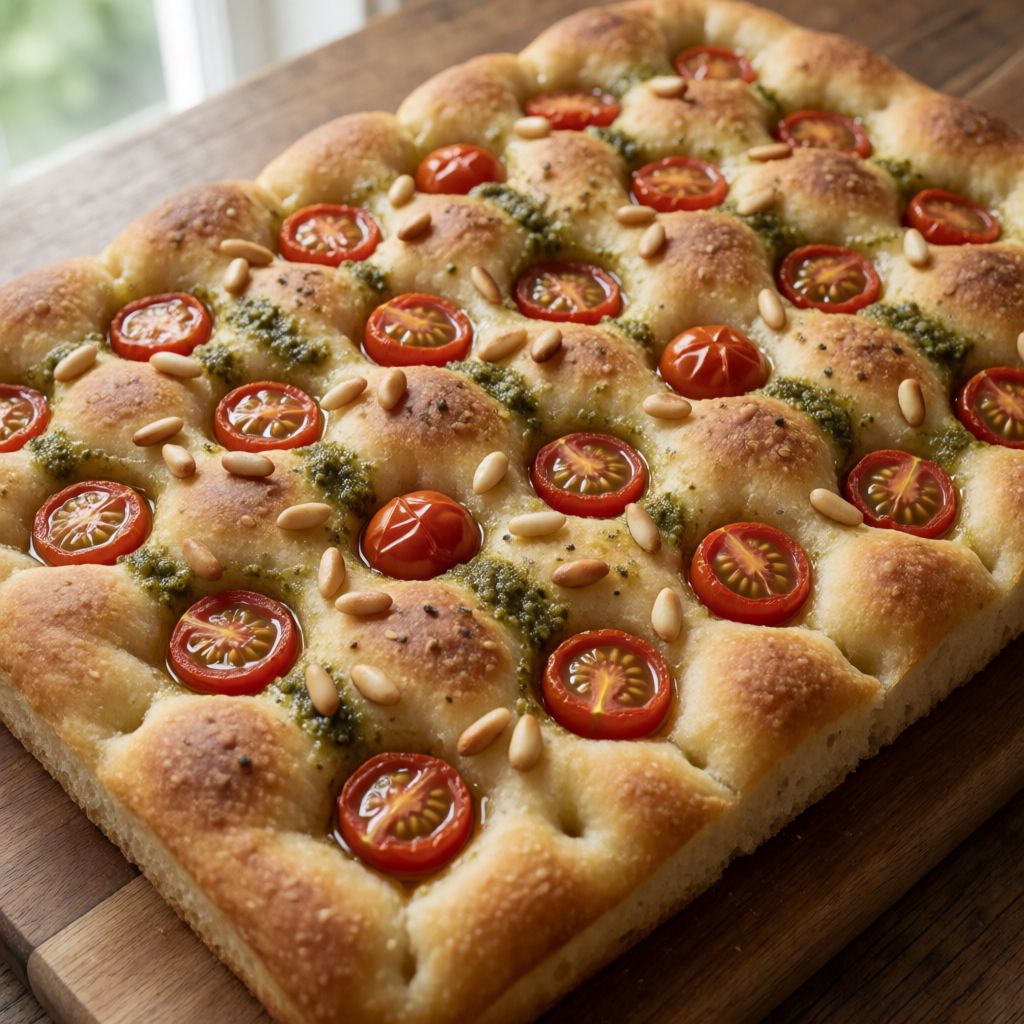
 AI photo
Focaccia with Cherry Tomatoes
A soft Italian-style focaccia with a pesto-enriched dough, topped with roasted cherry tomatoes.
Labels are worked out automatically from the ingredients and can be wrong. Check the packaging if it matters to you.
Ingredients
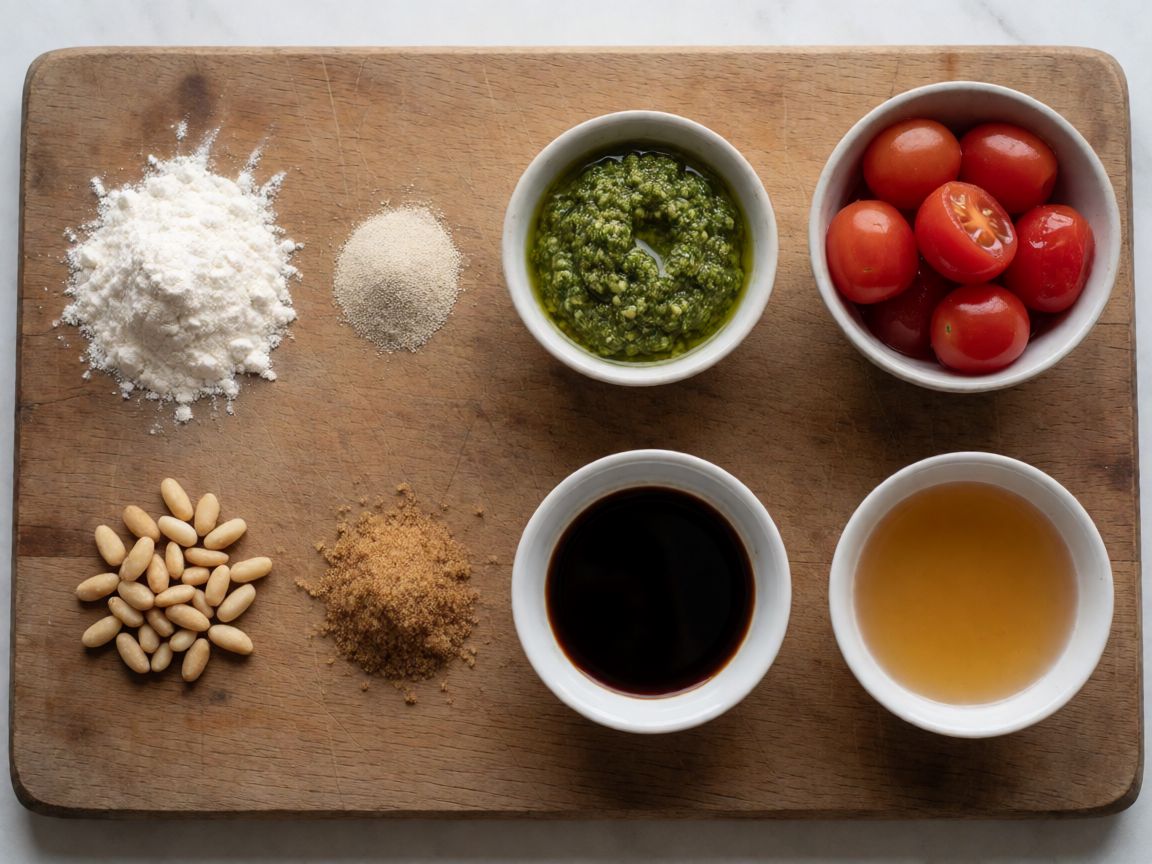
- 360 g strong white bread flour
- 4 g yeast
- 6 g salt
- 250 ml water
- 8 g pine nuts
- 40 g pesto
- 35 ml water
- 2-3 g salt
- 25 ml olive oil
- 250 g cherry tomatoes
- 0.5 tsp brown sugar
- 0.5 tsp salt
- 1 tsp soy sauce
- 1 tbsp olive oil
- 1 tsp apple cider vinegar










Steps
Put the strong white bread flour in a bowl, crumble in the yeast and add half the water. Mix, then add the pine nuts, salt and pesto diluted with water. Combine until smooth and knead briefly by hand.
Cover the bowl with a towel and leave the dough to rise at room temperature.
30 minTip the dough onto the work surface and fold it: stretch the edges and tuck them into the centre on all sides, then shape into a ball.
Return the dough to the bowl, cover with a towel and leave to rise.
20 minRepeat the folding twice more; before the last fold, grease the bowl with olive oil.
Leave the dough to rise at room temperature.
60 minIn a jar, mix the brown sugar, salt, soy sauce, olive oil and apple cider vinegar, close the lid and shake well.
Wash and dry the cherry tomatoes, coat them with the dressing and place on a tray lined with foil and baking paper.
Grill the tomatoes in the oven at 220°C.
11 minTake the dough out, tip it onto a work surface dusted with semolina, stretch it out with your fingers and place it into a greased 30x40 cm tin.
Leave the dough to rest.
60 minPour the mixed oil, water and salt over the focaccia, spread evenly and press in with your fingers.
Add the cherry tomatoes and bake the focaccia in an oven preheated to its maximum temperature.
12 min
What was changed
The roasting temperature for the tomatoes was set to , the midpoint of the original range, since this market states a single oven temperature.
Focaccia isn't bread that happens to be flat — it's dough that's been given permission to collapse. No shaping into a tight loaf, no scoring, no trapping of structure. You stretch it thin, you dimple it, and every one of those finger-holes is a little trap for oil and for steam, which is exactly what gives you that contrast: crisp, oil-blistered top, open, wet crumb underneath. The pesto and pine nuts in the dough itself mean the flavour isn't just sitting on top as a topping — it's baked right through the structure, so every bite, not just the surface, tastes of basil and pine.
What decides whether this works is hydration and patience, in that order. This is a wet dough — 250ml water to 360g flour, roughly 70% — and that wetness is not a mistake to fight with more flour. It's the whole point: water turns to steam in a hot oven and that steam is what blows the holes open. Some say you knead focaccia hard, like a baguette dough, to build strength — no, because a dough this wet barely holds together under hard kneading anyway, and strength here comes mostly from time and folding, not muscle.
Strong white bread flour, not plain — the gluten content is the entire reason this dough can hold the steam pockets that give you the open crumb. Plain flour has less protein, the gluten network is weaker, and a 70% hydration dough made with it just slumps and tears instead of stretching into a net. If all you've got is plain flour, you can still make bread, but don't expect the same holes — it'll bake closer to a thick pizza base, denser, less lacy inside.
Yeast is doing two jobs here, not one: rise, yes, but also flavour — those long, slow proves (30, then 20, then 60, then another 60 minutes resting in the tin) are fermentation time, and fermentation is what gives focaccia its faint sourness and depth, not just volume. Rushing the rises with extra yeast or a warm airing cupboard gets you a taller focaccia faster, but a flatter-tasting one — patience here is genuinely an ingredient, not a formality.
Pesto diluted with water, mixed straight into the dough, is a shortcut with a real logic: it gets basil, garlic, pine nut and Parmesan flavour distributed through every gram of dough rather than left as a surface smear. Homemade pesto is better if you have the time and a food processor, but a decent jarred one loosened with the 35ml of water works — the dilution matters because pesto on its own is too thick and oily to blend evenly into a wet dough; it'll sit in streaks instead of disappearing into it.
Olive oil shows up twice doing two different jobs. In the final topping (the oil-water-salt mixture poured over before baking) it's there to fry the surface of the dough in the oven — that's the mechanism behind focaccia's blistered, almost deep-fried-tasting crust, oil pooling in the dimples and shallow-frying the dough around them. In the tomato dressing it's a carrier for the soy sauce and vinegar, helping them coat evenly rather than pooling at the bottom of the bowl. Use an oil with a clean, not-too-strong flavour here — a fruity, flavourful olive oil is traditional and worth it if you can get one, but any neutral oil with no smell of its own will do the structural job, you'll just lose some of the flavour overlay.
The tomato dressing itself — brown sugar, soy sauce, vinegar, salt, oil — looks odd on a focaccia until you realise it's just a quick version of what balsamic-roasted tomatoes do: sugar for caramelisation at high heat, acid (vinegar, and the acidity already in soy sauce) to balance the sweetness so the tomatoes don't turn into jam, salt to season through rather than just on the surface, soy sauce for a savoury, umami backbone that plain salt can't give. If you don't have soy sauce, a splash of Worcestershire sauce gets you closer to that savoury depth than just adding more salt will.
On an ordinary UK hob and oven, the one honest limit is your oven's maximum temperature — domestic ovens rarely get anywhere near what a stone-floored bakery oven or a wood-fired one hits, so "preheated to its maximum" really is doing real work here: get it as hot as it goes, let it fully preheat (don't open the door the second it beeps), and don't expect quite the same oven-spring and blister you'd get professionally. A 30x40cm tin is a reasonable stand-in for a tray this size feeds six as a generous lunch alongside a salad, or cut into smaller squares it's a good thing to put out before a Sunday roast while everything else finishes — it holds at room temperature far better than it reheats, so eat it the day it's made if you can.