
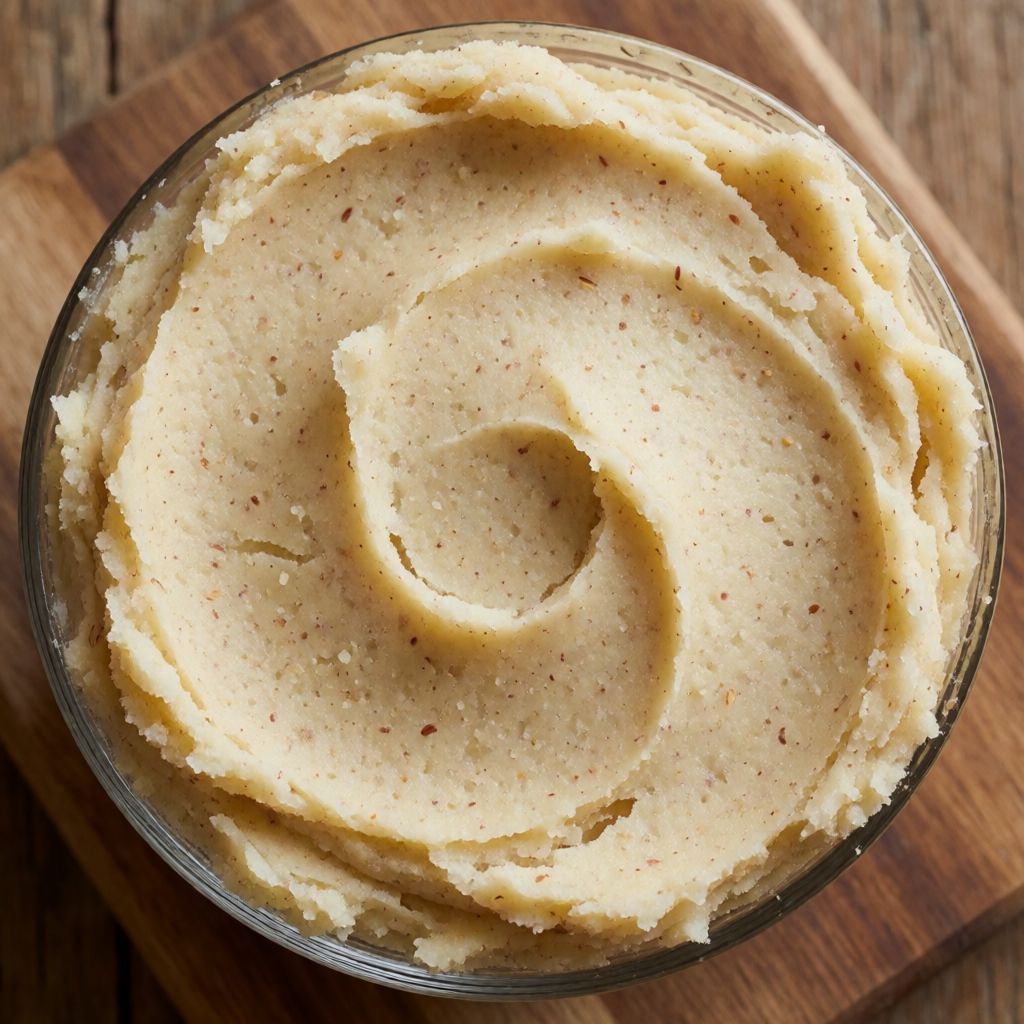
 AI photo
Frangipane: Almond Cream for Filling Cakes and Tarts
A rich almond cream used to fill cakes and tartlets.
Labels are worked out automatically from the ingredients and can be wrong. Check the packaging if it matters to you.
Ingredients
- 200 g Butter
- 160 g Sugar
- 3 pcs Eggs
- 1 pcs Egg Yolk
- 150 g Ground Almonds
- 70 g Plain Flour sifted in advance
- 130 g Flaked Almonds






Steps
Combine the softened butter with the sugar and beat with an electric mixer until pale and fluffy.
Add the eggs one by one, then the egg yolk, continuing to beat until fully combined.
Stir in the ground almonds and the pre-sifted plain flour, gently mixing until smooth.
What was changed
Egg Yolk because a bell pepper does not belong in this cream and, judging by the steps, an egg yolk was meant instead.
Frangipane isn't a cake on its own — it's the soft almond cream you tuck inside pastry, and when it goes into the oven it swells and sets into something between a sponge and a custard. Bakewell tart is the British home for it, hiding under a lattice of pastry and a slick of icing. The cream itself never sees direct heat in this recipe — cook time is zero because the real cooking happens later, inside whatever case you've chosen for it.
What decides whether it works is the emulsion, not the oven. You're building a structure out of fat, sugar, and egg before any flour gets near it, and that structure either holds or it splits. Butter and sugar beaten until pale and fluffy isn't decoration — the sugar crystals are cutting tiny pockets of air into the fat, and those pockets are what let the cream rise instead of sitting flat and dense once baked.
Some say frangipane is basically marzipan with eggs in it. It isn't — marzipan is almond and sugar bound into a paste for shaping and covering, no fat-beating, no air. Frangipane is closer kin to a buttercream that's been introduced to ground almonds. Confuse the two and you'll either overwork the marzipan logic (kneading, pressing) or underwork the cream logic (skipping the beating), and the texture tells on you either way — one ends up gritty, the other heavy.
Butter first, and it has to be properly soft — press it with a finger and it should give without being greasy or sliding. Cold butter won't hold the air you're trying to beat into it; melted butter holds none at all, it's just grease waiting to separate later. If you've only got fridge-cold butter, cut it into small pieces and give it twenty unhurried minutes on the counter rather than ten seconds in the microwave — melt one corner by accident and you've lost the whole batch's ability to aerate. This is the one place in the recipe where rushing shows up directly in the final crumb: skimp on the beating time and the baked frangipane comes out dense and short, because there was never enough trapped air to begin with.
Sugar here isn't mainly for sweetness, it's an abrasive — the crystals score the fat as the mixer runs, which is what creates the pale, fluffy look you're waiting for, more than any clock number. Ordinary white granulated does this job well; icing sugar is too fine to cut properly and caster works but slightly faster. Any sugar with sharp enough crystals and no strong flavour of its own will do.
The eggs, one at a time, then the extra yolk alone: each egg is mostly water held inside protein and a little fat, and the butter-sugar mixture can only take on so much water before the whole thing curdles into separate oily lumps. Adding them in sequence lets the mixer re-absorb each dose before the next arrives. The extra yolk at the end adds richness and fat without adding more water, which is exactly what you want once the base is already holding as much liquid as it comfortably can.
Ground almonds are the body of the thing — fat, protein, and flavour all in one, and they're what keeps frangipane from being just a sweet egg custard. Any finely ground nut with a mild fat content could stand in — hazelnuts, for instance, give you a different but genuine cream, not a lesser one. The flour that follows isn't there to taste of anything; it's a binder, giving the baked cream enough structure to hold its shape when sliced instead of oozing. Mix it in only until smooth and stop — work it longer and you start developing gluten, which has no business in a filling meant to stay tender, and you'll get a rubbery frangipane instead of a soft one. If you need it gluten-free, ground rice or cornflour will bind in a similar way, though the texture turns a touch firmer.
The flaked almonds aren't mixed into the cream at all — they go on top once the frangipane is sitting in its pastry case, pressed in lightly so they don't just roll off, and they do double duty: crunch against the soft cream, and a built-in doneness tell. Watch them rather than the clock — pale and raw-looking means the middle underneath is still wet; a shift to light gold, with the cream no longer wobbling like liquid when you nudge the tin, means it's done. No oven number is given here because this cream is only ever half the dish — the temperature belongs to whatever tart or cake recipe you're filling, and guessing one for you would be inventing, not explaining.
Patience earns its place twice here: once in letting the butter soften properly, and once in letting the mixer actually do its job on the creaming stage rather than being cut short because the bowl looks pale enough after a minute. Thirty minutes of prep is honestly about right once you count both waits — and a stand mixer or a decent hand mixer handles this without fuss on any ordinary UK hob-adjacent kitchen counter; no special equipment, no kazan, just a bowl and the will not to rush the first five minutes.