
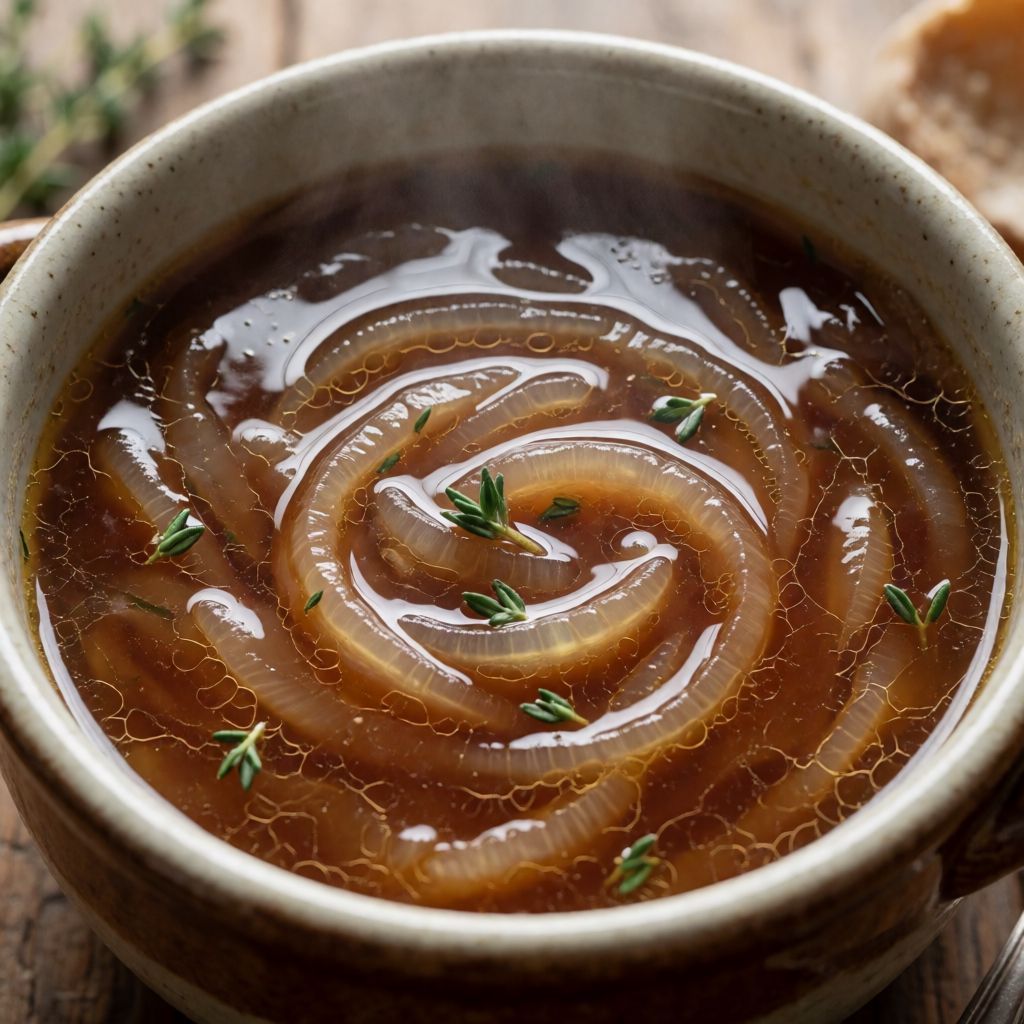
 AI photo
French Onion Soup
A classic French onion soup, slow-simmered and topped with melted mozzarella toasts.
Labels are worked out automatically from the ingredients and can be wrong. Check the packaging if it matters to you.
Ingredients
- 700 g Onion diced
- 6 clove Garlic finely chopped
- 1 tsp Sugar
- 1 tsp Red chilli finely chopped
- 2 tsp Dried thyme
- 1 l Stock
- 1 tbsp Balsamic vinegar
- 1 tbsp Olive oil
- Salt
- Black pepper freshly ground
- 8 pcs Bread slices
- 125 g Mozzarella sliced, fresh
- 2 clove Garlic halved












Steps
Put the onion, garlic and olive oil in a pan and sauté over medium heat until the onion softens.
Add the sugar and keep stirring well until the mixture caramelises and the onion turns slightly dark.
Add the chilli, thyme, stock and balsamic vinegar to the pan and bring to the boil.
Let it simmer gently for 20 minutes.
20 minSeason with salt, pepper and extra balsamic vinegar to taste.
Rub the bread slices with the halved garlic, then top with the mozzarella slices.
Place the bread on a baking tray lined with parchment and bake at 175°C (fan) for about 10 minutes, until the cheese melts.
10 minServe the soup in bowls with the hot cheese toasts on the side.
This is onion soup built on one bet: that 700 g of onion, given time instead of heat, will turn into something sweeter and darker than itself. That's the whole mechanism. You're not boiling onions in stock — you're caramelising them first, then using stock to carry that caramel flavour into a liquid you can eat with a spoon.
What decides whether it works is patience at the pan, not the recipe card. Onion at gentle heat softens in a few minutes — that's just cell walls giving up water. Caramelising is a different, slower event: sugars breaking down and rebuilding into new, darker-tasting compounds, and that only happens if you don't rush it or scorch it. Some say a lid speeds this up — no, because a lid traps the steam the onion is shedding, and wet onion just stews, it doesn't brown. You want the water gone and the sugar exposed to heat.
The added teaspoon of sugar isn't there to make the soup sweet — there's not enough of it for that. It's there to give the caramelisation a head start, because 700 g of onion doesn't always carry enough of its own sugar to brown reliably, especially out of season or if it's been sitting in a British kitchen cupboard for a fortnight losing moisture and flavour both.
The cheese toast on the side is doing a job too: crunch and fat against a soup that is, underneath the colour, mostly water and softened vegetable. Without it, the dish is one texture all the way through, and that gets dull by the third spoonful.
Onion is the engine here, so don't treat the dicing as a chore to get past. Smaller, even pieces caramelise together; a few big chunks sitting among small ones mean you either burn the small ones or leave the big ones pale and sharp-tasting. Garlic goes in with it, finely chopped, because it needs the same gentle heat the onion gets — thrown in too late or too hot, it turns bitter in seconds, and there's no fixing that afterwards.
Olive oil here is just the medium that carries heat evenly into the onion and stops it catching on bare metal — it isn't adding flavour you'll taste at the end over caramelised onion and stock. Any oil with no strong smell of its own will do the same job: sunflower, a neutral rapeseed, whatever's in the cupboard. Save the extra-virgin, peppery stuff for drizzling on something raw, where you can actually taste it.
The red chilli and thyme are there to stop the soup tasting like one single sweet note. Chilli gives it an edge, thyme a dried, slightly resinous backbone — dried thyme specifically, because dried herbs released into a simmering liquid for twenty minutes give up their flavour slowly and evenly, where fresh thyme would mostly just float on top looking decorative. If you've only got fresh, use three times as much and add it later, in the last five minutes, so it doesn't turn grassy and flat.
Stock is doing the heavy lifting on body. A litre of a decent stock — beef or a strong vegetable one, whatever you'd put in a Sunday roast gravy — gives you the savoury weight that water alone can't. Homemade is better only because it's usually less salty and more concentrated; a good shop stock cube or carton is a perfectly honest substitute, just taste before you add more salt, because stock cubes rarely need help there.
Balsamic vinegar appears twice — once in the simmer, once at the end to taste — because its sharpness fades a little as it cooks, and what you want on the plate is acidity that cuts through the sweetness of the caramelised onion, not vinegar that's boiled itself into something flat. Red wine vinegar, or even a squeeze of lemon, will do the same cutting job if balsamic isn't in the cupboard — just use less, since they're sharper and less sweet than balsamic to start with.
The toasts are simple arithmetic: eight slices of bread for four people, two each, rubbed with raw garlic — not cooked garlic — because raw garlic rubbed on toasted bread gives you a sharp hit of flavour on the surface without cooking it into bitterness. Mozzarella melts without turning greasy or separating the way some harder cheeses do under a quick blast of heat, which matters on a domestic oven where you're watching through the door rather than judging a grill by eye. If you haven't got mozzarella, any mild, meltable cheese works — Gruyère if you want more flavour, a mild Cheddar if that's what's in the fridge — just watch it under the heat rather than trusting a clock, because the moment it's gone from solid to glossy and give is the moment to pull it out, not ten minutes later because the recipe said so.