
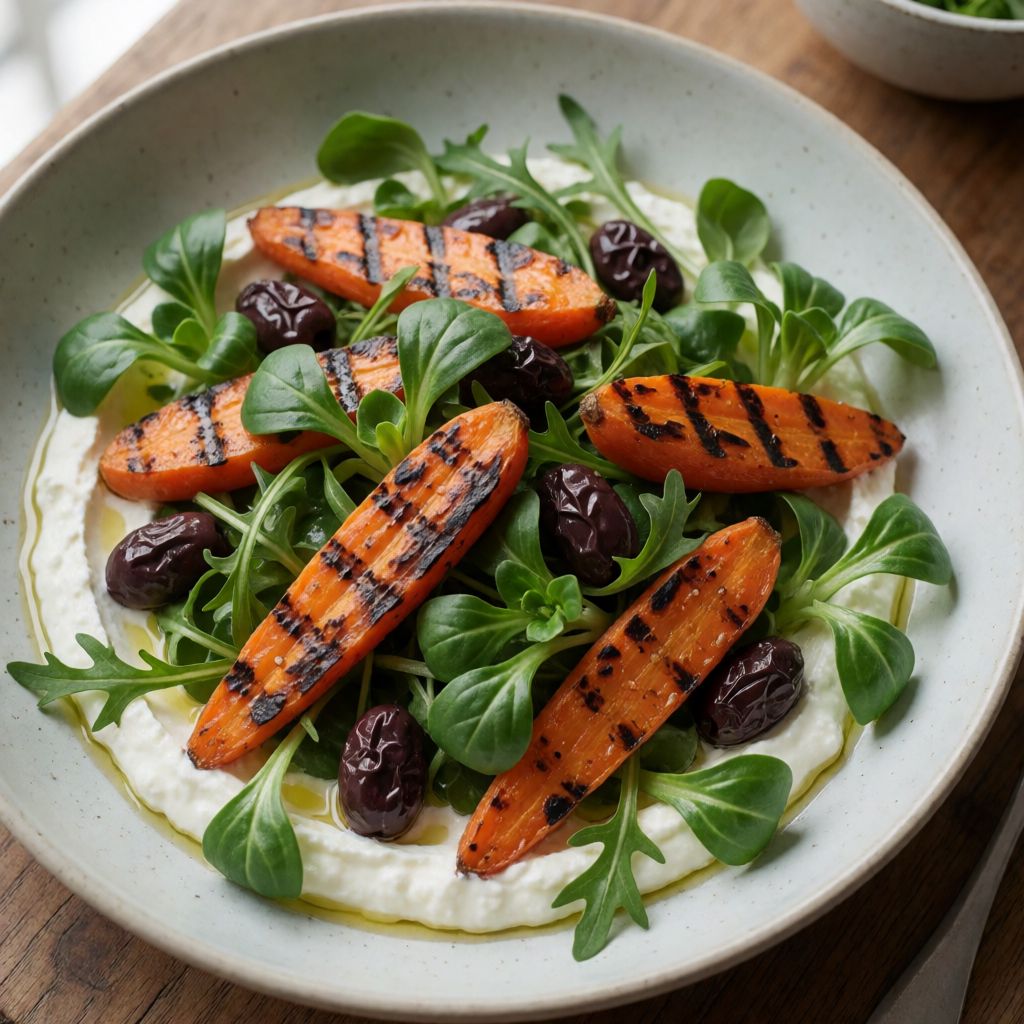
 AI photo
Grilled Carrots with Feta Cream and Olives
A simple salad of grilled carrots, peppery salad leaves and black olives, finished with a creamy feta dressing.
Labels are worked out automatically from the ingredients and can be wrong. Check the packaging if it matters to you.
Ingredients
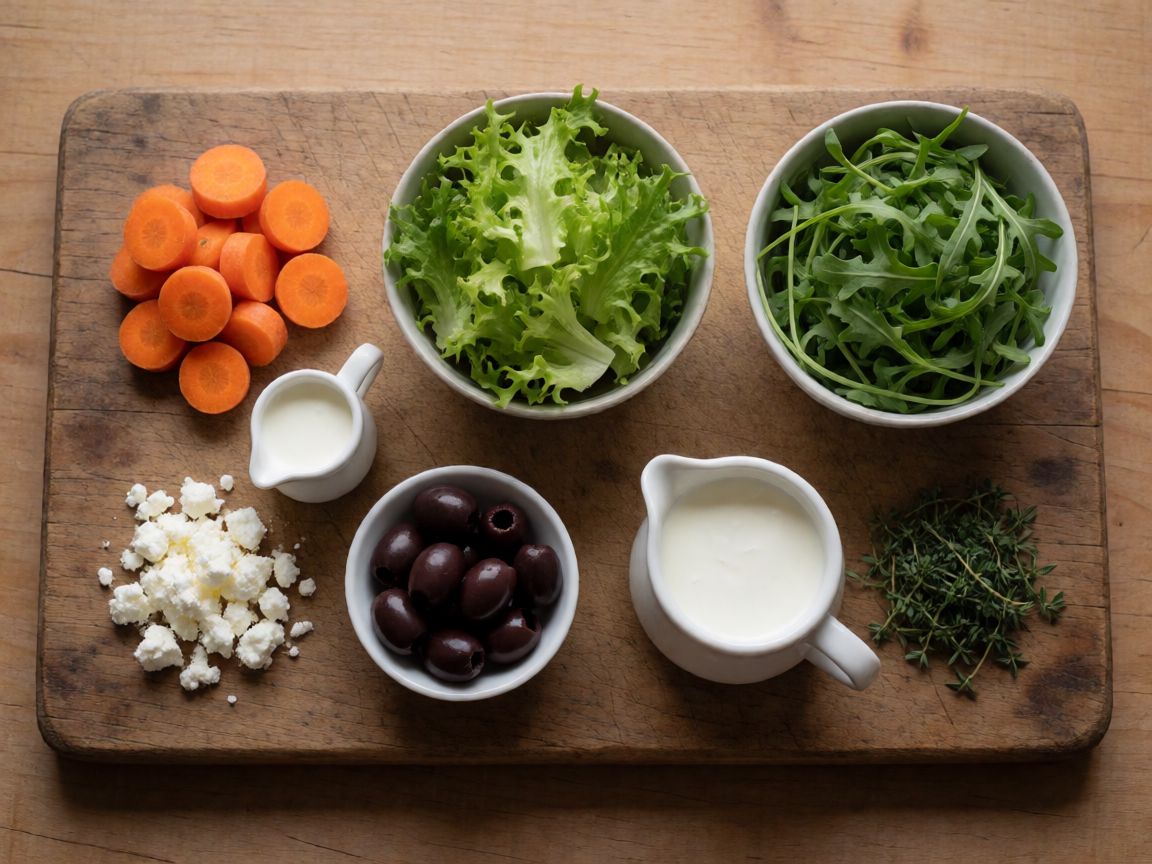
- 300 g Carrots halved lengthways
- 125 g Lamb's Lettuce
- 125 g Rocket
- 125 g Black Olives
- 1 tbsp Olive Oil for brushing
- 50 g Feta
- 100 ml Whipping Cream
- 100 ml Crème Fraîche
- 1 tbsp Thyme finely chopped
- Black Pepper freshly ground, to taste









Steps
Brush the carrots with oil and cook over direct heat on a hot barbecue or griddle pan for a few minutes on each side, until tender but still with a little crunch and nice char marks.
Arrange the salad leaves on a large platter and scatter the carrots over the top.
Feta cream: blend the feta with the whipping cream until smooth and creamy.
Adjust the consistency with crème fraîche, then season with finely chopped thyme and freshly ground black pepper.
Drizzle over the feta cream and scatter with roughly chopped and whole olives.
The carrots can also be pan-fried, or roasted in a fan oven at 180°C for 20 minutes.
20 min
What was changed
The oven temperature was adjusted to to match the 10°C steps used by UK ovens.
This is a warm-cold contrast dish built around one decision: how far you take the carrot before it stops being a vegetable and starts being a caramel. Everything else — the leaves, the cream, the olives — exists to answer back to that.
Carrots halved lengthways give you two flat faces to lay straight onto heat — a disc cut from the same carrot would touch the metal in one small ring and never really get there. Direct heat, skin to metal, is what makes the char: the sugar on the surface catches and browns a moment before the inside gives up its crunch. Don't look for a clock. Look at the carrot itself — it should bend in your hand like a green stick, not snap like a dry one. A few minutes a side is only where to start checking, not where to stop.
Some say a carrot on the heat needs to go limp to be properly "cooked" — no, because this isn't a Sunday-roast carrot. It's closer to toast than to boiled veg. Push it to mush and the dish collapses into the leaves underneath and vanishes as a thing in its own right.
The feta cream is the cold half of the argument. Blended rather than crumbled, because loose feta on a plate is just salt lumps here and there — blended with cream it becomes something you taste in every bite, and it goes on warm, not hot, carrot, so the two still read as two different temperatures when it lands on the table.
Choose carrots that are firm before they ever meet the heat. A carrot that already bends on the shelf is old and has nothing left to give under char — it goes soft without ever catching colour, because all its water has already thinned out. Thin carrots halve cleanly; fat ones are better quartered, so the flat face stays a sensible size and cooks through at the same rate it browns.
Feta: buy the real thing sitting in its brine, not the dry, crumbly "salad cheese" sold loose in a tub. The brine is what keeps the fat and moisture in the cheese that let it turn into a smooth cream rather than grit when you blend it. Low-fat feta blends thin and sour and won't hold the dish together.
Cream and crème fraîche do two different jobs, not the same job twice. Whipping cream gives the feta body; crème fraîche loosens it and brings back some sourness so it doesn't just taste of salt and fat. If you've only got one, crème fraîche on its own, thinned with a splash of milk, gets you closer than cream alone — the acidity matters more here than the richness.
Lamb's lettuce and rocket are one soft, one sharp, and the bed needs both — something to sit under the dressing-less carrot without wilting flat, something peppery to cut the cream. Any soft lettuce paired with any sharp leaf — watercress, mizuna, even young mustard leaves — does the same job.
Black olives bring salt and a trace of bitterness against all that char and cream. Brine-cured ones taste of olive; the ones packed hard in vinegar mostly taste of vinegar, which fights the thyme rather than backing it. Thyme itself should be fresh and chopped fine — the stem is woody and bitter whole, and dried thyme, while it'll do, is concentrated enough that too generous a hand turns it medicinal rather than savoury.
On the method: a barbecue isn't a weekday tool in most flats, and a griddle pan indoors gives you the stripes but not the smoke — that smoky edge comes from actual fire underneath, not just a hot surface, and no pan reproduces it. The oven at 180°C works by a different mechanism entirely — still, circulating air rather than direct contact — so you lose the char lines but the carrot still colours, slowly, over the full twenty minutes, as its sugars concentrate while the water cooks off. None of these three is a compromise exactly; they're different chemistry producing a similar carrot. What they all need is the same patience — leave the carrot alone on the heat rather than turning it every thirty seconds, or you get grey carrot with no mark on it at all, which is the real defect to watch for, not undercooking.