
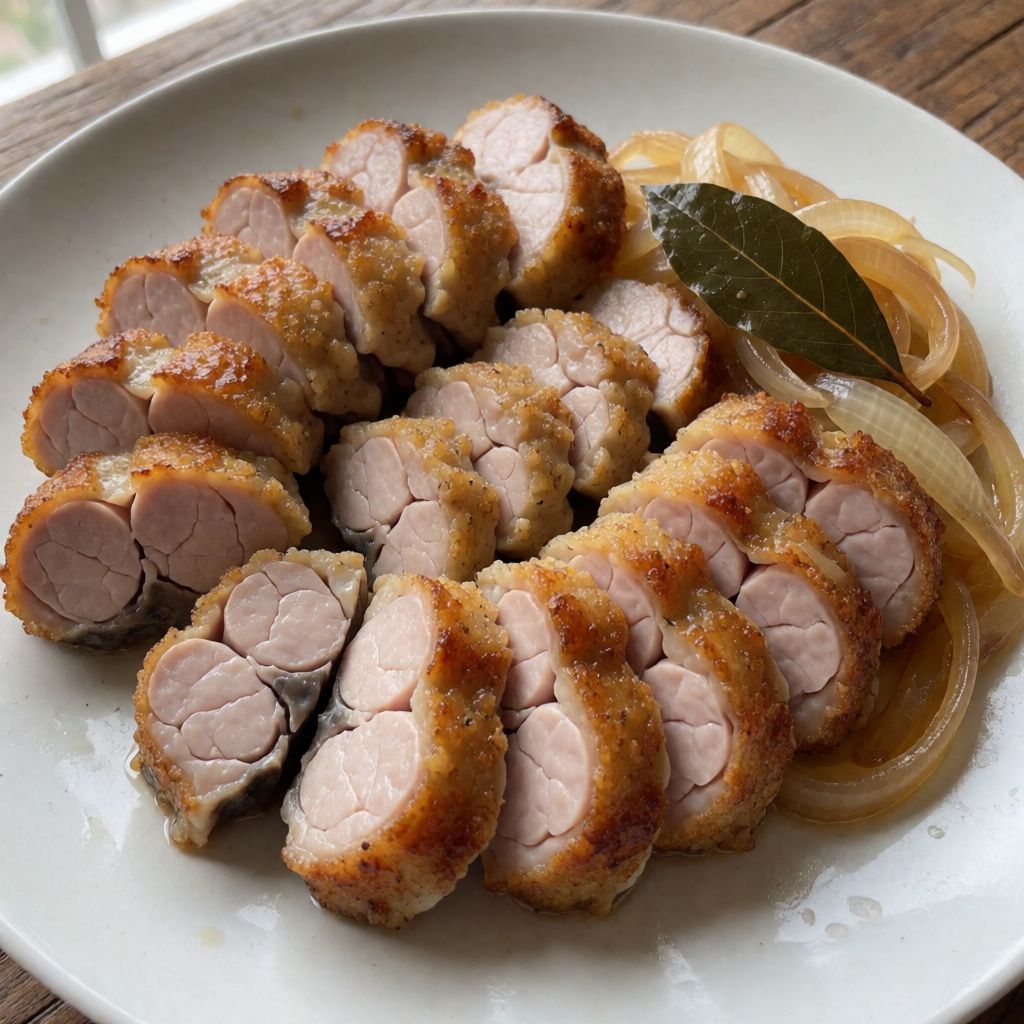
 AI photo
Pan-Fried Cod Roe
A simple poached and pan-fried fish roe dish, served on rye bread with remoulade and lemon.
Labels are worked out automatically from the ingredients and can be wrong. Check the packaging if it matters to you.
Ingredients
- 500 g fresh cod roe depending on size
- 1 pcs onion cut into quarters
- 4 pcs bay leaf
- 2 tbsp apple cider vinegar
- 1 pcs thyme fresh sprig
- 1 tbsp salt and freshly ground pepper
- 1 tbsp black pepper freshly ground
- 1 tbsp plain flour
- 2 tbsp butter for frying
- 1 tbsp olive oil for frying
- 1 tsp salt and freshly ground pepper
- 4 pcs rye bread slices
- 100 ml remoulade
- ½ pcs lemon cut into wedges
- 1 bunch dill
- pinch salt












Steps
Wrap the cod roe in parchment paper and tie it with kitchen string.
Place the parcel in a pot with cold water, salt, onion, bay leaves, apple cider vinegar, thyme and black peppercorns.
Bring to the boil, then reduce the heat so the water just barely simmers.
Cover and simmer for 25 minutes, depending on the size of the roe.
25 minTurn off the heat and let the roe cool in the pot together with the brine.
The roe can be served as it is.
It can also be sliced, then coated in plain flour, salt and black pepper.
Fry the slices in a pan in butter and olive oil on both sides until golden and crisp.
10 minServe on rye bread with remoulade, lemon wedges, sprinkled with dill, salt and black pepper.
Cod roe is one of those ingredients British fishmongers used to practically give away — a by-product of the catch, sold cheap because nobody wanted the fuss of cooking it. That history explains the whole dish: poach it gently once, in a flavoured brine, then fry it hard the second time. Two different jobs, two different fires, and most failures come from trying to do both at once.
The poach is not for flavour so much as for structure. Cod roe straight from the fishmonger is soft, almost custardy — it will fall apart in a frying pan before it ever browns. Wrapping it in parchment and tying it does two things: it holds the roe's shape against the rolling of the water, and it stops the delicate outer membrane splitting open and spilling eggs into your brine. The water must only just shiver, not boil — a hard boil would blow the parcel apart from inside, the same way a rolling boil bursts a sausage skin. "Barely simmering" means you can count to three between bubbles breaking the surface, not that there's no movement at all.
Cooling the roe in its own brine matters more than people assume. Pull it out hot and slice it, and it crumbles — the proteins haven't finished setting, they're still loose from the heat. Let it sit in the warm, slowly cooling liquid and it firms up as it goes, the way a terrine does. This is also where it picks up the last of the onion, bay and vinegar — flavour moves slowly into cold things, so patience here is doing the seasoning for you.
Some say roe has to be cooked from frozen, straight into boiling water, no fuss. No — because frozen roe has already been through one shock of ice crystals tearing at its structure, and a second shock of violent boiling finishes the job: you get roe that disintegrates into porridge rather than slices. Fresh roe, poached gently, is forgiving. Frozen roe barely survives being handled.
The onion, bay, thyme and vinegar in the poaching water aren't decoration — they're there because roe on its own tastes flatly of the sea and not much else. The vinegar does double duty: it firms the surface proteins slightly (the same reaction that tightens a poached egg white) and cuts the richness before it even reaches the pan. If you haven't got cider vinegar, any vinegar with a mild, fruity edge will do — white wine vinegar, even a squeeze of lemon in a pinch — the point is acidity, not a particular bottle.
Flour, salt and pepper for the coating is the thinnest dusting you can manage, not a batter. Its job is to give the butter and oil something to grip and caramelise, and to seal the cut face of the roe so it doesn't weep moisture into the pan — wet surface meeting hot fat is exactly how you get spitting and a pale, steamed crust instead of a crisp one. Pat the slices dry before you flour them; skip that and the flour goes gluey rather than crisp.
For frying fat, butter and olive oil together is really a workaround for a kitchen without a kazan's steady, even heat — a domestic hob's rings run hotter in the centre and cooler at the rim, and pure butter on a hob like that will catch and blacken before the roe is through. Any neutral oil with no smell of its own — sunflower, groundnut — would protect the butter the same way; it doesn't have to be olive oil, that's just the version here.
Rye bread isn't a random base. It's dense and slightly sour, so it holds up under a runny remoulade without collapsing into mush the way a soft white slice would — and the sourness echoes the vinegar from the poach, so the whole plate tastes considered rather than assembled by accident. Remoulade itself is only mayonnaise sharpened with capers, mustard, gherkin — if you haven't got a jar, stir those into plain mayonnaise and you've made it.
This feeds four as a light lunch or starter, not a Sunday roast's worth of appetite — treat it as something you'd put out before the main event, with tea afterwards rather than wine, if that's your habit. The whole thing, poach included, takes the better part of an hour, and nearly all of that hour is waiting, not working. That's the ingredient you can't buy in grams: let the water barely simmer, let the roe cool in its own time, and the frying pan at the end will reward you for it.