
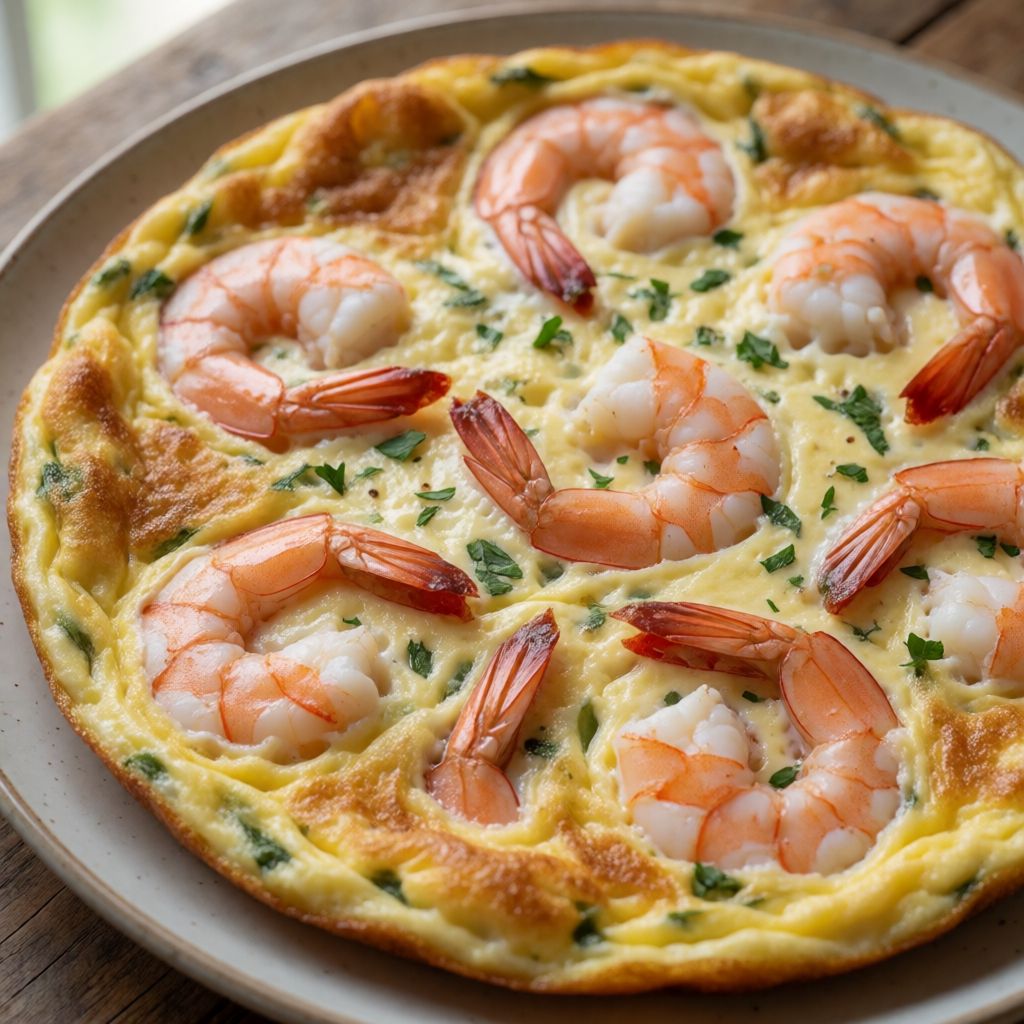
 AI photo
Prawn Frittata
A quick pan-fried frittata with juicy tiger prawns, mint and basil, deglazed with brandy.
Labels are worked out automatically from the ingredients and can be wrong. Check the packaging if it matters to you.
Ingredients
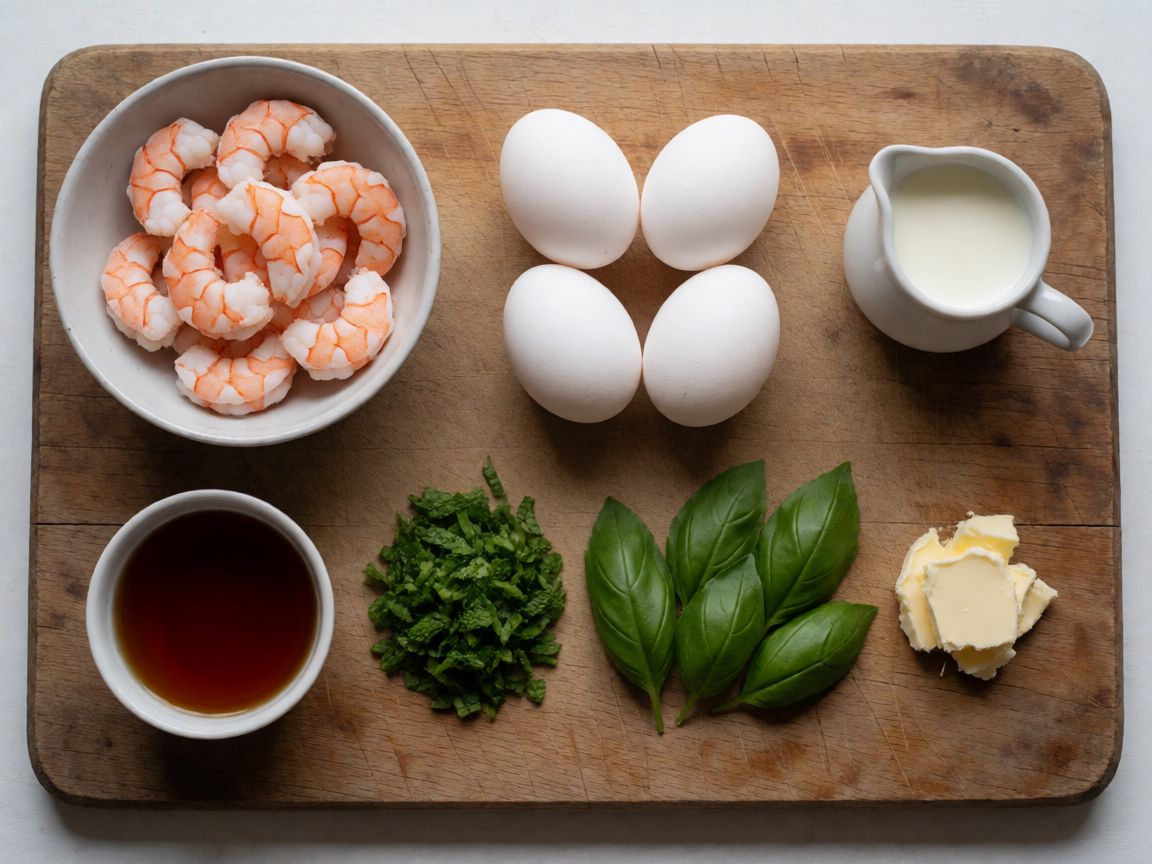
- 350 g Tiger prawn tails
- 4 pcs Eggs
- 8 tbsp Brandy
- 3 tbsp Double cream
- 10 pcs Mint leaves, finely chopped
- 5-6 pcs Basil leaves
- 35 g Butter
- Salt to taste
- Black pepper to taste









Steps
Peel the prawn tails. Melt the butter in a non-stick frying pan.
Fry the prawns for 5 minutes. They are done when the thickest part reaches 63°C.
5 minPour in the brandy and let it evaporate.
Crack the eggs and separate the yolks from the whites.
Whisk the yolks with the cream and the finely chopped mint and basil leaves.
Whisk the egg whites to stiff peaks with a pinch of salt and gently fold them into the yolk mixture.
Pour the mixture over the prawns and cook covered, turning the frittata halfway through cooking.
10 minServe immediately, sliced, as a starter or as a main course with a fresh salad.
This isn't an omelette with prawns dropped in — it's built in two separate acts that only meet at the end. First the shellfish: hot butter, fast cooking, then brandy poured in and burned off. Second the egg: yolks and whites parted, whites beaten to stiff peaks, then folded back into the yolks like you're building a soufflé, not scrambling breakfast. The lift you taste under the fork comes from air trapped in the whites — not from the prawns, not from the cream.
What decides whether this works is the prawn, and it decides early. You want the flesh to go from translucent and slightly grey to a tight, opaque white that gives a little spring when you press it — that's the shellfish equivalent of a steak's firm bounce instead of its give. Push past that point and no amount of airy egg on top will rescue what's underneath: it turns from sweet and bouncy to chalky and tough, and there's no fixing cooked prawn once it's gone.
Some say a frittata is just "an omelette you don't flip." No — that's the part that gets skipped and the dish suffers for it. An omelette is yolk and white beaten together into one liquid; a frittata, done properly, is a yolk mixture carrying a cloud of beaten white through it. On a domestic hob with no grill overhead to finish the top, that trapped air is the only thing giving you height and a soft, not rubbery, set. Skip the separating and you've made a thick prawn omelette, which is a perfectly fine thing to eat, just not this.
Tiger prawns are chosen for size and texture, not fashion — a big tail stays springy through a hot pan where a small prawn turns to nothing in the same ten seconds. Any large, firm prawn does the job; what you're after is something with enough bulk that you can actually watch it change colour and stop it in time, rather than something so small it's done before you've noticed.
The brandy isn't there to get anyone tipsy — the alcohol is meant to flare and burn off, taking its raw sharpness with it and leaving behind sugar and fruit notes that sit well with butter and shellfish. This is a flambé in miniature, the same logic restaurants use to deglaze a pan: alcohol lifts what's stuck to the base, then cooks away, concentrating flavour rather than diluting it. Any spirit with some fruit or wood character and not too much sweetness will do the same work — brandy, cognac, even a dry sherry at a push. What you don't want is anything sticky-sweet; that just caramelises into a glaze and masks the prawn instead of seasoning it.
Separating the eggs is the actual engineering of the dish, already explained — but it's worth saying why the cream goes only into the yolks. Fat coats the egg proteins as they set, keeping them from binding too tightly into each other, which is what turns egg from silky to rubbery under heat. Double cream does this well because it's mostly fat with little water to thin things out; whole milk will work in a pinch but gives you a looser, slightly wetter set, because it brings more water and less fat to the same job.
Mint and basil go in raw, chopped straight into the yolk mixture, because their flavour lives in volatile oils that cook off within minutes of real heat — menthol and basil's clove-like eugenol don't survive a hot pan, they survive a gentle fold and a short covered cook. This is also why the herbs are fine leaves, not stems: stems carry less oil and more fibre, so they add texture without adding scent, which defeats the point of putting them in at all.
On a British hob there's no kazan, no live coals, nothing radiating heat from above — so the lid matters more here than it would over an open flame. Covering the pan traps steam, which cooks the top of the frittata gently from above while the base firms against the metal; without a lid, you're relying entirely on heat climbing up through a few centimetres of egg, and the middle stays wet long after the edges are done. If you don't own a lid that fits, a large plate turned upside down over the pan does the same job — it's crude, but it holds the steam in, which is all that's being asked of it. Turning the frittata halfway corrects for the fact that a domestic ring heats unevenly under a wide pan — the centre runs hotter than the rim — so a flip swaps which side faces the strongest heat and stops you ending up with one half set and one half still raw in the middle.
Butter is there for its own flavour as much as its heat tolerance, so don't swap it for a neutral oil unless you're happy to lose that. If you must — dairy allergy, or just an empty fridge — use a fat that can take real heat without smoking and without fighting the brandy's sweetness: ghee or clarified butter are the honest substitutes, because they keep the buttery note without the milk solids that scorch fastest.
The quantities here — four eggs, 350 grams of prawns — read generous for one plate; treat it as a hearty single serving if you're hungry, or stretch it to two with a proper salad alongside, which is exactly what the recipe suggests doing with it anyway. And don't rush the whisking or the folding to save two minutes — patience here isn't sentiment, it's the only thing standing between a frittata with height and a flat, if tasty, prawn omelette.