
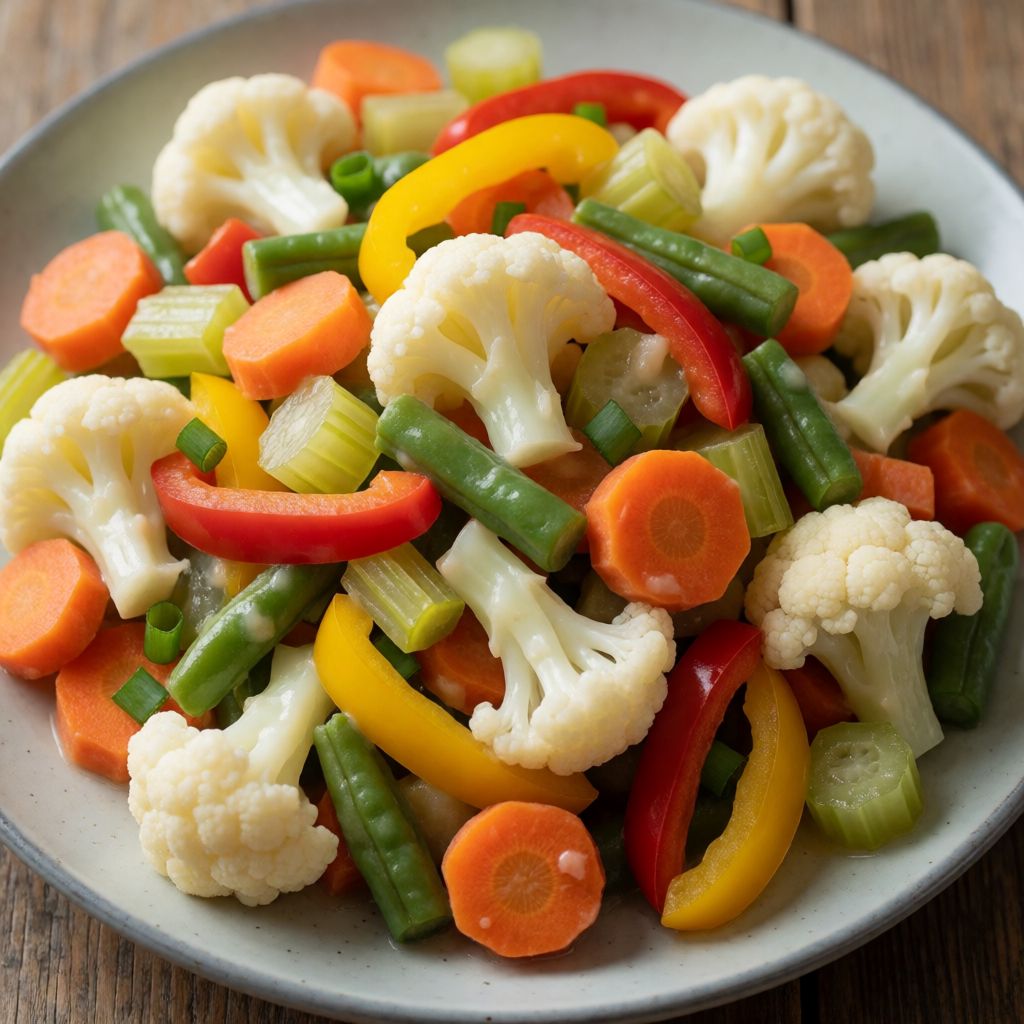
 AI photo
Giardiniera
A colourful mixed vegetable pickle, cooked briefly in vinegar brine then jarred for keeping.
Labels are worked out automatically from the ingredients and can be wrong. Check the packaging if it matters to you.
Ingredients
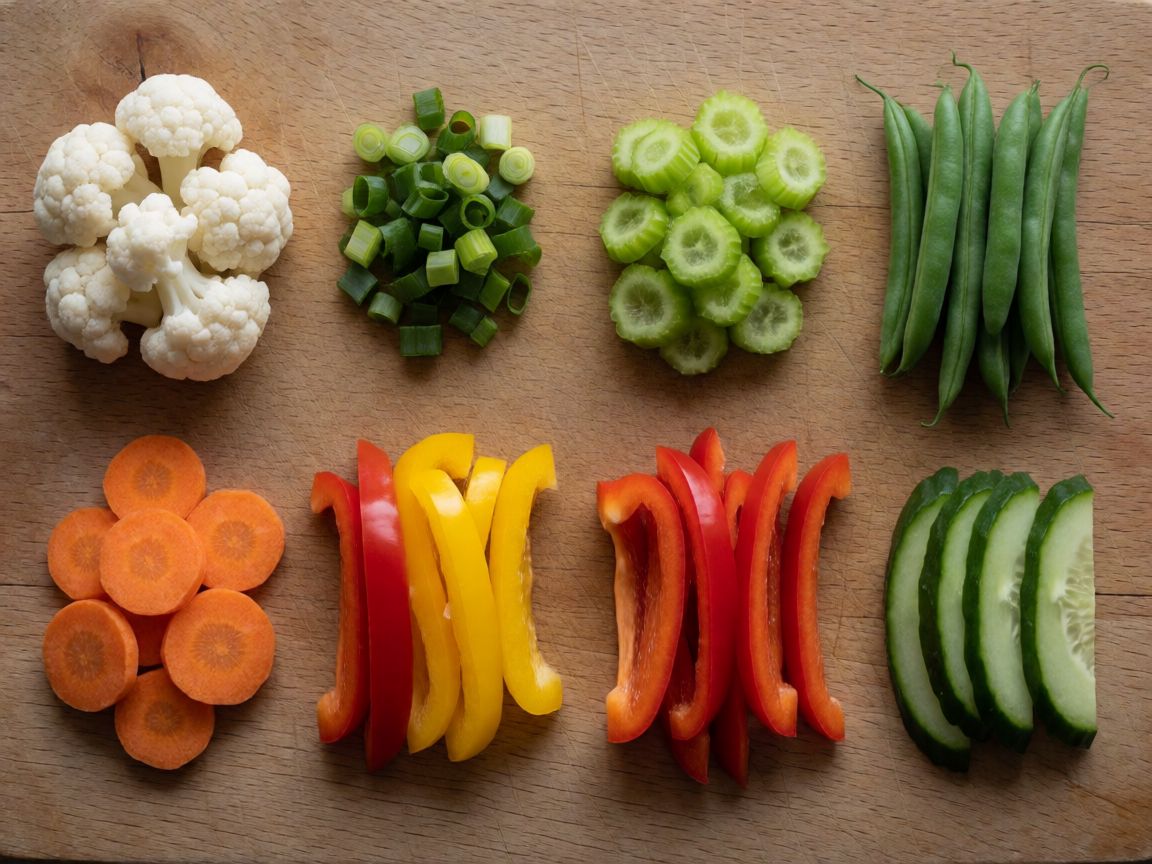
- 300 g Cauliflower
- 150 g Spring onion
- 150 g Celery stalks
- 150 g Green beans
- 300 g Carrot
- 200 g Yellow bell pepper
- 200 g Red bell pepper
- 150 g Cucumber
- 1 l White wine vinegar
- 1 l Water
- 2-3 pcs Bay leaves
- 20 g Salt
- 20 g Sugar











Steps
Rinse the vegetables under running water. Peel the carrot and cut into small cubes; trim the ends of the green beans and slice into thin strips; remove the leaves and base from the celery, strip off the fibrous parts, and cut into small pieces.
Cut the cucumber into rounds and the bell peppers into strips. Remove the leaves and core from the cauliflower and break it into florets. Trim the spring onions and cut them in half.
Bring the water and white wine vinegar to the boil. Add salt, sugar and bay leaves to the pot for flavour.
Cook the carrot and green beans. After a couple of minutes add the celery and cauliflower. Then add the cucumber, bell peppers and spring onions. Cook for a further 3-4 minutes.
4 minDrain the vegetables in a colander and spread them on a plate or tray. Cover with a clean towel and leave for at least 3 hours.
180 minStrain the cooking liquid and let it cool. Sterilise the glass jars and lids by washing them well, then boiling for about 30 minutes.
30 minFill the jars with the vegetables, pour in the cooking liquid and seal. Boil for about 20 minutes.
20 minLeave to cool, turning the jars upside down.
Giardiniera is vegetables that keep their bite after the jar has been sitting in a cupboard for months. Not pickles in the sweet-and-soft English sense, not the vinegar-soaked cucumber from a chip-shop jar. The whole point is that the carrot still resists your teeth in January the way it did in August, just with a sharper, sourer personality.
What decides whether it works is staggered cooking, not seasoning. Carrot and green beans go into the boiling vinegar-water first because they're dense — cell walls packed tight, need the longest exposure to heat before they soften even slightly. Celery and cauliflower follow a couple of minutes later because they're looser structures. Cucumber, peppers and spring onion go in almost last because they're mostly water already, and water doesn't need convincing to accept vinegar — it practically asks for it. Get this order wrong — everything in at once — and you get soft peppers sitting next to crunchy carrot, with nothing in between.
Some say you have to blanch each vegetable separately in its own pot, timing each by the stopwatch. No — because the whole trick of giardiniera is that one brine does the staggering for you. You're not cooking vegetables to doneness here, you're barely waking them up, and a shared pot at a rolling boil with vegetables added in sequence does that job for the lot, with no extra washing-up.
On the vegetables themselves: the list is really a study in "what holds its shape in brine," and you can swap freely within that logic. Cauliflower and carrot are backbone — firm, low water content, built to survive weeks in acid. Celery and green beans are the crunch in between. Cucumber, peppers and spring onion are the soft, bright, almost-raw element that gives colour and a different bite. If you haven't got yellow pepper, use more red — the job is colour and sweetness, not a specific pepper. No spring onion — a mild white onion, thinly sliced, does the same work, though it won't give you that long green ribbon in the jar.
The brine is one litre each of white wine vinegar and water, which tells you something: this isn't meant to taste purely of vinegar, it's meant to taste of vegetable with vinegar as the frame around it. White wine vinegar earns its place because it has no flavour of its own beyond sourness — no malt sweetness, no cider fruitiness getting in the way of the vegetables' own taste. Any vinegar with a clean, neutral acidity will do the same job; distilled white vinegar works, just expect a slightly sharper, less rounded edge, since wine vinegar carries a little of the wine's roundness even after fermentation.
Salt and sugar — 20 grams each against that two-litre brine — aren't there to make it taste "seasoned." Salt draws a little water out of the vegetable surface, which actually helps the brine penetrate rather than sit as a film; sugar balances the vinegar's sharpness so the brine reads as savoury-sharp rather than purely sour. Bay leaf is scent, not a load-bearing flavour — leave it out and nothing collapses, you've just lost a faint background note.
On the jars: sterilising by boiling for half an hour and then processing the filled, sealed jars for another twenty minutes is what lets this sit unrefrigerated. The boiling isn't superstition — it's driving out the air inside the jar and killing what would otherwise grow in a low-oxygen, acidic but not acidic-enough environment. The upside-down cooling at the end checks the seal: if the lid's vacuum has pulled tight, you'll hear it click as it cools, and nothing will leak past the rim. If a jar doesn't seal — lid stays slightly loose, no click — that one goes in the fridge and gets eaten first, not stored on the shelf with the rest.
In an ordinary UK kitchen, your "kazan" here is just the biggest pot you've got — a stockpot or your largest saucepan, wide enough that the vegetables aren't crowded three layers deep, because crowding means uneven, patchy cooking in that brief minute or two it's actually in the liquid. You don't need a water-bath canner for the final boil; a big pot with the jars stood on a folded tea towel (so they're not sitting glass-on-metal, which can crack them) and water coming most of the way up the sides will do it.
Patience is the actual ingredient that makes this antipasto rather than a soggy vegetable soup — the three-hour towel rest, and then ideally a few weeks in the jar before you open it, letting the vinegar work its way properly through rather than just coating the surface. Open it the same day you jar it and you'll taste vinegar sitting on top of vegetable, two separate things. Give it the wait, and they've actually become one dish.