
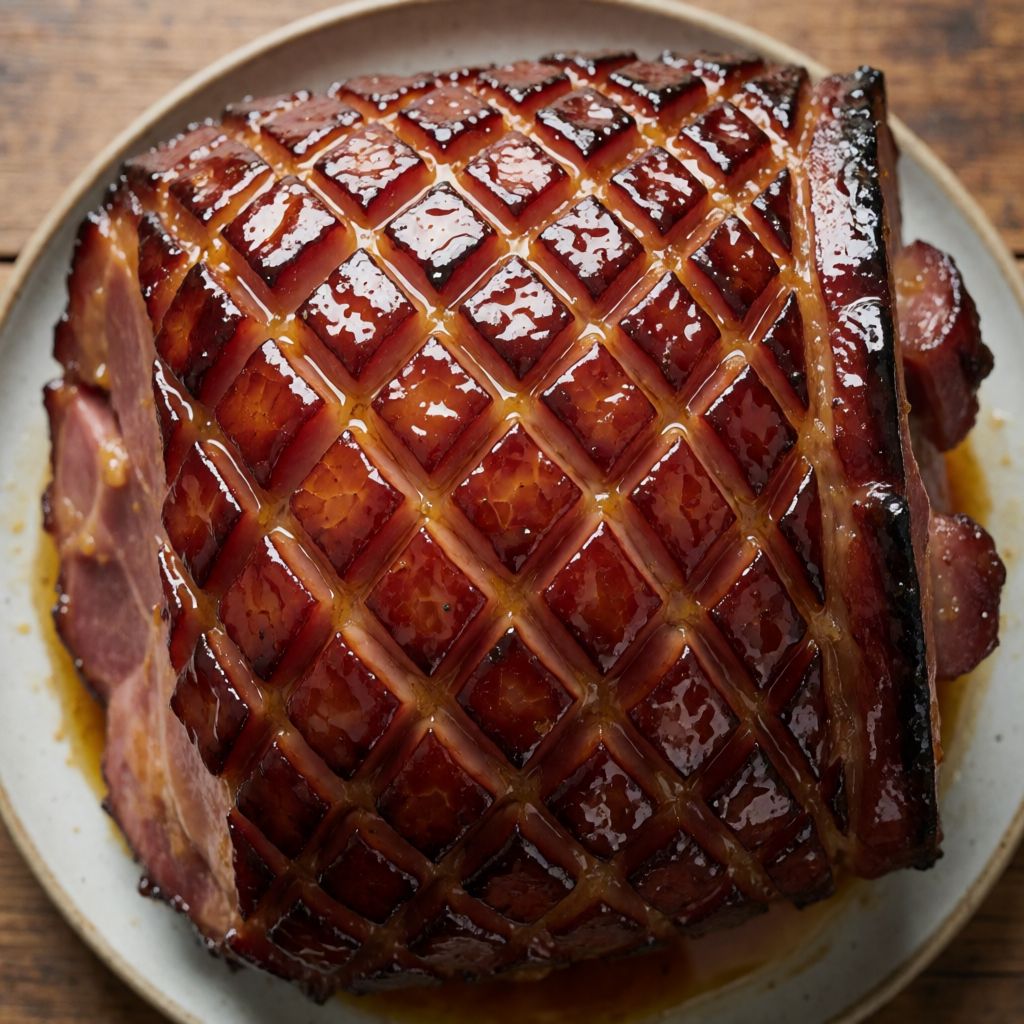
 AI photo
Baked Glazed Ham
A classic baked ham with a mustard, honey and orange glaze, finished with a crisp breadcrumb crust.
Labels are worked out automatically from the ingredients and can be wrong. Check the packaging if it matters to you.
Ingredients
- 1 kg Ham
- 3 tbsp Dijon mustard
- 1 tbsp Honey
- 2 tbsp Brown sugar
- 1 tbsp Ginger freshly grated
- 1 pcs Orange finely grated zest and a little juice, from half an orange
- 100 ml Breadcrumbs
- Salt
- Black pepper freshly ground
- 200 ml Water








Steps
Place the ham skin-side up in a heatproof roasting dish. If it is netted ham, leave the net on and place it the same way, skin-side up.
Insert a meat thermometer into the centre of the ham to make sure it does not overcook.
Pour 200 ml of water into the bottom of the roasting dish, set the ham on a rack in the dish and bake in a preheated fan oven at 175°C for about 1 hour 30 minutes, or until the internal temperature reaches 65°C.
90 minTake the ham out of the oven and let it cool slightly.
Remove the net and the skin, without taking off the layer of fat just beneath the skin.
Score deep cuts into the fat layer of the ham so the mustard glaze can best flavour the meat. Put the ham back into the roasting dish.
Mix the glaze from Dijon mustard, honey, brown sugar, grated ginger, finely grated orange zest, 1–2 tablespoons of orange juice, salt and freshly ground black pepper.
Spread a thick layer of glaze over the whole ham and finish by sprinkling with breadcrumbs until the ham is fully coated.
Put the glazed ham back into the oven and bake for about 15 minutes at 175°C, until the glaze is crisp and golden.
15 min
What was changed
The final baking step for the glazed ham is given at an oven temperature of 175°C, same as the first bake, since 65°C in the original referred to the meat's internal temperature, not the oven
A baked ham is really two cooks in one pan. First you cook the meat gently through, as a plain hot-water bath with the oven doing the work of a kettle that never boils. Then, once the meat's done, you switch jobs entirely and cook the surface — hard, fast, sugar-and-mustard surface — into a shell. Try to do both at once and you get either raw middle or burnt crust; this recipe is built to keep them from ever fighting each other.
What decides whether it works is the thermometer, not the clock. "About 1 hour 30 minutes" is a guess based on an average joint of average shape; the only honest number is 65°C at the centre, because that's the point past which the muscle fibres start squeezing their water out and the meat turns from moist to stringy. The water in the base of the dish isn't for flavour — it's there so the dry oven air doesn't scorch the fat before the inside is anywhere near ready, and so the drips don't burn onto the dish and smoke the kitchen out.
Scoring the fat is not decoration. A smooth sheet of fat is basically waterproof — the glaze would sit on top of it and slide off in the oven's heat, giving you a thin brown varnish instead of a crust with flavour in it. The cuts open channels for the mustard and sugar to actually get into the fat, not just coat it.
Some say you have to take the skin fully off ham to glaze it — no, because it's the skin itself you remove, while the soft white fat underneath stays on: that fat is what renders and crisps, the skin is just leather in the way.
Ham, here, means a joint that's already cured and usually already cooked to some degree by the producer — that's the whole economics of why this recipe reheats it gently rather than cooking it raw through: you're not cooking meat, you're warming and finishing something preserved for keeping, the way hams have been salted since before anyone had a fridge. If your piece is raw gammon rather than ham, you cannot shortcut the first stage — it needs to reach a proper safe core temperature, not just 65°C, so check what you've actually bought before you trust the timing here.
Dijon mustard is doing a specific job beyond taste: its acidity and bite cut through the sweetness of the honey and sugar so the glaze doesn't read as pure candy on meat. Any sharp, smooth mustard with no big visible seeds will do the same work — English mustard is hotter and more one-note, so use less if you swap in.
Honey and brown sugar together give you two different kinds of browning: honey burns and darkens fast because of its fructose, sugar melts slower and gives body to the glaze so it clings rather than runs. Leave out the honey and the glaze will be paler and take longer to colour; leave out the sugar and it scorches before it sets.
Fresh ginger and orange zest aren't there for a "festive" flavour — they're acid and aromatic oils cutting the fattiness of the ham, the same logic as mustard with roast beef or horseradish with pork. Ground ginger from a jar will work in a pinch but it's flatter and more one-dimensional; grate the fresh root straight into the bowl so you lose none of the oil to a chopping board.
Breadcrumbs are the crunch layer, not flavour — they toast in the last fifteen minutes while the sugar beneath them is still soft, giving you a shell with bite instead of a sticky glaze you'd struggle to carve through. Any dry, plain breadcrumb works; stale bread blitzed in a processor is the same thing for free, and it's exactly what breadcrumbs always were before anyone sold them in a bag — a way to not waste bread.
On a domestic hob and oven, the one thing to watch is your rack and dish: if you don't have a proper roasting rack, improvise one from a few skewers or even scrunched foil under the joint — the point is to keep the ham's underside out of the water, not sitting in it, or it steams rather than roasts and the fat never gets the chance to render.