
 AI photo
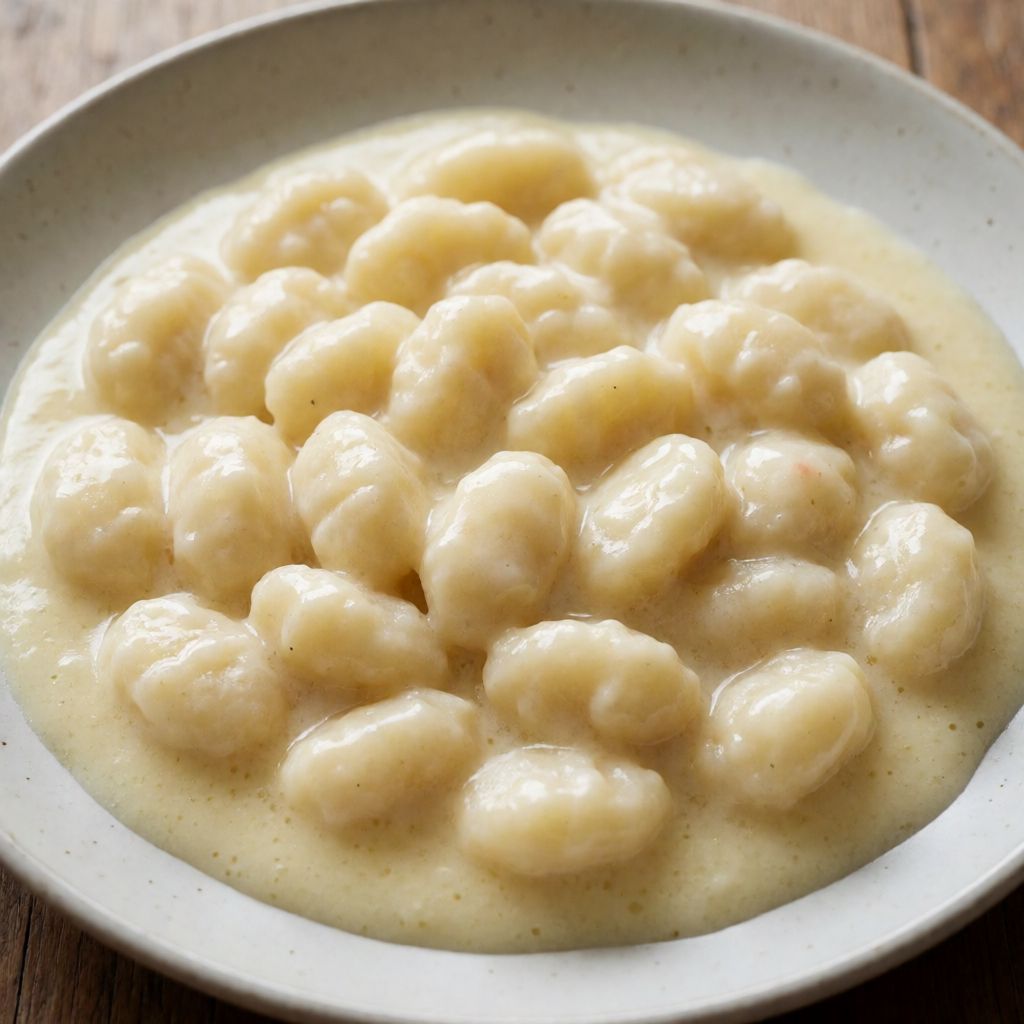
Gnocchi with Castelmagno Cheese
Soft gnocchi folded through a silky cheese cream sauce, finished with black pepper and parmesan.
Labels are worked out automatically from the ingredients and can be wrong. Check the packaging if it matters to you.
Ingredients







Steps
In a bowl, sift the cornflour into the milk gradually, whisking as you go.
Pour the milk and cornflour mixture into a pan and warm it gently over low heat until it thickens.
Cut the butter into cubes and slice the Castelmagno cheese.
Add the Castelmagno and butter to the milk, stirring until a smooth cream sauce forms.
Bring a large pot of water to the boil.
Add salt and drop in the gnocchi.
Wait until the gnocchi are cooked and rise to the surface.
Lift out the gnocchi with a slotted spoon.
Add the gnocchi to the cream sauce and stir to combine.
Add the parmesan and season with black pepper to taste.
Transfer to a plate and serve hot.
Gnocchi with Castelmagno is a Piedmontese dish built around one fact: Castelmagno is a cheese that melts into silk instead of turning into rubber or grease. It's a blue-veined, semi-hard cow's cheese from the Alpine pastures above Cuneo, aged enough to have real character but still full of moisture — that moisture is what lets it dissolve into a sauce rather than clump. This is not a bechamel with cheese stirred in afterwards; the cheese and the thickened milk become one thing, because the cornflour has already done the stabilising work before the fat and protein arrive.
What decides whether this works is temperature discipline in two separate places. First, the milk: cornflour thickens through starch granules swelling and bursting, and that happens gradually around a gentle simmer, never a boil. Rush it and you get lumps that never resolve, because the outside of each granule gelatinises before the heat reaches the centre. Second, the cheese: once you drop the Castelmagno and butter in, you want warmth, not heat — a sauce that can break. Dairy fat and protein held too hot separate, the fat floating free, the proteins seizing into grains. You're not cooking the cheese, you're coaxing it to let go into the milk.
Milk is the base, not water, because this sauce needs fat and protein already in suspension before the cheese goes in — water alone gives you a thin, hungry liquid that the cheese has to do all the emulsifying work in, and it won't manage alone. Whole milk is what the dish wants; semi-skimmed will thin the result slightly, but in a flat with a weekly tea-with-milk habit, you've got the right carton in the fridge already. Don't reach for cream instead — it brings too much fat too early and the sauce turns heavy and flat rather than silky.
Cornflour here is doing a specific job: it's a thickener with no flavour of its own and, crucially, no gluten, so it gives you body without the slightly pasty, flour-forward taste a classic roux would add. Any pure starch works on the same principle — potato starch, arrowroot, even rice flour in a pinch — the criterion is "starch with no taste," not "cornflour specifically." Whisk it into cold or lukewarm milk first, never straight into the hot pan, because starch dumped into heat clumps before it can disperse, and that's the one mistake that ruins the sauce before the cheese even arrives.
Butter adds the fat that pure milk doesn't carry enough of, and it's what gives the sauce its gloss rather than a flat, watery sheen — cut it into cubes so it melts evenly instead of sitting as one slow-dissolving lump dragging the pan's heat down unevenly. Use unsalted if you have a choice, because the Castelmagno and the parmesan at the end both bring salt, and you want to be adding seasoning deliberately, not fighting an accident.
Castelmagno itself is worth understanding rather than just buying. It comes from a small patch of mountain pasture in Piedmont, made in a place where the grazing season is short and the cheese had to be a way of storing a summer's milk through a long winter — that's the whole reason it exists as a semi-hard cheese at all, not some mystique about terroir. Age changes it: young Castelmagno is milder and creamier, which is what you want for melting into a sauce; very aged wheels turn crumbly and sharp, better eaten on their own with honey than coaxed into cream. Ask for the younger end if your shop stocks a range.
Parmesan comes in at the end as a seasoning, not a melting cheese — it's added off the main heat-work, mainly for salt and savoury depth, so a vegetarian hard cheese with a similar dry, granular bite will do the same job if that matters to you. Black pepper is the only aromatic in the whole dish, which tells you something: this isn't a sauce built on garlic or herbs, it's built on the cheese being interesting enough on its own, and pepper's role is just to give it a small edge of heat against all that richness.
One honest note on equipment: you don't need a kazan or anything special here, just a wide pan you can watch closely, because the whole sauce lives or dies on you seeing it change rather than timing it. A slotted spoon for lifting the gnocchi matters more than people think — tip the pot and pour, and you lose some gnocchi down the plughole along with half your evening's patience.